
Translated material
TOY AND PROCEDURALITY
The doll has already died several times in the last century. She was "taken apart and put back together again" [1], chased off the stage, or assured that she was "not a doll". The tendency of the doll to disappear can be understood. Theft of the Theater with a capital letter, which synthesizes all, not only stage, arts, reduce the doll to the level of "raisin" in the style of one or another master of the Theater. The doll, having received its last rebirth, lowers its hands again. And I'm happy about that.
The doll does not die, but signals the need for a metamorphosis, an epistemological break, which will remove from it the heavy shame of children's entertainment, the shame of its entertainment history, and give it the freedom to do as part of the Theater, what its younger brothers - people - cannot do.
Puppet theater is considered by the puppeteers themselves to be a conceptual art [2], in the works of which the concept of a playwright or director first arises, then materials belonging to the artist by authorship are provided, and all this is provided to the actor for performance. Thus, everything in this chain is stillborn, and leads to nothing except a unique vision for this art.
According to such a sequence system, no impulse can pass through the doll, only a concept can materialize in it. Therefore, the association, the private creativity of an actor, as an author, can only be in the embodiment of a concept. Example: I want my character to transform from a human to the Eiffel Tower. For this, the Eiffel Tower must be created. Literally, materially realized, as a product that can be touched. This is not a dramatic art, where the idea must be created and implemented at the level of internal structures. Everything is material here. Even the issue of internal expression requires a conceptual approach. If a drama actor can connect the moments of his technique into an expression of sadness, and this can remain only in his middle, appearing for the viewer as a small change in the degree of the neck, then a process of choosing recognition is needed for the doll. The doll is inextricably linked to expressiveness, without expressiveness the doll does not exist as an actor, and this forces the actor to go through a specific duration in time to highlight the concept of embodiment. This process in the actor's body is inexorable, in the puppet theater it requires the involvement of the entire creative workshop.
Puppet theater needs to break out of the dramatic theater into the post-dramatic one , especially considering the fact that Hans Lehmann himself considers us to be post-dramatic [3].
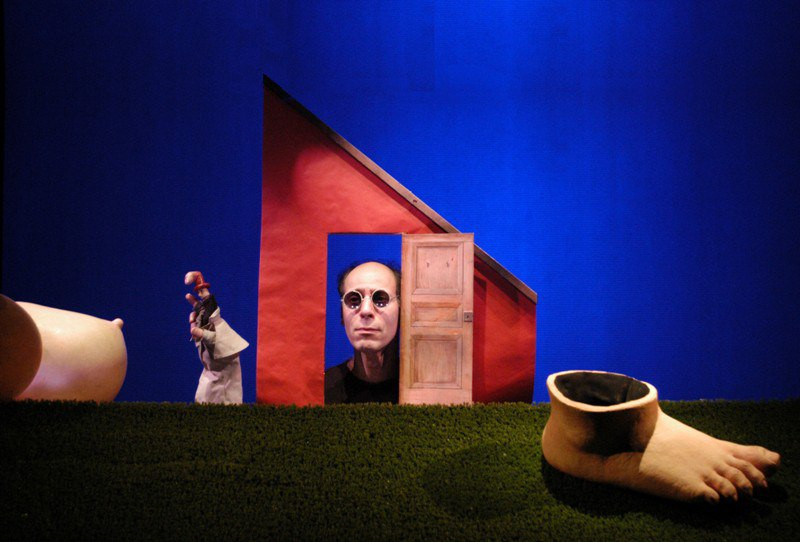
The problem of the conceptuality of the puppet theater is the problem why it remains dramatic. Or, it is better to say it differently: the problem is that the doll cannot improvise .
According to this, the plan of the revolutionary evolution of the doll is to liberate it from conceptuality for the sake of improvisation. This is a multi-layered process that must take place not only in the director-actor connection, a revolution in which would be enough for the theater of the body, but in all the connections on which the theater of performative objects [4] remains unbroken, that is, those connections that arise with the figure of the artist. Now, I will give an example of approaching an improvisational puppet by changing the organization of the performance, according to its beginnings.
One teacher, when a classmate of mine was having trouble with puppet control technology, advised him to think of working with a puppet as a computer game where the player (puppeteer) controls a virtual character (puppet). Such a view of the interaction between the actor and the doll states that the concept of play , which is a source of improvisation, is accessible to the art of performative objects.
This analogy prompted me to say that it is necessary to rediscover puppet theater - a toy . A toy is a playful potential of a doll that needs to be extracted from it in order to open improvisation to performative objects. Turn the doll inside out.
Replacing a doll with a toy is a specific expansion of the doll's actions, without disturbing its comfortable environment, and at the same time, with a violation of conceptual dependence.
In practice, I see this as the discovery of procedurality in the puppet theater, which deconstructs the work of its creative workshop, giving the opportunity to operate with the elements of the puppet theater ensemble according to the conditions of the post-dramatic theater.
The gap between dramatic and post-dramatic theater is the perception of process and result. In post-dramatic theater, only the process is important. And all the more theater is a theater when the process in it does not achieve a result .
How can such a technology be achieved with a fundamentally conceptual puppet theater?
Processuality in the puppet theater is achieved by creating the image of the puppet during the performance . A set of subjects, the synthesis of which can be consonant with the dramaturgy or "rules" of the performance.
As I see it: the work of an artist is to collect such objects, the assembly of which at the time of the performance may or may not become the desired image. Before the performance, the actor receives a set of objects that he puts together for the first time before the performance itself. For him, this is not a special doll, but a random, chaotic object. In such a situation, the puppeteer's creativity is most present: bringing the material to life, working to make the speechless speak. Being in a situation of enlivening right on the stage, the actor confronts the uncomfortable material and irons it out, constructing his character, and thus the performance, here and now , which causes the process in the stage situation.
This is just one example of proceduralism. There are as many ways to arrive at the process as there are situations in the process itself that create it, but their disclosure is a matter of the theatrical process itself.
It is only necessary to understand: in order to save the doll from "elementality", that is, from using it as an element in the Theater, it is necessary to return to the doll the fundamentality, the uniqueness of its language. But now, before the discussion about language, it is necessary to understand the direction, following which, the theater of animation will reach the promised land, which is called improvisation.
Notes:
[1] — "Lenora Shpet used a famous metaphor, comparing a puppeteer to children who take apart a toy to see what's in the middle. Now - as it was said in 1967 - our toy has been disassembled into pieces and it's time to put it back together" - Henrik Yurkovsky. Postmodernism and dolls. http://www.booth.ru/teor_teatr_kuk/postmodern_jurkowski.shtml
[2] — This is what the founder of the American political theater of puppets ("Bread and Puppets", "Bread & Puppets") Peter Schuman believes in the manifesto "Radicality of the Theater of Puppets". "Radicality of the Puppet Theater", thesis "Conceptual Art" http://breadandpuppet.org/wp-content/uploads/2013/01/Radicality-of-the-Puppet-Theater.pdf
[3] — At 1:04:22, Lehmann is questioned about the "Puppetry has always been post-dramatic" thesis he supports https://www.youtube.com/watch?v=MYejOv5bZu4&index=36&t=1s&list=WL
[4] is a term, along with animation theater, that is used in the West for puppet theater. About the new phase of puppet theater terminology, the most up-to-date article in Russian that I have seen is: Rusabarov. "To the definition of animation theater" http://www.levlivshits.org/index.php/materials/doklady/147-2010-10-13-14-14-00.html
"representative objects are material incarnations of living beings or personified entities that are created, demonstrated or controlled by an actor-animator in the process of stage animation-spiritualization"
I translate "representative objects" as performative objects, according to Frochan's original concept, Puppets, Masks, And Performing Objects https://www.scribd.com/doc/88915375/Puppets-Masks-And-Performing-Objects
My translation is not correct, but is used by me only as a means by which the puppet theater can sound somewhat differently, in line with the necessary research.