
Translated material
Witness Holmes
Kobrin K.R. Sherlock Holmes and the birth of modernity: Money, girls, dandies of the Victorian era. - St. Petersburg: Ivan Limbach Publishing House, 2015. - 184 p.
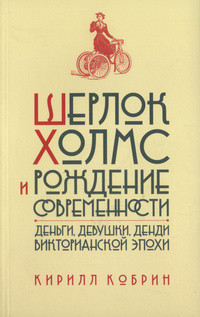
It seems that Sherlock is one of the few characters from Victorian culture who still remain firmly in our horizons. Dickens or Thackeray with their heroes - yes, these are classics, but that is why for the most part they are not read, they have heard about the Pickwick Club much more often than they have read them, the story of Oliver Twist has been watched and perhaps only “Vanity Fair” has been read in its entirety. Even Wilde is not able to compete with Conan Doyle as the author of stories about Sherlock in the claim to the attention of the general public - stories about the London detective are familiar to everyone and are read to this day in the best known way - for the sake of pure pleasure and interest.
Among other things, this means that the world of Holmes is quite recognizable to us, the actions of the characters are generally understandable, and the reasons for their moral condemnation or approval are shared by us. When one hero is sent to prison or he dies himself - receiving retribution for his crime - and the other, although he has broken the law, is released by Holmes - we do not need detailed justification and explanation of such decisions, the inequality of two actions, equally prohibited by law, is clear to us as well as to Holmes, and we would consider another decision unfair, although formally correct.
Reading stories about Sherlock Holmes, we perceive a temporal distance, but it does not turn out to be a boundary for us, a limit - on the contrary, representing an additional temptation - old-fashionedness, good quality, Victorian virtues and the same vices, crimes that are both sophisticated and at the same time naive. The past of stories about Holmes is “their” past. Realities that no longer exist attract our attention - like cabs, street urchins or an Aborigine from the Andaman Islands - because the general frame is initially clear to us, and if so, then we can savor the details, play an authentic reproduction of London in the late 1880s, or wonder what Holmes might look like today - a former drug addict successfully undergoing rehabilitation, a stylish sociopath with either uncertain or whether by excessively broad sexual preferences, or to realize his dream of ideal “Englishness”.
And if so, then why not try to use the stories about Holmes as a key to that very past, which is already completely “ours” - one of the ways available to us to understand what it means to be “modern” and the appearance of what features make the world “ours”, while the absence of other components of our current environment does not prevent us from considering it “ours”. Outlining his plan, Kobrin writes:
“[...] the cycle of short stories and tales about Sherlock Holmes is a kind of encyclopedia of the Victorian world, an era that is now defined as “modern,” as “modernity,” modernity (or, given that the term was invented in France, modernité). To try to analyze this world from the point of view of a historian, to designate “modernity” as a state of social consciousness, as a type of historical thinking (including the author himself, Arthur Conan Doyle) - this is my task. I try to analyze various aspects of the Victorian era - attitudes towards money and wealth, the social role of women, and even the birth of the modern humanities" (p. 122).
However, in the mosaic that Kobrin collects, there is one remarkable detail - this “modernity” is much more attractive to the author than the one that replaced it - this is our world, but one where one can hope for rationality and believe in the Enlightenment, and not suspect its logic of being partial to dialectics. You can even allow yourself to assert, for example:
“in this drama of Victorian society, the bearers of social good, defenders of the idea of justice and (let’s not be afraid of this word) humanism are strangers, unsystematic people, eccentrics, aesthetes, one of whom is a drug addict, and the other, moreover, fits perfectly into the then image of an exotic rich homosexual. Wealth is unjust, justice is for the marginalized. And yet Holmes voluntarily stands up for the defense of such a society, making it his profession. Victorianism actually relies on the marginalized - let me remind you that it gets its wealth, so to speak, ad marginem, on the edges of the world, in India" (p. 138) -
but no matter how you look at the margins and do not place justice, goodness, humanism at the edges of Victorian reality - it, this very reality, turns out to be a reliable construction. You can rely on it and be sure that it will endure - Victorian virtues will inevitably triumph, and moral criticism is possible as an exposure of hypocrisy, inconsistency, double morality - while invariably affirming the existence of ranks: those who have the right to vote and those who are deprived of it - in the presence of those speaking here and now, who in turn will respectfully fall silent before those who will surpass them. Virtue is tested, but not doubted - the villain can claim that there is no one who follows in practice the principles that he himself proclaims, but the principles themselves are withdrawn in the face of attack, even while affirming social Darwinism, the cult of strength and survival of the fit, adherents refer to moral justification - good is, say, the victory of the strong, and not force determines post factum what good is.
However, the idea of using the stories about Sherlock Holmes as an encyclopedia of the Victorian era in the hands of the author encounters an obstacle that he, oddly enough, does not notice - the genre nature of these stories. Thus, speaking about several main features of the “structure of the Victorian empire according to the “Sign of Four”,” Kobrin notes:
“This is a system with no center of gravity. […] The state is represented by swindlers, traitors and idiots. The law applies only to those who come to hand; its action is selective and almost random. The middle class is also almost absent; the wealthy Major Sholto is a criminal, his “normal” son is killed, the other, “abnormal” one, can hardly be considered a typical representative of the middle class. On the contrary, worthy ordinary people with the consciousness of a bourgeois, like Dr. Watson, cannot get there on their own; Watson's older brother also failed. The economy in the Sign of Four is even worse. Money - and even then modest - is earned here by maintaining the city menagerie, renting a boat [...], street children earn their living as surveillance, Mary Morstan has immured herself in the role of an old lady's companion, because otherwise the girl simply cannot survive. […] In this world, wealth is exotic; and its origin is especially exotic. Wealth is a colonial treasure, which, due to complicated bloody circumstances, ends up in the metropolis. The second (chronologically, but according to the narrative - the first) act of this drama takes place in Britain - and ends with the loss of wealth. The modest life of the heroes remains almost as modest; the treasures seemed to pass by. Actually, this is an amazing prediction of what will happen to Great Britain after the collapse of the empire: the dominance of the “service economy,” a country chock full of immigrants from the colonies; a world inhabited by “former people”, cocaine aesthetes and decadents. And of course, this is a world inhabited by people who are completely disoriented morally; justice and other commendable qualities can only be discovered by chance - and even then in people who in ordinary life are difficult to suspect of having them” (pp. 155 - 157).
Let’s not quibble over trifles - and agree that “everything is so”, but this puts into question the initial position that determines the development of Kobrinov’s text - after all, what is told about depends on who is being told, who is the addressee of Conan Doyle’s narrative? We do not find in these stories the “center of gravity [of the empire],” the “middle class,” the “worthy common people”—because they are the readers of Lippiscott’s Monthly Magazine, in the February 1890 issue of which “The Sign of Four” was published.
The detective genre is not a high genre; by its nature it is “reading fiction”, and not fine literature or even “literature” (and if it manages to become such, it is by accident, turning out to be larger than itself). The most “modern”, it seems, of the genres - it is born along with modernity, the new world of anonymity and anomie - big cities, where everyone is a stranger to each other, where a neighbor can turn out to be not only a grocer, but also a murderer - since others are turned towards us only by some aspect of their existence, role, function - peddler, cabman, doctor, notary - we communicate with a notary named John Smith, but what else is this John Smith doing at that time? a time when the deeds brought by his clients are not evidenced in their notary books - we do not know and usually do not want to know. A big city, first of all, for the respectable man in the street, that very person of the “middle class”, turns out to be visible only to a small extent - by daytime life and on well-lit streets. What is happening above - and what is happening below - is hidden from his sight - only briefly falling into the field of vision, as a designation of the presence of another reality, which he, being a well-bred person, should not look closely at. The detective story turns out to be his foray into “another reality”, a story about the “wrong side”, where the guide is a detective - a mediator between worlds, the one “who knows the passages underground” - and the translator of his oracles, Doctor Watson, the only character who completely belongs to the good bourgeoisie and, having settled down, having acquired a wife and a private practice, leaves his friend - regretting the adventures that are no longer available as an old burgher regrets student revelry, because these very regrets and memories are part of the image of a proper, orderly and self-confident life. The “wrong side” being revealed is also the “other side” of the possible reality of the reader himself, “another story” - those who are similar to him in origin, biography, lifestyle - another option, which is interesting because it is recognizable and unexpected: stories at the beginning of which you can place yourself or your acquaintances - for example, the reluctance to part with an inheritance going into the hands of a stepdaughter - a temptation that is understandable, experienced or easily imaginable, unfolding in a fascinating, intricate story: a simple motive that cannot be recognized immediately behind the intricacy of traces.
The Victorian era ceases in the stories about Holmes, because not only in what is said, but also in what remains outside the frame, why these stories are of interest - being, in the end, just stories, plot prose, where the reader follows with curiosity details that he does not expect, listens to stories about characters the likes of which he has never met - the measure of verisimilitude is not great precisely because it is - if not about unknown lands, then about strangers and strangers.
***