
Translated material
'Nurse Ratched': 'One Flew Over the Cuckoo's Nest' Prequel as a Disappointing LGBT Anthem
 Photo: Photo in article: screenshots from YouTube
Sobesednik.ru – about why Ryan Murphy’s new show won’t appeal to fans of Ken Kesey’s novel.
On September 19, the long-awaited series “Nurse Ratched” from one of the most prolific American producers Ryan Murphy (“Glee”, “American Horror Story”, “The Politician”) launched on the Netflix platform.
This time, the idea of the creators, among whom, in addition to Murphy, is the young showrunner Evan Romansky, was the backstory of nurse Mildred Ratched, familiar to the viewer from the cult work of Ken Kesey “One Flew Over the Cuckoo’s Nest” and the film adaptation of the same name by Milos Forman from 1975. But the connection with them is unlikely to play into the hands of the series, but first things first.
America, 1947. The turquoise car is heading towards one of the largest psychiatric hospitals in the state of Lucia, where a new patient, Edmund Tolleson, is soon to be brought. The killer of several Catholic priests, he attracted all the attention of the public, and especially the governor, who hoped to increase his popularity among voters through the death penalty. But Sister Ratched (Sarah Paulson) has her own plans for Tolleson.
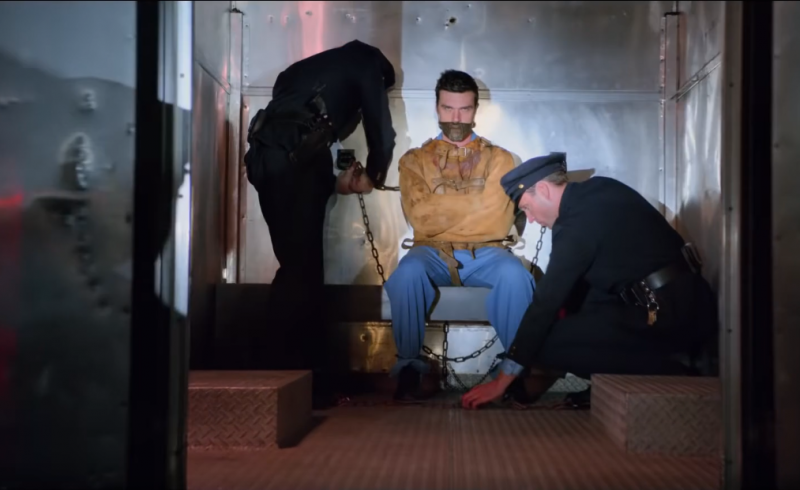
Like Ryan Murphy's previous projects, Nurse Ratched is in no way inferior to them in style. His recent “Hollywood” comes to mind with the same atmosphere of the mid-20s, a signature bright color palette that adds a sense of grotesqueness to what is happening, and thoughtful costumes of the characters down to the smallest detail. A glamorous hospital strongly reminiscent of the Overlook Hotel, sterile rooms for conducting creepy experiments, elements of noir and a play with red and green filters in the style of giallo - the aesthetics of the film is on the verge of surrealism and is an absolute feast for the eyes. Actually, the producer always liked to express the emotional and mental state of the characters using a range of colors, but in this particular case, before you have time to “buy” the picture, the narration immediately gives you a bitter slap in the face.
Murphy plays the same record again. If the original characters of Ken Kesey were based on real people of his time, when he himself worked in a psychiatric institution, then the characters of “Ratched” are painfully reminiscent of a light version of his acclaimed “American Horror Story”, where the handsome killer with the appearance of an American icon of the 50s, rebel without a cause, James Dean, is played by Finn Wittrock, who either tortured or killed someone in different parts of AHS, and the role of the sister herself is played by the producer’s favorite Sarah Paulson, whose character Lana Winters (AHS season 2) seemed to have simply moved to another treatment facility.
Absolutely emotionless initially, intolerant of manifestations of sexuality and the only one who does not look away from the terrible experiments of Dr. Hanover, Nurse Ratched by the series finale turns into one of Murphy’s favorite queer characters who is trying to recognize this otherness in herself. In love with the governor's assistant, Gwendolyn Brix (ironically, she is played by open lesbian Cynthia Nixon, who at one time also aspired to a high post), Mildred does not fit in with the personification of that inhumane and cruel system in the person of Louise Fletcher, who is accustomed to solving any problem with the help of electric shock and lobotomy. We do not immediately understand Ratched’s character and for every smile or slightest manifestation of compassion we grin triumphantly (I don’t believe it!), but the further the story develops, the more bewilderment appears on our face and the fat blot in the plot. From the personification of the Leader's "Combine" (i.e., the system that turns a person into a puppet), Paulson's version of the nurse turns into the very victim of the system with her far from the most skillfully written childhood trauma, and the series slogan "real monsters are made, not born" is completely bewildering, because the cold in the heart of Sister Ratched gives way to her finally accepted lesbian love (and a vacation in Mexico).

Of course, feminist motives have always been present both in the text of the novel itself and in the film by Milos Forman. Big-breasted, angelic-looking Mildred Ratched represents the so-called soulless castrator, whose charges are victims of matriarchy (remember that McFerphy described the nurse’s treatment method as “pecking balls”?) Paulson’s version is not at all scary: yes, at first it seems as if she despises male sexuality (“Obviously, excitement distracted you, I asked for the local newspaper”) and men in general, but this, rather, applies only to the caricatured characters of the opposite sex created by Ryan Murphy, who grotesquely evaluate a woman’s butt and vulgarly ask representatives of the fair half of humanity to open their mouths less. Such a simplification of the psychological component hits the viewer, tired of empty manifestations, right on the forehead.
From the multi-part film (which is also planned for a sequel), of course, we can highlight an impeccable cast. Ryan Murphy has always loved paying homage to older actresses, so here you will meet Sharon Stone as an eccentric millionaire whose obsession with avenging her child takes over her to the same extent as her love for her pet monkey; Judy Davis as Head Nurse Bucket, unrequitedly in love with the head physician of the clinic, and the same Cynthia Nixon (Miranda from Sex and the City), a lesbian forced to hide her sexuality under the guise of a happy marriage. Each of them plays the role perfectly, but the further we delve into the narrative, the more the story falls apart, loses the thread of elementary logic, and the character arcs remain too superficial for us.
Apparently, Murphy's five-year, $300 million contract with the streaming service forces the producer to rely on quantity rather than quality. In any case, One Flew Over the Cuckoo's Nest has long since won its niche in world culture, and Ryan Murphy in the hearts of modern viewers, so that nothing could overcome their popularity. But I still want to hope that the future fate of Mildred Ratched will not be reduced only to her queer history. Otherwise, the audience, but of their own free will, will want to undergo a lobotomy.