
Translated material
My own antipoet
Pushkin's trace in an exemplary graphomaniac text
Which works should be considered masterpieces of poor poetic writing, by what criteria should they be separated from the mass of other graphomaniac poems, what is the secret of the reader's pleasure derived from them - all these are old and still unresolved questions. Meanwhile, ideally mediocre, one might say textbook, examples of poor poetic writing exist. In one of the most famous such texts, Pavel Rybkin discovered Pushkin’s trace: this does not solve the mysteries of poor writing, but it allows us to clarify the image of the main genius of Russian poetry - if he is truly “our everything,” then he simply must include his own opposite.
All of us, since February 24, 2022, have found ourselves in the face of advancing barbarism, violence and lies. In this situation, it is extremely important to preserve at least the remnants of culture and support the values of humanism - including for the sake of the future of Russia. Therefore, the editors of Gorky will continue to talk about books, reminding our readers that there is still a place for thought and fiction in the world.
Together or separately
These poems have long since taken on a life of their own and have become so isolated from the original source that already in the 1980s even serious literary scholars began to quote them as a single text. Vladimir Markov, for example, published them in the form of two couplets separated by commas in the article “About the Russian “Stuffed Owl”, or Is It Possible to Enjoy Bad Poetry” (1983).
And then the celebration took place:
The deity was arrested
Judas hung on an aspen tree -
First all red, then blue.
Vladislav Khodasevich, who first cited these outstanding lines in the article “ Below Zero ” (1936), nevertheless spoke about two disparate fragments of a certain poem about Judas, and in the first of them there were no punctuation marks and the Deity was written with a capital letter.
“There were mediocrities and ignoramuses, who in their own way corresponded to Pushkin and Lermontov... I personally knew a certain E.A.M., a most respectable man, director of the Northern Insurance Company, a full member of the Moscow Literary and Artistic Circle, the author of a poem about Judas. I am absolutely sure that he was a real genius, “but only on the other side,” because you have to be a kind of genius to speak about the Gethsemane night as briefly and expressively as E.A.M. said:
And then the celebration took place
Deity arrested
Traits of the same genius cannot be overlooked in the description of the death of Judas:
Judas hung on an aspen tree -
First all red, then blue.”
Of course, V. Markov was perfectly familiar with V. Khodasevich’s article, but he did what he did without noticing, it seems that Judas, when merging the fragments, purely syntactically, due to the coordinative, and not the adversative or cause-and-effect connection, himself turned into the Deity, since in the stated logic one should, of course, write something like:
And suddenly there was a celebration,
The Deity was arrested.
And at noon, on the fifth day of the week,
Hanged on a tree Crucified.
It is difficult to say what we are dealing with - the inattention of the researcher or his subconscious adherence to the tradition that has already developed over half a century of perceiving fragments as a coherent, exemplary graphomaniac text. In any case, the merger makes this text not just absurd, but fundamentally ambivalent, oxymoronic, since Judas and the arrested Deity become interchangeable figures. And since the concept of “genius below zero” introduced by V. Khodasevich is also an oxymoron, the reader should be prepared for other appeals. He also has the right to assume that at least the bearer himself was involved in the creation of the “masterpiece by contradiction” presented to him, and then, you see, one of the textbook geniuses of Russian poetry will catch up. The first, of course, is Pushkin, especially since the author declared the peculiar correspondence of the most “brilliant” graphomaniacs to him from the very beginning (see above). However, first we will deal with E.A.M.
Co-authored work
Actually, the secret of the initials has already been revealed 10 years ago by Alexander Sobolev in the article ““Judas Hanged on an Aspen Tree”: the story of one line.” For E.A.M. a certain Evgeny Aleksandrovich Morozov was hiding, who was actually the secretary of the insurance company and a member of the literary and artistic circle indicated by V. Khodasevich. He did not write any poem about Judas, but he published the book “Poems” (1892), where, among others, the text “When Judas betrayed Christ ...” was found, and in it the following lines:
And finally he was exhausted
And I couldn’t bear it anymore, -
And soon the corpse of Judas is blue
Hanging on a tremulous aspen.
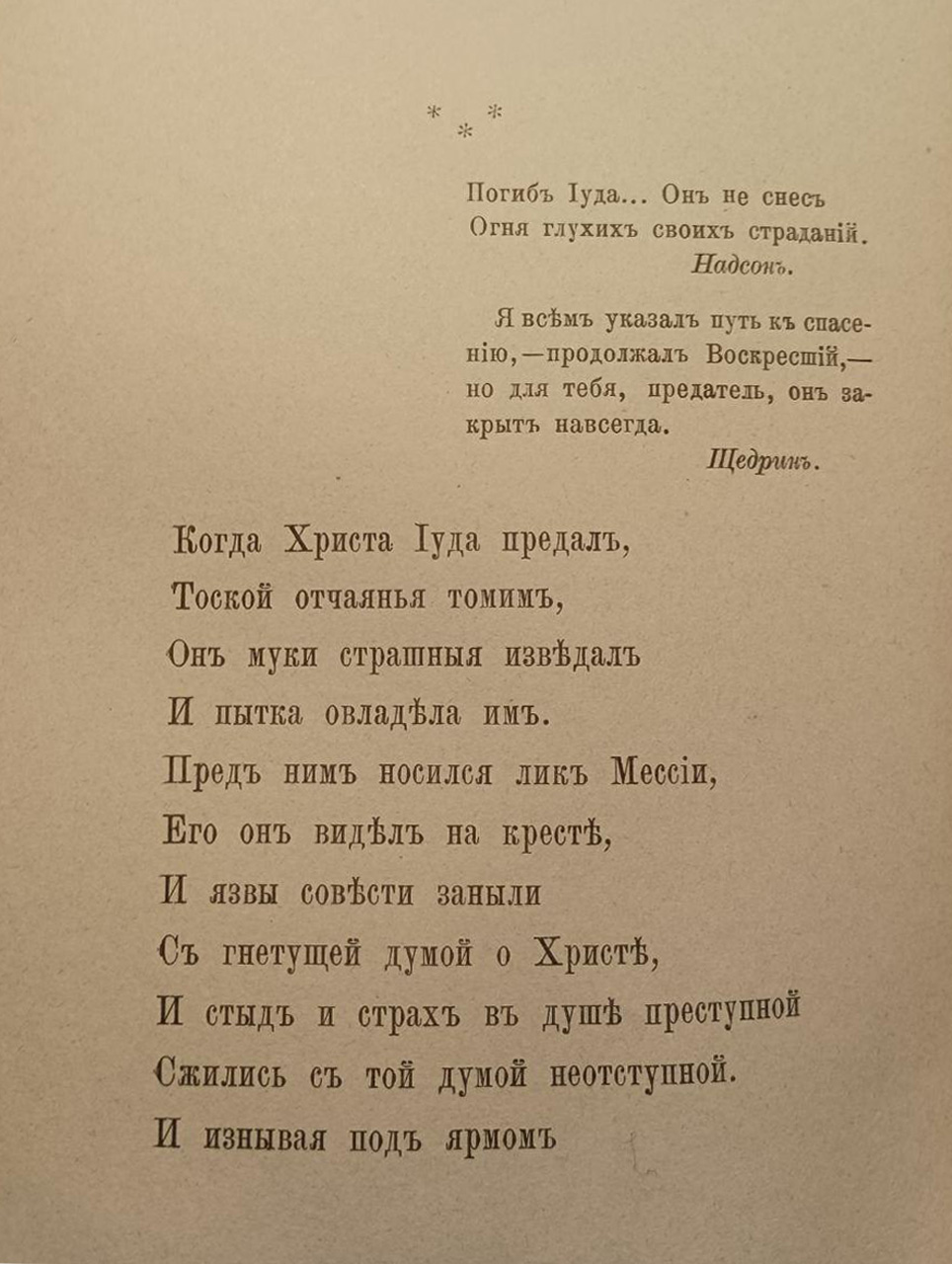
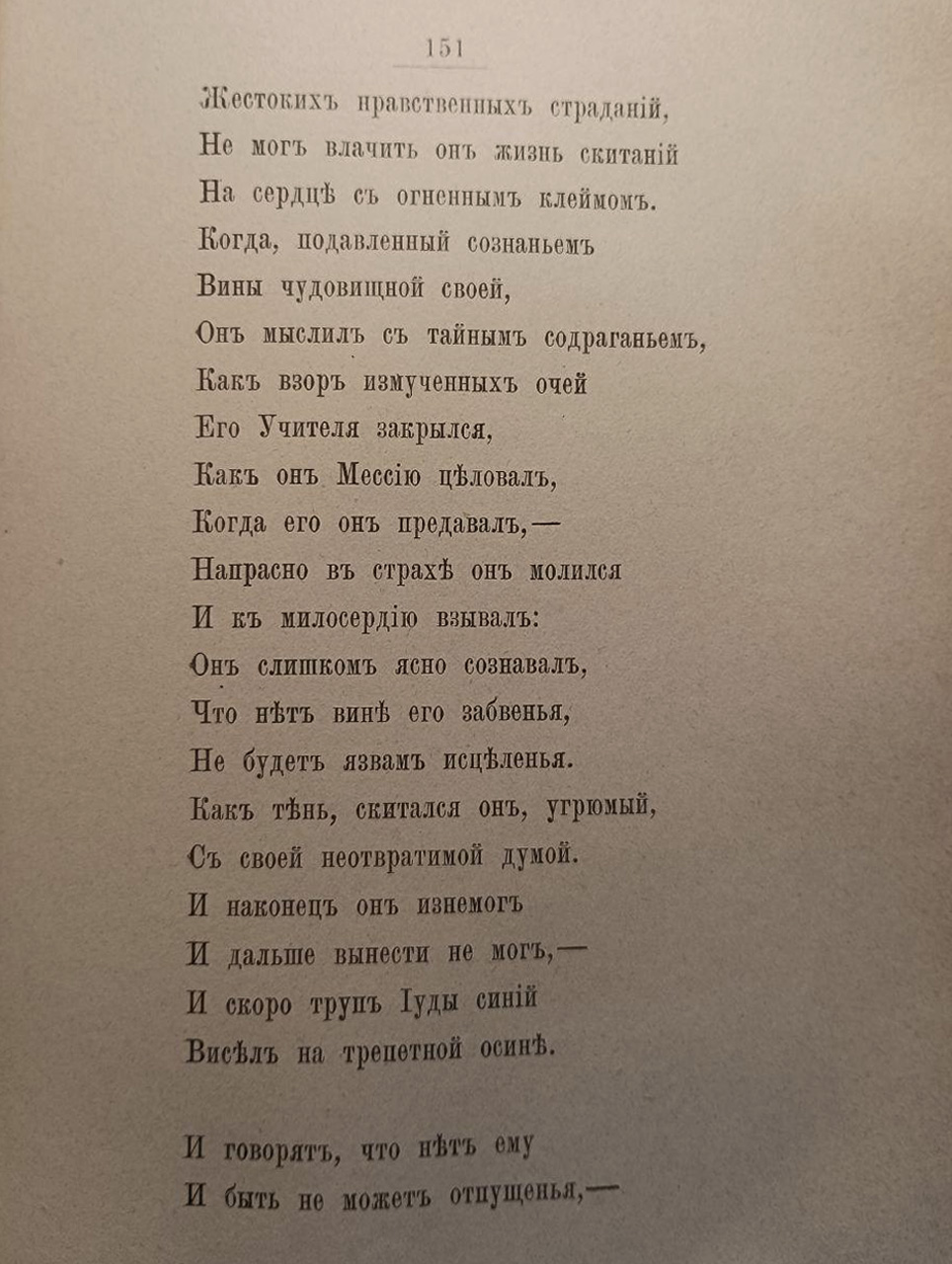
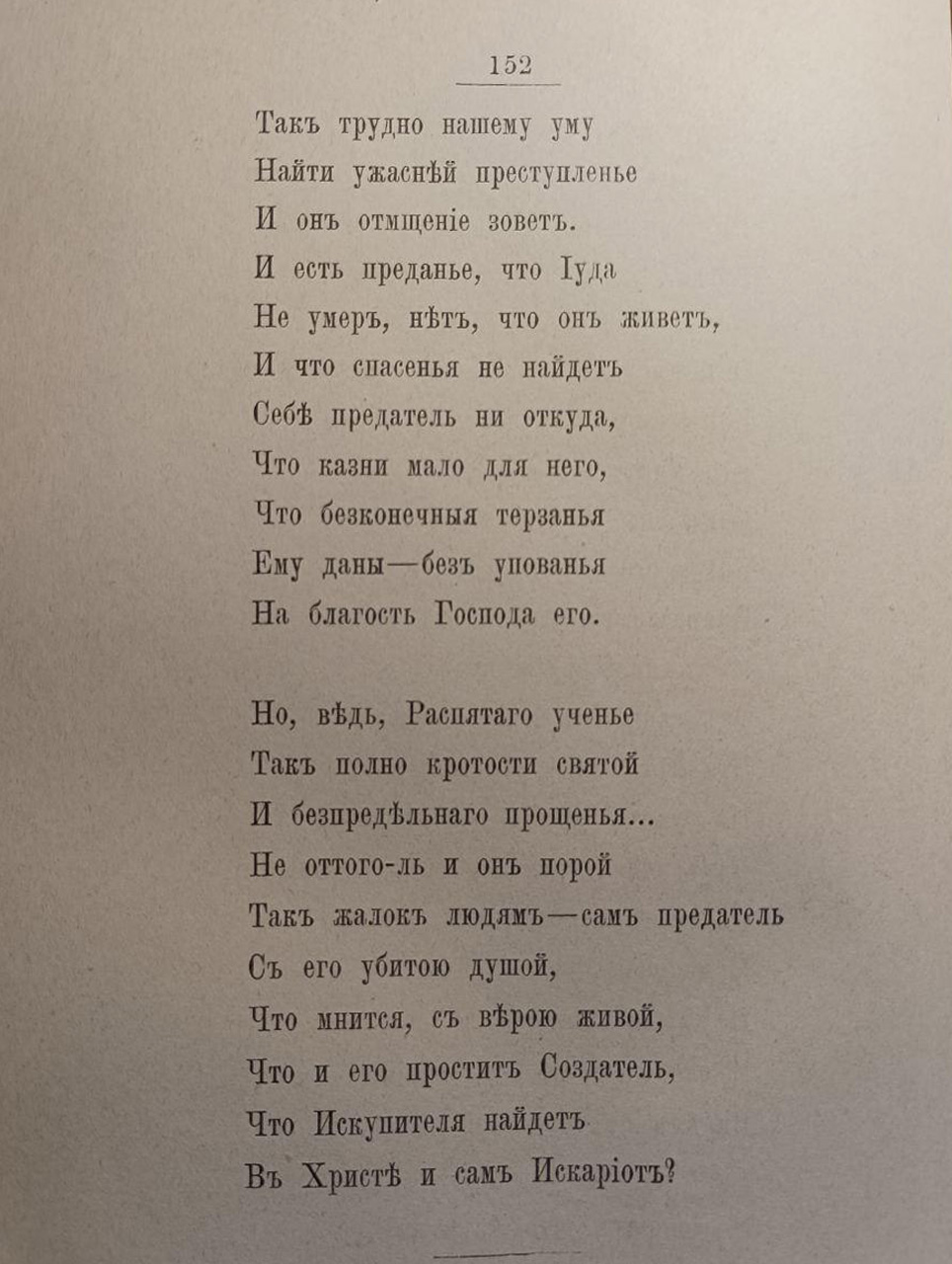
The author compensated for the lack of a title with two epigraphs at once - from Semyon Nadson’s poem “Judas” (1879) and the fairy tale legend “Christ’s Night” by M. E. Saltykov-Shchedrin (1886). The first sounds like this: “Judas died... He did not bear / The fire of his silent suffering,” the second: “I showed everyone the path to salvation,” continued the Risen One, “but for you, traitor, it is closed forever.”
Any epigraph is a conscious connection to tradition, and E. Morozov’s poems are also a direct rehash of Nadson’s “Judas.” Whether or not M. Saltykov-Shchedrin knew about these poems is no longer important, since contextually he also connects to the tradition: leaving aside the death of the traitor from the pangs of conscience and shame, he develops another plot motif - doom to wandering, which Nadson stated as follows:
Run, traitor, from people
And know: nowhere is your soul
You won't find peace:
Wherever you are, everywhere with you
Your ghost will go fatal
A guarantee of torment and condemnation.
In M. Saltykov-Shchedrin, Christ closes the “path to salvation” through death: he is doomed to wander the earth forever. And in order to carry out this curse of his, the Son of Man resurrects the traitor who has already hanged himself. It is worth paying attention to the detailed description of the decomposition process, with very specific indications of some phases (hereinafter our italics - P.R. ): “... The East turned red, and in the thinning darkness of the forest an ugly human mass appeared, swaying on an aspen tree. The head of the hanged man, almost torn off from the body, hung down; The crows had already pecked out her eyes and eaten her cheeks. The very torso was stripped of clothes in places and, gaping with purulent wounds, waved its arms in the wind. A flock of birds of prey circled over the body, and the bolder ones fearlessly continued the work of destruction .”
It happened on Easter night. The risen Christ commands Judas: “Come down from the tree, traitor!.. may your shameful appearance be restored to the same form in which it was at that moment when you kissed the one you betrayed. Live!”
The restoration of flesh and clothing is no longer worthy of description. The traitor simply leaves the tree and immediately (!) begins to beg for death. The prayers were in vain. I had to get up, pick up the staff that arose from the branch of that same disastrous aspen, and, like a certain Cain or the Eternal Jew, set off on an endless mournful journey. “And to this day he walks the earth, dispersing confusion, treason and discord,” the fairy tale ends with these words.
The essence of the technique
Already the story of one couplet about the blue Judas on the aspen was enough for Sobolev to exclude the sole authorship of E. Morozov and to conclude that the original source was deliberately constructed: “Probably, the situation was like this: Khodasevich somehow, at an unlucky hour, fell into the hands of Morozov’s book; Having memorized and slightly twisted (to make it funnier) two lines, he made them part of the circle folklore. In principle, this is a technique common to the poetics of the late Khodasevich the memoirist: to take an expressive detail of actual history and deform it for the sake of the power of artistic impression...”
If V. Khodasevich really read poems about Judas in E. Morozov’s book, then he simply could not ignore the epigraphs. We don’t know why Sobolev ignored them, but it is obvious that they themselves lead to the idea of collective work in line with tradition, and at the same time help to understand what kind of deformation of the original source the poet made.
In the first epigraph we see the fire of dull suffering. It is logical to assume that it should have burned on the face of the traitor - at least in the form of shame for what he had done. It is quite natural, therefore, that “at first,” that is, at the moment of hanging, Judas was “all red.” Then, with the same naturalness, he cooled down and turned blue. In E. Morozov, this process is not explicit in any way, although there is shame, and even its fiery brand (albeit on the heart). Moreover, like Nadson, his Judas sees the face of Jesus on the cross everywhere, and for Nadson the whole story initially begins in crimson tones: “Christ prayed... Bloody sweat / ran from the drooping brow.”
The word “corpse” in poetic speech carries with it the epithet “cold” (cf. A. Pushkin in “The Bronze Horseman”: “They found my madman, / And his cold corpse is nearby”). And “cold” means “blue.” V. Kuchelbecker, by the way, an absolute genius below zero at least for his lyceum environment, in 1819 wrote a letter “To Pushkin from his unheated room.” There are such funny words:
It's not warm here; but the thought of a friend,
About a passionate, fiery singer,
Will it really not warm me up?
Will the heat really not go away?
On my blue face?
V. Khodasevich could well have included the last two verses in his article. Even if the poet did not know about them, they perfectly illustrate the essence of the technique used in relation to the original. E. Morozov was absolutely right when he spoke about the blue, that is, the cold corpse of Judas: this color arises by itself, by default and remains silent, because otherwise it would turn out absurd and funny. But it was precisely “to make it funnier” that V. Khodasevich decided to give a detailed explication of the process with a clear indication of its time and temperature phases. Actually, this was the technique, perhaps referring, among other things, to Shchedrin’s description of the bodily disintegration of Judas: it is also quite absurd in its extensiveness, but is perceived without a smile due to the abundance of “horrific” details.
But the main thing is that for both M. Saltykov-Shchedrin and V. Kuchelbecker, the heat of resurgent life ultimately turned red on the blue face of the traitor, even if there was a huge distance between “resurrected” and “warmed up.” If desired, in the words “first all red, then blue” one can discern V. Khodasevich’s hidden polemic with both authors and a fundamental refusal (on behalf of the seemingly naive E. A. Morozov) to resurrect the traitor, and a subtle indication (already on his own behalf) of Pushkin’s trace in the first couplet, because, as we will see below, Pushkin did resurrect Judas in one of his poems.
Be that as it may, the technique used by V. Khodasevich enhances the ambivalent sound of the text. On the one hand, it turns the author (E.A.M.) into a complete graphomaniac who explains to the reader all sorts of “first” and “then”, which are not very appropriate in poetic speech in general, and especially in the chosen context. On the other hand, the very deliberateness in stating the obvious inspires suspicion and may well hint at non-obvious subtexts - the same rejection of the idea of \u200b\u200bthe resurrection of Judas and the accentuated affirmation of the usual, linear order of color changes - from life to death, from red (blood, heat) to blue (cold). This duality, according to our hypothesis, precisely prepares the reader for the appearance of Pushkin’s trace in an ideally graphomaniac text.
"Worldly Power"
Having established the original source of the verse about Judas, A. Sobolev reports: “The origin of the remaining two lines (about triumph and deity) remains unclear - I would, perhaps, risk including them in the dubia section of Khodasevich’s complete collected works, which somehow stalled in the second volume and has not shown signs of life for several years.”
PSS shows no signs of life even today, but you definitely shouldn’t wait another 10 years to try to figure out the origin of the lines about celebration and deity. It seems that this was already easier to do than to establish the identity of E.A.M.
Contextually, the name of Pushkin has already arisen in connection with the “cold corpse” of Evgeniy and the poetic message of V. Kuchelbecker with his fantastically ridiculous “blue face”. In the first case, we are dealing with a common cliché, and in the second, on the contrary, with a rather rare context. But V. Khodasevich was not just a Pushkin poet, but also a Pushkin scholar. And although in Irina Surat’s book “Pushkinist Vladislav Khodasevich,” as well as in his works about Pushkin themselves, there is nothing about our plot, it seems extremely unlikely that Vladislav Felitsianovich could not know Pushkin’s Kamennoostrovsky cycle (1836). Namely, in this cycle there is a poem “ Worldly Power ”, which begins with these words:
When the great celebration took place
And the deity ended in agony on the cross...
It seems that until now it has not occurred to anyone to connect E. Morozov’s exemplary mediocre poem with these Pushkin lines, and yet they themselves are quite funny, and not only and not so much because today’s reader wants, first of all, to discard the reflexive suffix in the verb “ended.” No one here had yet discerned any obscene shades of meaning either in the 19th or early 20th centuries. But the vernacular connotation was definitely noticeable and could refer, for example, to the proverb: “Whoever you marry with, God willing, you end up with.” In relation to the Deity, it was quite appropriate in a poem whose pathos is angry bewilderment about the sentries posted at the crucifix: are they standing here because “the common people are not ordered to be allowed here,” who, you see, can offend “The One Whose execution redeemed the entire race of Adam” and who himself was from a carpenter’s family?
However, vernacular inevitably gives a comic coloring to any phrases and plots. The author’s smile can also be discerned in the earlier poems of A. S. Pushkin “ Once upon a time there lived a poor knight ...” (1829):
By the time it ended,
The evil spirit has arrived
The soul of the knight was collected
To drag the demon to your limit:
He didn’t pray to God,
He did not know fasting,
Not the path I was dragging
He is behind the Mother of Christ...
The verse “Before it ended” noticeably reduces the pathos of dying, but before that it was actually said: “He died without communion.” It turns out that now the action is rewinding back, from death as an accomplished fact (blue) to death as a process (blue). Next, a demon appears, in the context he is also a comical figure and, wow, the colloquial particle “de” is used to convey his speech. The intercession of the Most Pure One for “Her paladin,” if it returns the text to its former “high tone,” is again more likely in its popular version: what comes to the fore is not the romantic, bookish service to the Beautiful Lady, but precisely the warm faith in the protection of the Mother of God (the paladin still did not partake of the flesh and blood of the Father).
E. Morozov's poems are written in iambic tetrameter, "Worldly Power" - in hexameter. But if you divide the two initial verses of A. Pushkin by caesuras and take only the second hemistiches, you will again get something very comical:
The celebration took place:
The deity has ended...
The point, of course, is not that we have discarded the epithet “great” and the torment of the cross, but in the prosody itself: the truncated “edition” of the initial lines reveals, in addition to the colloquial, their clearly punning sound, and the puns in the described situation are somehow especially absurd (they would be just as absurd if the deity, according to the proverb, got married).
Pushkin also has other poems with the rhyme “triumph - deity,” for example, a message to “Chaadaev From the seashore of Taurida” (1824):
On these ruins it happened
Holy friendship celebration
And the souls of the great deities
He was proud of his creation.
Here, as we see, the very significant gospel verb “it is finished” is also repeated. In "Ruslana and Lyudmila", in Finn's story about Naina's transformation into a 70-year-old old woman burning with love, he is also found, and again in a comic context:
But here's something terrible: witchcraft
It was completely unfortunate.
My gray deity
There was a new passion for me.
In the white manuscript of Eugene Onegin, after the XXIV stanza of the third chapter, two more followed, which were removed during publication. The second, about virgins without reproach, ended like this:
And tomorrow is a light court of rumor
Attributed to a fashionable hero
Victory new celebration:
The deity is looking for your love.
More examples can be given, say, “ Her Eyes ” (1828), but in general, it was very difficult not to see Pushkin’s trace already in E. Morozov’s poems about Judas. Let us recall that the image of suicide was preceded by the following description:
And finally he was exhausted
And I couldn’t bear it anymore...
Well, isn’t this a reference to the textbook beginning of the first chapter of Onegin, right down to the root tautology in the rhyme (“I fell ill - I couldn’t”)? In general, in the short note “Below Zero,” Pushkin’s name is mentioned in one form or another 13 (!) times, including saying that the poet “generally has the misfortune of attracting the sympathetic attention” of graphomaniacs. V. Khodasevich calls the pearl of his collection the book “The History of the World in Verse” (1927) by a certain Viktor Kolosovsky. The author was imbued with the spirit of Pushkin to such an extent that he eventually recognized himself as his reincarnation and even signed his double name on the cover. All this cannot serve as proof that Khodasevich constructed exemplarily mediocre poems based not only on the opus of E. A. Morozov, but also on Pushkin’s “Worldly Power,” but there are some grounds for the hypothesis here, especially if we remember that in the Kamennoostrovsky cycle this poem is preceded by “( Imitation of the Italian ),” which talks about Judas. By the way, both texts, like the text by V. Khodasevich (E. Morozov did not have this), are written in couplets.
("Imitation of Italian")
Like a traitorous student fell from a tree,
The devil flew in and touched his face,
Breathed life into it, soared with its stinking prey
And he threw the living corpse into the throat of hellish hell...
There are demons, rejoicing and splashing, on their horns
Received with laughter the world enemy
И шумно понесли к проклятому владыке,
И сатана, привстав, с веселием на лике
Лобзанием своим насквозь прожег уста,
В предательскую ночь лобзавшие Христа.
За 6 лет до статьи В. Ходасевича Б. В. Томашевский доказал, что в «Подражании…» мы имеем дело с вольным переложением сонета Франческо Джианни (Sopra Iuda) по французскому переводу Антони Дешана (Supplice de Judas dans l'enfer). Приведем подстрочник второго сонета (цит. по работе Сергея Давыдова «„Подражание италиянскому“ и его источники»):
Когда Иуда, утолив свое отвратительное бешенство,
наконец сорвался с одинокого дерева,
страшный демон-искуситель
немедленно бросился на него.
Схватив его за волосы, он на огненных крыльях
поднял на воздух окаянный труп,
и, опустившись на дно вечного ада,
он, трепеща, насадил его на железный трезубец.
Мясо Искариота с треском загорелось,
костный мозг жарился и кости шипели.
Тут сатана заключил проклятого в свои объятия
и, взглянув на него с улыбкой на лице,
спокойно, дымящимися устами
вернул ему поцелуй, данный предателем Христу.
Сюжет у всех поэтов одинаков: сатана возвращает Иуде его предательский поцелуй. Но как тонко отметил С. Давыдов, благодаря появлению рогатых бесенят пушкинский текст становится более гротескным, как более гротескным благодаря одному-единственному бесу стало некогда стихотворение «Жил на свете рыцарь бедный…». Кроме того, у нашего поэта складывается некая адская антитроица: дьявол, бесенята, сатана. «Самое интересное, — пишет исследователь, — пушкинский дьявол не причиняет физической боли, его роль духовного порядка: он, не более не менее, как воскрешает Иуду». То есть принимает роль Бога! «„(Подражание италиянскому)“ построено полностью на приеме оксюморона, с помощью которого Пушкин драматизирует столкновение адской и божественной сил, — продолжает С. Давыдов. — Самоубийство Иуды, его воскресение, низвержение в преисподнюю повторяют в перевернутом виде таинство распятия, воскресения и вознесения Христа <…> В этом смысле Пушкин следует учению православной церкви об Антихристе, лже-Христе, который действует от имени Христа. <…> Возможно, что оксюморон божественного и сатанинского основан на предании, что сатана есть падший ангел, который возжаждал творения… Но в сатанинском творении все вырождается в свою противоположность: поцелуй становится средством предательства, вознесение оборачивается низвержением, жизнь смертью, награда наказаньем, любовь ненавистью».
Исследователь показывает, что оксюморон пронизывает все уровни текста, от сюжетного до лексического, и что словосочетания вроде «предатель-ученик», «труп живой», «проклятый владыка», «лобзанием прожег» несут в себе свое собственное отрицание.
В контексте нашего разговора центральный оксюморон — это образцово бездарный текст, можно сказать «литпамятник», сконструированный в том числе на основе текстов первого нашего поэта из того самого Каменноостровского цикла (предсмертного и пасхального и одновременно предсмертного), к которому примыкает и «Памятник».
Доказательство от противного: «Свершилось!»
Пушкин, солнце русской поэзии, и сам превратился в божество. Дмитрий Быков (признан властями РФ иноагентом) даже выступил с лекцией «Пушкин как наш Христос». Жаль, что в таком контексте не обозначено, какое значение в произведениях Александра Сергеевича, а заодно и в поэтической пушкиниане занимает слово «свершилось» — одно из семи слов, произнесенных Христом перед смертью: «Иисус, отпив вина, сказал: „Свершилось!“ И, склонив голову, предал дух Богу» (Евангелие от Иоанна, 19:30).
Пушкин употреблял его и в шутку, например в «Руслане и Людмиле» (см. выше), и всерьез, скажем в стихах , посвященных смерти Наполеона:
Чудесный жребий совершился:
Угас великий человек.
В стихотворении «Недвижный страж дремал на царственном пороге…» (1824) те же слова произносит Александр I — правда, об отречении Наполеона, а не о его смерти; умерла в этом произведении европейская свобода: «О грозные витии, / Целуйте жезл России / и вас поправшую железную стопу». В « Клеопатре » (1828) евангельское слово возникает в разговоре о любви, ради которой жертвуют жизнью:
Свершилось: куплены три ночи…
И ложе смерти их зовет.
Тремя годами ранее оно возникало и в другом любовном стихотворении , «Сожженное письмо» (1825). Тогда еще речь шла все-таки о расставании, а не смерти как таковой, но интересно, что мы снова видим и двустишия, и повторы, и даже внутреннюю глагольную рифму:
It's finished! Темный свернулися листы;
На легком пепле их заветные черты
Белеют… Грудь моя стеснилась. Пепел милый,
Отрада бедная в судьбе моей унылой,
Останься век со мной на горестной груди…
В стихотворениях на смерть Пушкина, хлынувших потоком в 1837 году, слово «свершилось» встречается в 8 из 77 текстов. А в 1830-м, когда состоялась помолвка поэта и Н. Гончаровой, египтолог И. А. Гульянов отправил жениху анонимное письмо со стихами «Олимпа девы встрепенулись…», где были в том числе такие слова:
Свершилось таинство природы!
Исчезли прелести свободы,
Погас изменный пыл крови,
Подруга в сердце воцарится,
И новым светом озарится
Певец мечтаний и любви.
Разумеется, Гульянов не имел в виду никаких роковых последствий для поэта, связанных с предстоящим браком. Но свершилось все, как в пушкинской «Клеопатре».
Все эти тексты собраны в антологии «Пушкин в стихах современников. 1813–1837» (2024), составленной М. В. Строгановым, и если читатель к ним обратится, то сразу увидит: их качество вполне достойно «гениев ниже нуля», притом что евангельский контекст местами вполне различим. Некий безымянный гвардейский офицер и вовсе сравнивает пушкинские стихи со святой проповедью, а его Дантес в чем-то предвосхищает Иуду сразу и С. Надсона, и М. Салтыкова-Щедрина, хотя те (равно как и Е. Морозов с В. Ходасевичем) никак не могли знать этого опуса, впервые опубликованного В. Вацуро в 1976 году:
Беги, злодей! Терзай себя!
Здесь не взведут тебя на плаху!
Земля чуждается тебя —
И твоего не примет праха!
Когда Пушкин шутя использовал слова Христа на Голгофе в «Руслане и Людмиле», теоретически он мог следовать давней европейской традиции — латинскую версию этих слов, Consummatum est, иронически обыграл еще Франсуа Рабле в «Третьей книге героических деяний и речений доброго Пантагрюэля» (1546). В реальной жизни вышло так, что Пушкин и сам стал мучеником. «Свершалось торжество: кончалось божество» — так вполне можно сказать уже о последних днях поэта, когда весь Петербург дежурил у его квартиры на Мойке, 12, а графоманские стихи на смерть в полной мере реализовали комизм этого трагического «Свершилось!»
Если В. Ходасевич действительно имел в виду «Мирскую власть», конструируя фрагмент морозовской поэмы об Иуде, то это пушкинское стихотворение может прояснить еще и причины замены глагола «кончалось» на «арестовали». Мы уже говорили о гневном недоумении поэта, возмущенного видом «поставленных на место жен святых / В ружье и кивере двух грозных часовых». Но вообще-то стража была и у Голгофы, и у гроба Господня. Сходным образом и во время похорон самого Пушкина город наводнили жандармы и агенты охранки в штатском, а его гроб в Святые Горы сопровождал жандармский капитан. Все это очень похоже на содержание под арестом. В конце концов, статья «Ниже нуля» появилась сто лет спустя после Каменноостровского цикла, в парижской монархической газете «Возрождение», в выпуске от 23 января, то есть накануне 99-й годовщины смерти Пушкина. Впереди светило столетия. И это было время, когда за право наследовать первому национальному поэту шла настоящая битва между белой эмиграцией и СССР, как раз вступившим в эпоху Большого террора. «Возрождение» занимало очень жесткую позицию в отношении Советской России, чьи претензии на Пушкина вполне могли рассматриваться как желание арестовать Божество и держать его у себя под стражей. Это, конечно, не более чем допущение, да еще и в виде метафоры, но исторический контекст был вполне уместным для указанной глагольной метаморфозы. Куда более важный литературный контекст — а именно соседство «Мирской власти» и «(Подражания италиянскому)», — на наш взгляд, переводит допущение в ранг гипотезы.
Конечно, Пушкина можно притянуть при желании к любой теме, но его предполагаемый след в эталонном графоманском тексте крайне важен. Илья Виницкий в монографии «Граф Сардинский. Дмитрий Хвостов и русская культура» (2017) придал своему герою национальный статус антипоэта, назвав его комическим двойником Пушкина. Спору нет, Александр Сергеевич вместе с ближайшим окружением старательно взращивали этого двойника. Но недаром же П. Вяземский писал Пушкину в 1825 году: «Ты сам Хвостова подражатель, / Красот его любостяжатель…» Поэт не был бы «нашим всем», если бы не мог взрастить собственную противоположность в самом себе. Сознательно или нет, В. Ходасевич реализовал этот потенциал. Он сконструировал не просто замечательно бездарный текст, такого рода удачи случались у него и раньше, взять хотя бы стихотворение «Ниничек глаза таращит…» (1925). На сей раз поэт сумел привести еще одно, весьма оригинальное доказательство и в пользу тезиса А. Григорьева, и в пользу неисповедимости путей поэзии. Где божество, там и торжество.