Translated material
Book surgeon
The complicated history of alterbookers
“Gorky” continues a series of materials about near-book professions. Today we will talk about alterbooking - the practice of using books as material for creating art objects. What happens to the book in this case - transformation or damage?
Drink tea from Goethe
The concept of alterbooking is based on the idea of transforming and modifying an object to acquire new pragmatic functions or aesthetic properties. A well-known medieval embodiment of this idea is the creation of palimpsests (Greek palipmpseston - again scraped off), the application of new texts on parchment over old manuscripts in order to save writing material. A similar practice in fine art is the application of new elements on top of finished canvases, sometimes while maintaining the visibility of fragments of the previous version of the painting.
The ancient principle of “out of the old, new” in relation to books receives both curious and ambiguous applications in modern times. One of the current trends is associated with the fashion for upcycling (English: upcycling - reuse) - creative recycling of outdated things, remaking all sorts of old things. There are so many things people don’t make from paper books these days: boxes and lamps, clocks and vases, carpets and curtains, jewelry and furniture.
You can sleep on Tolstoy, drink tea from Goethe, and store trinkets in Homer. But “a simple and budget-friendly way to decorate a buffet area in the theme of the evening” from Event magazine is a book tablecloth. At a dinner hosted by the Toronto Public Library, desserts were placed directly on open books, and miniature chocolates were decorated with figuratively cut out pages.
Spaniard Alvaro Tamarit constructs sofas entirely from old books. Dutchman Richard Hatten turns stacks of books into elegant tables. American Jim Rosenau has released a whole set of designer furniture of this kind. Imitating the famous clutches of Olympia Le-Tan, which skillfully imitate printed publications, home-grown craftsmen rushed to produce “literary handbags” en masse. The topic is not only for foreigners, but also for Russians - just visit the well-known website “Fair of Masters”.
Fashion designer Sylvie Facon from France and artist Ryan Novellin from the USA create real dresses from books. The basis of the outfits are color illustrations removed from the bindings, superimposed on the fabric and connected with thin wire or metal threads. British inventor Jeremy May came up with the idea of producing “biblio” jewelry. The book page is cut to shape, pressed very tightly, colored, laminated and varnished, then inserted back into the book and sold as a set. American designer Betty Pepper creates similar jewelry with caskets made from bindings - so that good things don’t go to waste.
Typically, for book upcycling, printed publications are used on orders from second-hand bookstores or copied from libraries. But incidents also happen. One Parisian second-hand bookseller objected to the acquisition of a 17th-century book by a suspicious American, who, as it later turned out, intended to tear out the cover from it to decorate his diary.
Russians are not yet so keen on such experiences, but are gradually becoming familiar with foreign fashion. In the St. Petersburg anti-cafe “FreeDom” the bar counter and walls are completely “lined” with books. The domestic publishing house YanikO has released a series of jewelry from mini-books: earrings from Hamlet, a pendant from Tsvetaeva’s poems, a pendant for a mobile phone from Pushkin’s microtomy.
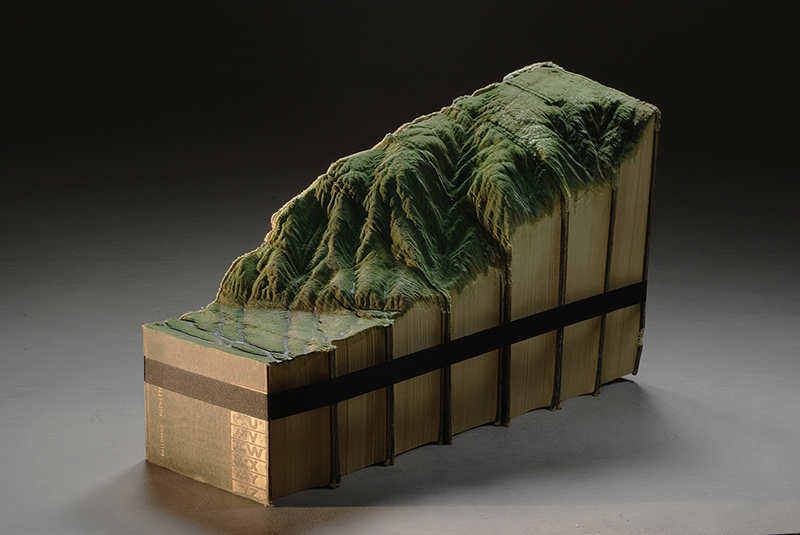
Another popular trend is the creation of architectural biblio-objects and art installations. They build houses from books, construct pyramids, erect towers, lay out ornaments, and imitate natural landscapes. There are masters who work in diorama, 3D portrait, and book-cut sculpture formats.
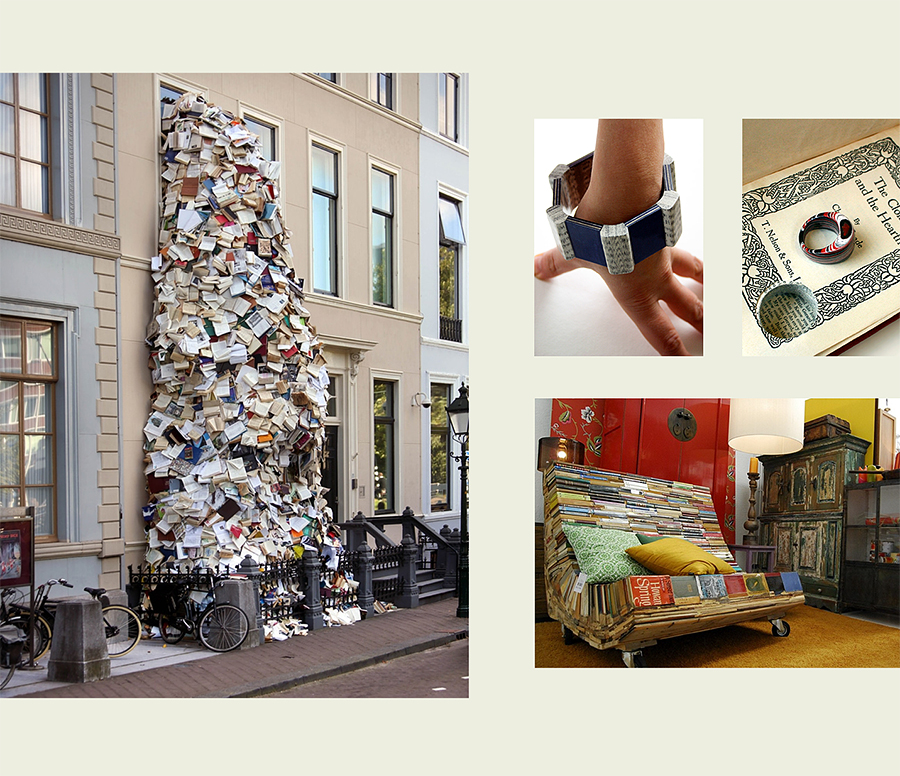
Alicia Martin's project "Biografias"; b bracelet and book ring from Jeremy May; D Ivan Alvaro Tamarita
Photo: imhomir.com; littlefly.co.uk
Large forms of alterbooking are also used in street art: for example, Spanish designer Alicia Martin’s project “Biografias” is a waterfall of books pouring from the second floor of an ancient building. One of the streets of Toronto amazed passers-by with the grandiose art installation “Literature Vs Traffic” in the form of a river valley made of 10 thousand luminous volumes. In the Prague library there is a sculpture “Tower of books” - a tall tower of many books as a road to the “literary otherworld”.
Will paper endure anything?
The main and perhaps the most impressive type of alterbooking is the creative alteration of books, up to the complete loss of their original appearance. According to one version, the founder of alterbooking, American designer Tom Phillips, who back in 1966 transformed the edition of William Malloch’s novel “A Human Document” into the creative miracle “Humument”. Armed with ink and watercolor, Phillips selectively erased words from the original 367-page text, added whimsical images, pasted-ins, and inserted collages.
Now alterbooking uses a lot of skillful and mostly labor-intensive, sometimes even jewelry techniques: draping, silk-screen printing, gluing, corrugation, burning, soaking, applying stamps and appliqués, adding new images and texts, embedding foreign elements. Some techniques received special names: distress (aging), embossing (embossing), quilling (paper rolling).
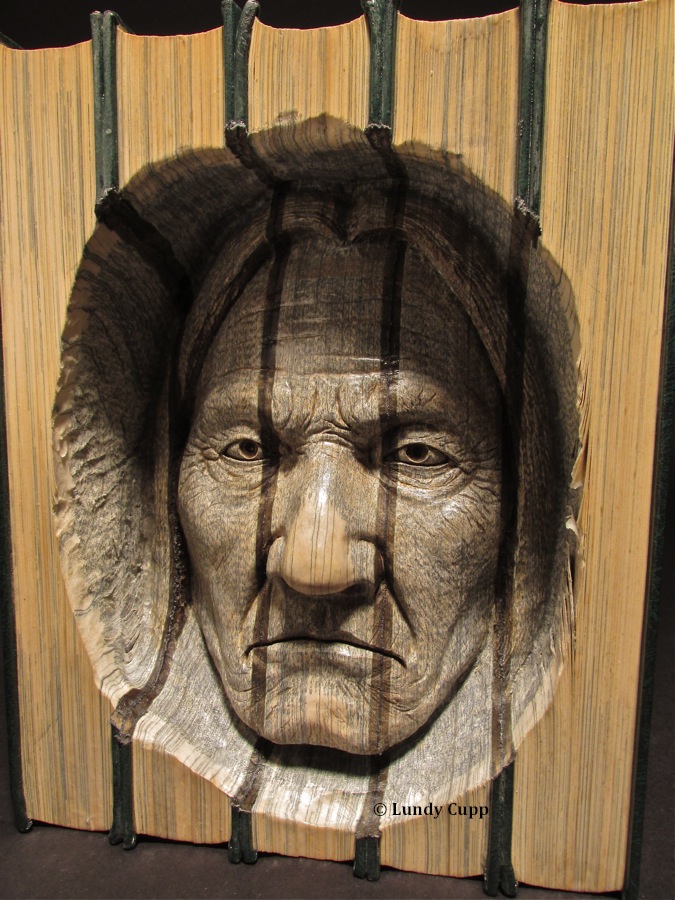
Currently, the most relevant creative practice is book carving (English book - book + carving), the transformation of printed publications into three-dimensional art objects or simply “carving on books”. For bookcarving, special knives and scissors are used, and medical instruments are often used - scalpels, dissectors, tweezers, clamps. Glue, paints, and varnishes are used as additional materials.
Sue Blackwell cuts out illustrations from fairy tales, glues them with text, hangs them on fishing lines and places them on a plane, playing with the effects of chiaroscuro. Georgia Russell divides the pages into thin strips and creates fantasy panels. Thomas Allen creates flying silhouettes of literary characters from book pages. Nicholas Jones sculpts hardcover sculptures. Robert Ze makes paper mops from the Encyclopedia Britannica, pistols from psychotherapy manuals, and cockroaches from art albums. Kylie Stillman carves counter-reliefs from books in the form of exotic trees and flower bouquets. Lundy Kapp carves impressively realistic faces into book edges.
1/4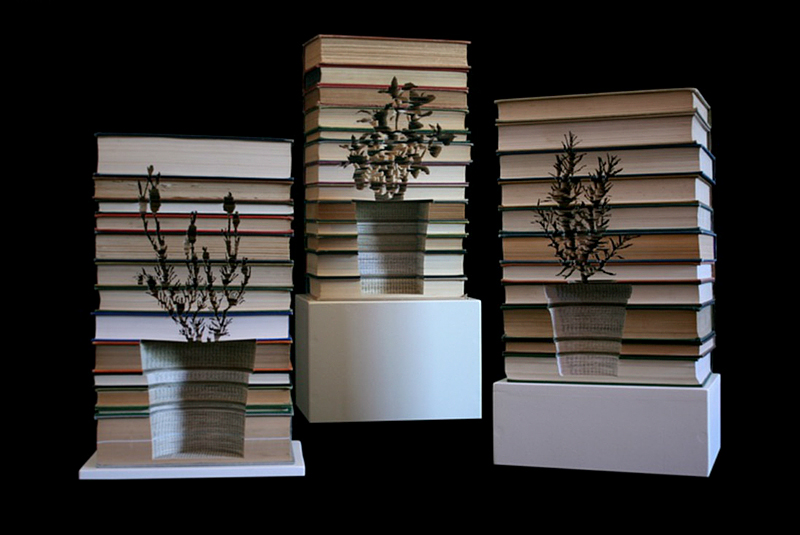 Bookcarving Kylie Stillman Photo: prohandmade.ru 2/4
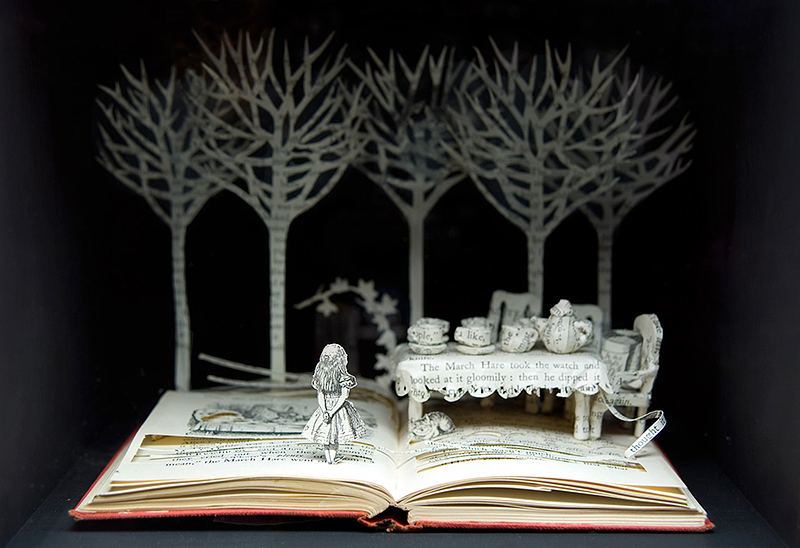 Artwork by Sue Blackwell Photo: rvampie.wordpress.com 3/4
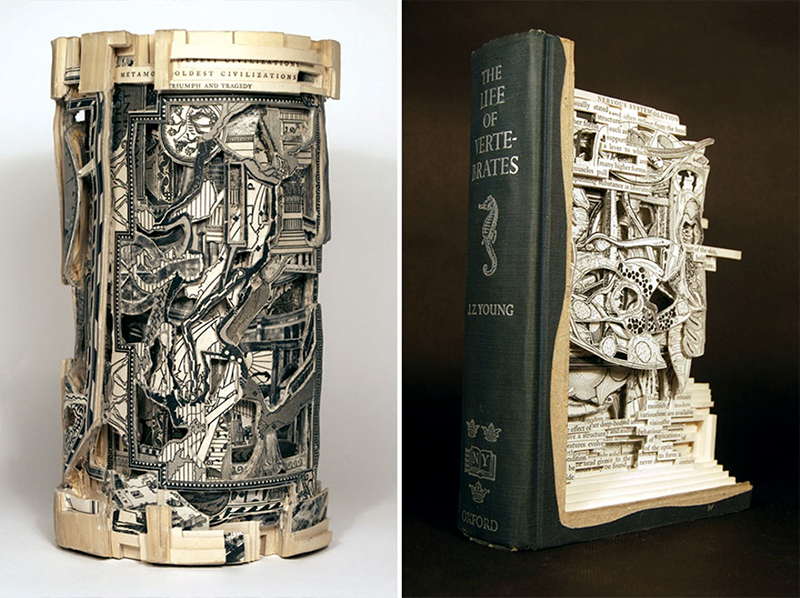 Brian Dettmer “Vertebrate Life” Photo: flickr.com 4/4
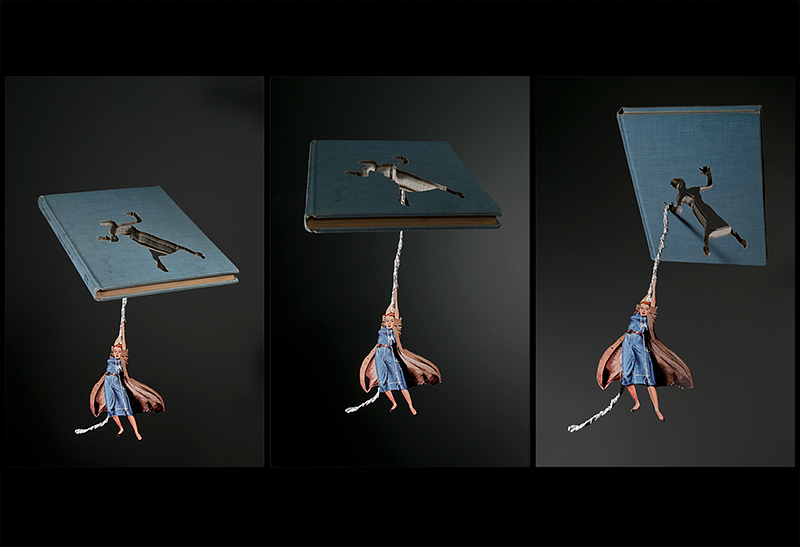 Book sculptures by Thomas Allen
Among the bookcarvers there are many real luminaries and bright stars. In addition to those mentioned, these are Japanese Tomoko Takeda, Canadians Guy Laramie and Maskull Lasserre; British Alexander Korzer-Robinson, Georgia Russell, Thomas Whitman; Americans Kara Barer, Julia Feld, Nicholas Galanin. But perhaps the main celebrity is the American master Brian Dettmer, nicknamed the “book surgeon.”
A distinctive feature of bookcarving is conceptualism. The masters don’t just shred books, but present it as something full of deep meaning, with an artistic super-task and a cool message. Thus, Dettmer insists that his work “reveals images and ideas, exposing history and memories.” Korzer-Robinson claims that he, who is also a practicing psychologist, manages to “look directly into the soul of a book” and “control the viewer’s mood.”
Laramie states that “unnecessary books eventually turn into mountains,” and he “only helps them take on their true appearance.” Galanin positions his author’s series as “a unique way to show the world that a person remains himself, even when he finds himself in an unconventional, unfamiliar and uncomfortable environment.” Whitman calls his book sculptures allegories of mental illness. Margaret Wiley knitted a tunic from strips of New Testament pages and presented it as combining a traditionally feminine occupation with the idea of male dominance in the Christian religion.
Summarizing the concepts of bookcarvers, we get three main arguments: “new life” of an old book (the idea of rebirth); “giving meaning” to an unnecessary book (the idea of imparting value); “exposing the essence” of any book (the idea of “cutting off all unnecessary” - as when creating a sculpture). There is a fair amount of slyness here, since for artistic cutting they rarely take literary slag, printing defects or junk pocketbooks - they prefer high-quality, often even antique and very rare editions.
Art or parasitism?
Previously, it seemed that alter booking was nothing more than a passing fad, a fashionable fad. Today it is turning from a marginal practice into a strong mainstream. The making of utilitarian objects and the creation of creative products from printed materials is growing with new techniques, skilled craftsmen and ardent fans.
Abroad, alterbooks are exhibited in famous museums, awarded prestigious prizes, and studied by art historians. Practical manuals are already being published in Russia, for example, “Do-It-Yourself Book Carving: Masterpieces for Book Lovers,” and educational websites like “Book Carving for Beginners” are being created. To demonstrate the possibilities of alter art therapy at the Ariadne's Thread festival of creativity for people with mental disabilities, participants were given identical printed books with the invitation to transform them according to their own imagination.
Bookcarving is quietly penetrating into public practices. Let us remember the solemn ceremony for the completion of the Sochi Olympics - with a heavy rain of book pages. Book Week advertising in the Netherlands featured the work of bookcarver Isaac Salazar. The format of a book sculpture is played out in posters of the Prague store Anagram.
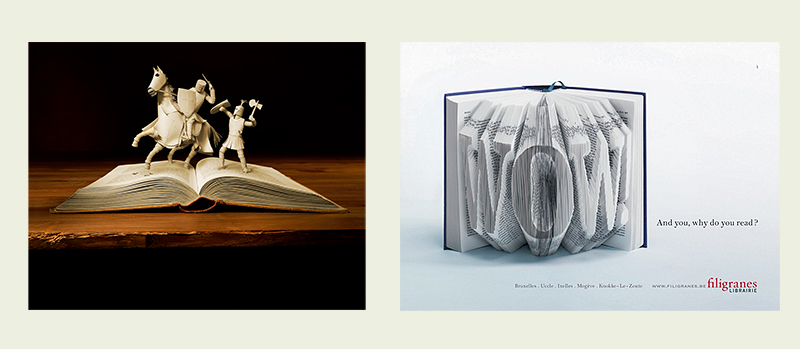
Poster from the advertising series of the Prague store “Anagram”; work by Isaac Salazar in the book advertisement “Why are you reading?”
Photo : behance.net/adeevee.com
What does this all look like? On the one hand, the use of books for other purposes puts alterbooking on a par with the thoughtless decoration of interiors, which has been condemned since antiquity (tellised imitations of libraries, making dummy books) and the actions of bibliophiles-“flayers” (collecting covers, titles, illustrations separately from books). Gorky already talked about this in one of the previous publications in the series .
On the other hand, the loss of the original anthropomorphic appearance of the book—the transformation of a human document into a monstrous “Humument”—reveals the dehumanistic nature of the alterbook, allowing it to be viewed from the same perspective as the production of plastinoids—the infamous sculptures from dismembered mummified human bodies. An odious invention of the German anatomist Gunther Hagens: a plastinoid is outwardly human-like, but is neither a person nor even a corpse. Likewise, the bookcarving product sometimes still vaguely resembles its prototype, but no longer corresponds to the concept of “book”.
Apologists for alterbooking are often very categorical, even aggressive. They declare their opponents to be, at best, book snobs, at worst, alarmists, retrogrades, and generally stranglers of creative thought. Moreover, many discussions are replete with indirect justifications. “I can’t believe that historically valuable and rare publications are going under the knife,” some people convince themselves. “Since books have been copied from libraries or thrown away by their owners anyway, what’s wrong with creatively recycling them?” - others are sincerely perplexed. “For bookcarving, they probably make special orders from printing houses,” say a third.
In this debate, it is necessary to clarify several implicit, but very significant points. Firstly, the problem is not at all how many books were “damaged” (one or a hundred) and which ones were “desecrated” (valuable or unnecessary). The problem is the legitimacy of such practices—their professional incentives and public recognition.
Secondly, it is quite obvious that at some deep, subconscious level, most of us have some understanding of cultural boundaries and universal prohibitions. If anyone tries to seriously engage in carving icons, they will immediately be subjected to mass condemnation. But the Book, being an icon of Culture, is constantly subject to all sorts of attacks.
Thirdly, the analogy between alter booking and waste paper collection that regularly arises in public debate is not entirely correct. During industrial recycling, the book will not just be put under the knife, but will end up being made into another book. Alterbooking can be somewhat likened to an execution, and disposal to a funeral rite. The difference is obvious, isn't it?
Fourthly, the creation of alterbooks is not barbaric, as many of its opponents believe. Barbarism is an ignorant attitude towards cultural values and their senseless destruction, while alterbooking declares creativity, deep meaningfulness and (in the best examples) high skill. If we are to give an emotional definition, then this is rather a mockery of the Book, but artistically sophisticated and possessing an ideological and conceptual alibi.
Finally, many see the reasons for the popularity of alterbooking in the displacement of printed formats by electronic ones and, as a result, an overabundance of paper books. However, almost no one asks the question: why are ready-made books used? After all, stitched blocks without printing are quite suitable for creativity. But no, it is the book - with its living archetypes and rich cultural tradition - that turns out to be an ideal object for experiments with dismemberment.
Is it any wonder after this when, in a production of “The Cherry Orchard” by one of the capital’s theaters, a maid demonstratively burns her master’s book? Or the inventive patching of holes in the asphalt with volumes copied from libraries? Or the newfangled craze for “book bonfires” for the sake of a spectacular selfie? Stack in the firebox - and a hundred hundred likes on Instagram. But what alterbooking is—an original trend of contemporary art or a parasitic practice that exploits the sacredness and super-symbolism of the Book—is still determined by everyone independently.