
Translated material
Gogol in colors
Book in Pavel Fedotov’s painting “Fresh Cavalier”
An official frozen in a comically proud pose with an order on a greasy robe a la a Roman toga and curlers on his head that cartoonishly resemble a laurel wreath. The first completed oil painting by Pavel Fedotov, “Fresh Cavalier,” is a textbook subject of school descriptive essays and an indispensable exhibit on sightseeing tours of the Tretyakov Gallery. Known under two other titles - “The Morning of the Official Who Received the First Cross” and “The Consequences of the Feast” - the genre painting, according to the artist himself, was his “first chick”, which he “nursed with various amendments for about nine months.”
As follows from the author’s description, “the new gentleman could not stand it: as soon as it was light, he put his new one on his robe and proudly reminded the cook of his importance, but she mockingly showed him his only boots, but they were worn out and full of holes, which she was taking to clean.” The description is crowned with a poetic explanation - “Where a bad relationship starts, there is dirt on a great holiday.”
An eloquent confirmation of this folk wisdom is a littered room with traces of yesterday's feast. The home of the “fresh gentleman” clearly does not sparkle with freshness. Uncollected scraps, broken dishes, a guitar with frayed strings and (what interests us most) a book carelessly thrown under a chair. An inconspicuous, tattered volume can tell a lot about its owner.
The book lies so that the text is upside down, and the viewer needs to tilt his head to see the author and the title: the novel “Ivan Vyzhigin” by Thaddeus Bulgarin. What is this author famous for? They don’t take it at school, they don’t take it to the Unified State Exam. But in the era of the painting, Thaddeus Venediktovich was one of the most popular writers, whose circulation was several times higher than that of Pushkin’s works. “Ivan Vyzhigin” caused a boom in reading; the first edition was sold out in just a week. The book became the first Russian bestseller. And here is how Pushkin himself spoke about it.
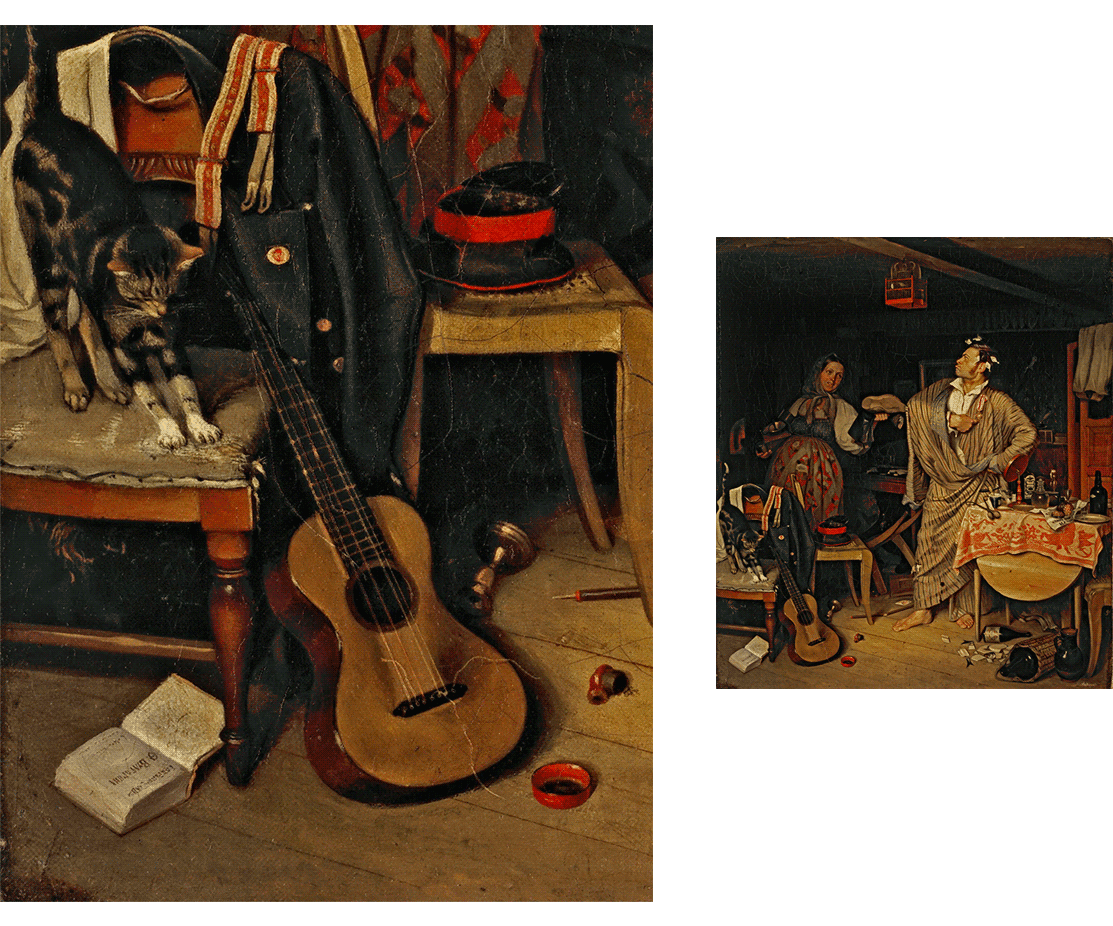
For such a poser and fanfare as Fedotov’s official, Bulgarin’s novel is about the same as a dagger hanging on the wall or the same curl-papers. Fashion accessory, a sign of prestige. The newly-minted order bearer strives to “join the cultural culture,” but his boorish handling of the book betrays his spiritual wretchedness. An abandoned book automatically becomes a junk item, symbolically devalued. It is equivalent to the newspaper “Vedomosti of the St. Petersburg City Police” crumpled on the table with pieces of sausage lying on it.
Apparently, the gentleman did not master the book, or even did not start reading at all. In this way, he is reminiscent of two Gogol characters at once: Barsukov, who dreamed of an “order on his neck,” and Manilov, with a book always pawned on page fourteen. It is no coincidence that Fedotov was called “Gogol in colors.”
Bulgarin's closeness to power and the approval of “Ivan Vyzhigin” by Benckendorff and Nicholas I introduce another subtle semantic nuance into the picture. Obsequious bureaucracy is the target audience of Bulgarin’s works. In the space of the picture, Bulgarin, lying under a chair, ironically rhymes with the drunken neighborhood guard sleeping under the table. The artist searched for this colorful image for a long time and finally created a portrait from life, having previously taken it on his chest along with his model.
The bureaucrat boasts not just of “the first order in his buttonhole”, but of the Order of St. Stanislaus of the third degree - the lowest in the hierarchy of state awards of the Russian Empire, but giving the right to hereditary nobility. In 1845, the effect of the tsar's decree was suspended, but Fedotov had the idea for the painting earlier - and the official, most likely, had time to help. You know, his glee is not so comical. And to erase Stanislav from the canvas, as the censor demanded, was as impossible as removing Bulgarin’s book - otherwise the whole plan would have been destroyed.
However, the story of "Fresh Cavalier" becomes much more interesting when compared with its original plan. The original version was a sepia sketch, which was approved by fabulist Ivan Krylov. And inspired by the praise of the literary master, the young painter creates his first work in oil technique based on the drawing.
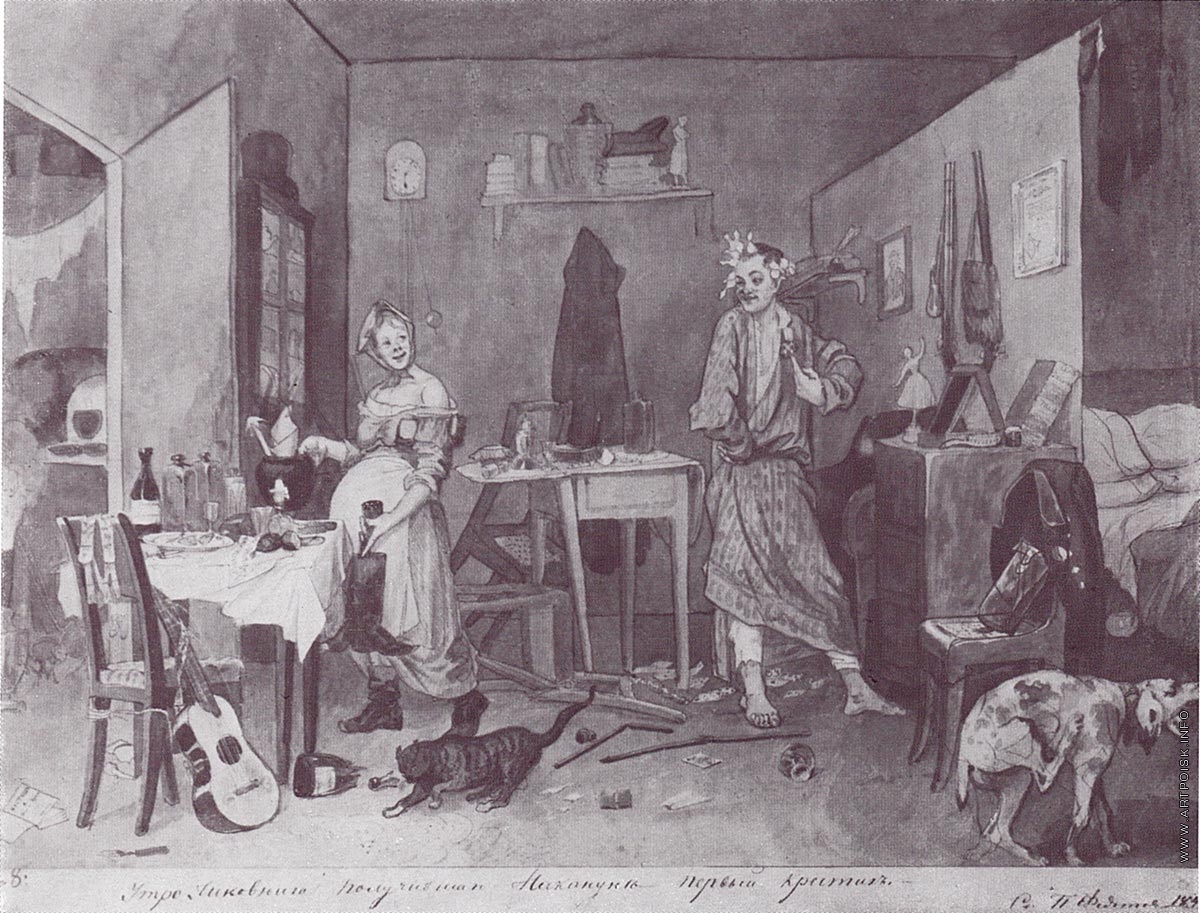
The open volume is depicted in almost the same place, only this is Paul de Kock’s novel “Mustache” (1838). The content of the scene and the meaning of the presence of the book in it, although not radically, change.
The French writer Charles Paul de Kock was no less popular in Russia at that time than Bulgarin. His works served as examples of frivolous writings. “Mustache” was most succinctly characterized by Belinsky: “A novel by Paul de Kock: there is nothing more to say about him.”
The author’s description of the drawing in the form of a satirical mini-poem ends with a fabled moral: “Victory celebrates victory, Impudently wears its wreath. And if suddenly he meets with contempt, It will not be repentance, but vengeance. The vicious soul will boil: A step towards villainy, since the conscience is asleep.”
The critical pathos of the original version of the picture is visible stronger and more clearly than in the final one. Fedotov portrays here a hero rooted in debauchery and ready to commit baseness for the sake of his career. Whereas in the oil painting the official is simply childishly ambitious. And the book here is not just a characterological detail, but emphatically satirical, full of the author’s sarcasm.
The behavior of the official in sepia looks shameful, but in the final canvas it is simply funny. The oil painting emphasizes everyday vulgarity, while the sketch emphasizes cynical obscenity. This is how the comedy of debauchery evolves into a comedy of vanity. The trashy little man transforms into a would-be hero.
Finally, let's pay attention to an elusive but interesting element of the composition. In both versions, the book is depicted from the very edge - as if ready to fall out of the picture. Even a frivolous opus and an opportunistic novel seem to have everything unpleasant and alien in the official’s little room.