
Translated material
Basic minimum
On the priorities of the party in power
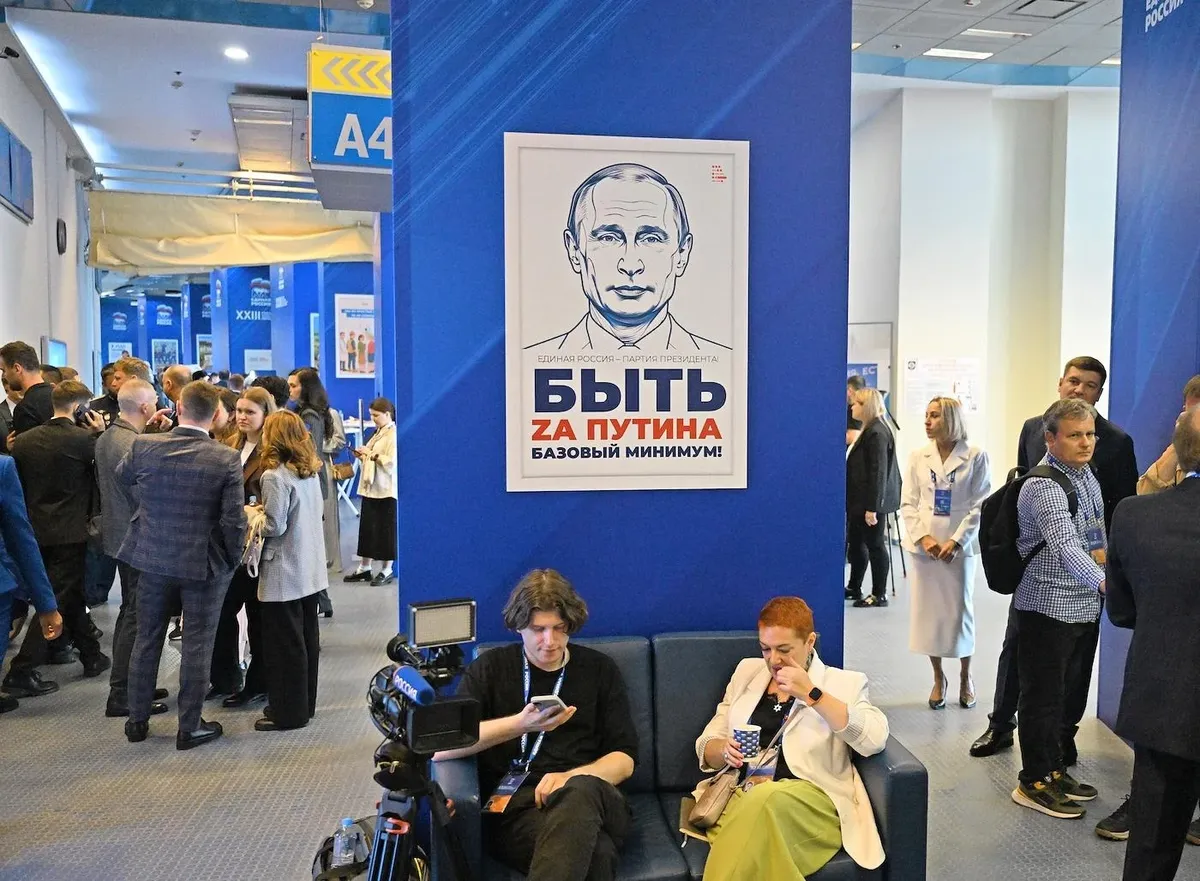
“Being for Putin is the basic minimum.” The party in power decided to play on the “youth” field. I write in quotes because that’s what she did in quotes. Young people are not interested in such PR, and for them to understand you, it is not enough to quote a funny song. But that's not even what I'm talking about.
The party goes to elections, holds a congress, calls itself the party of the president, even if he is not formally a member, but the president goes to the podium, gives a speech - this still fits into some kind of logic. The “basic minimum” does not fit into it. I naively thought that the basic minimum not only of United Russia, but of any party, was caring for citizens and the prosperity of the country. I understand that this sounds so banal that it simply couldn’t be more banal.
But we are talking about the base. More precisely, says the party. And all these platitudes cannot but be included in this base, this necessary minimum or “gentleman’s set” - without them, otherwise what kind of party is it and how does it expect to get votes? But it turns out that the base consists of a single task - to be for a specific person. What’s next, what other tasks are there? This is a free program. Well, thanks for your honesty. Now we know about your minimum.
However, this slogan also applies to us voters, right? This is our basic minimum - to be for (more precisely, for) Putin. Family, children, work, health, some personal plans and achievements - all this is not so important. Be loyal to the leader - the rest is a bonus or extravagance.
It is clear that we rarely read party programs, we ignore slogans and ignore election banners, especially since the promises of all parties and candidates are similar, they all stand for everything good and promise everything that goes without saying. In this way, they even somewhat resemble birthday or New Year greetings, when we have to read and listen to a string of duty stamps. And, in the end, it doesn’t matter what they promise us, it’s what they do. However, United Russia deviated from the template too openly.
I'm walking down the street in Moscow past the Russian Railways headquarters on Krasnye Vorota. There is a banner hanging, huge letters ZA and then - “President! Army! Russia! Apparently, this is also a basic minimum. And the priorities are set eloquently.
It is understandable why in a country at war people are asked to join the army. It is not clear why in this triad the country for which the army is fighting is in third place and not in first. But in first place is the president.
We, of course, have not forgotten the words of Vyacheslav Volodin that “if there is no Putin, there will be no Russia.” But at the time it seemed like the typical toadying of an official who was unsure of his political prospects and decided to express his loyalty beyond the limit. Now they talk about it with banners on the buildings of the largest corporations and in the party program.
There was, of course, a suspicion that citizens were needed for show - in the literal sense. That checkmark that is placed on the ballot in elections. And now they are moving from hints to direct formulations.
Recently, an eerie International Legal Forum took place in St. Petersburg. There has been no internationality in it for a long time, and lawyers are successfully replaced by priests, “social activists” and Nikita Mikhalkov. But some legal scholars also experienced their finest hour - like, for example, Minister of Justice Chuychenko: “We are saying that the mission of the Ministry of Justice consists of a triad, namely: protecting the rights and legitimate interests of citizens, ensuring the rule of law, and thirdly, strengthening statehood. But at the same time, we had approaches that arose from the early 1990s, when our Constitution was written and said that the rights and freedoms of citizens are a priority. I think this is not quite the right approach...
A weak state cannot properly ensure the rights and legitimate interests of citizens.”
They talked about the next rewriting of the Constitution in St. Petersburg more than once, even proposing to convene a Constitutional Assembly in order not just to make amendments, but to rewrite the unchangeable part of the Basic Law. Where, among other things, it talks about human rights and freedoms, and priorities. Now the priorities, at least formally, are such that the person is more important, that this state is for the people, and not vice versa. In a normal country this is exactly how it should be. But country and state are not the same thing. And the state increasingly ceases to like this order in the country. The actual situation has long ago changed. They want to change the formal one too.
The Soviet Constitution contained Article 6 on the leading and guiding role of the CPSU. There is no proposal yet to return such an article to the Russian Constitution, but deputy Oleg Matveychev spoke here the other day: “Russian voters now face a simple choice: who are they with—Putin or Zelensky? If he is with Putin, he votes for United Russia. If with Zelensky, he votes against her. There is no other option." A little later, however, this text was removed, but it had already been quoted hundreds of times, and Matveychev’s word also turned out to be not a sparrow. And it applies the “basic minimum” not only to United Russia, but not to all parties in general. If the communists are closer to you or the LDPR is dearer to you, you therefore support not them, but Zelensky. But he must support Putin - and there is no other option. Is it time to fix not the guiding role of some party in the Constitution, but a specific person? And not make state interests a priority, but the interests of the president? How else can we understand this?
Okay, the deputy may blurt out - after all, they tried to hush up his statements. Can the Minister of Justice blurt out? No one disavowed his words. And the party’s “basic minimum” was not only not disavowed, but is beginning to be replicated in visual campaigning. Well, at least we won’t have unnecessary illusions, if they still exist. But it is strange that the state, informing us about the prioritization, really hopes for reciprocity on our part. Or does it no longer care about our feelings, because it doesn’t doubt our ticks?