
Translated material
France itself
An excerpt from Olga Togoeva’s book “The Heretic Who Became a Saint”
Joan of Arc was not always a folk heroine for the French: her transformation into a symbol of the nation began after the French Revolution and culminated in the works of historians of the 19th century. Read about how Chateaubriand, Thierry, Sismondi, Michelet and their followers created the familiar image of the Virgin of Orleans in an excerpt from Olga Togoeva’s book “The Heretic Who Became a Saint.”
All of us, since February 24, 2022, have found ourselves in the face of advancing barbarism, violence and lies. In this situation, it is extremely important to preserve at least the remnants of culture and support the values of humanism - including for the sake of the future of Russia. Therefore, the editors of Gorky will continue to talk about books, reminding our readers that there is still a place for thought and fiction in the world.
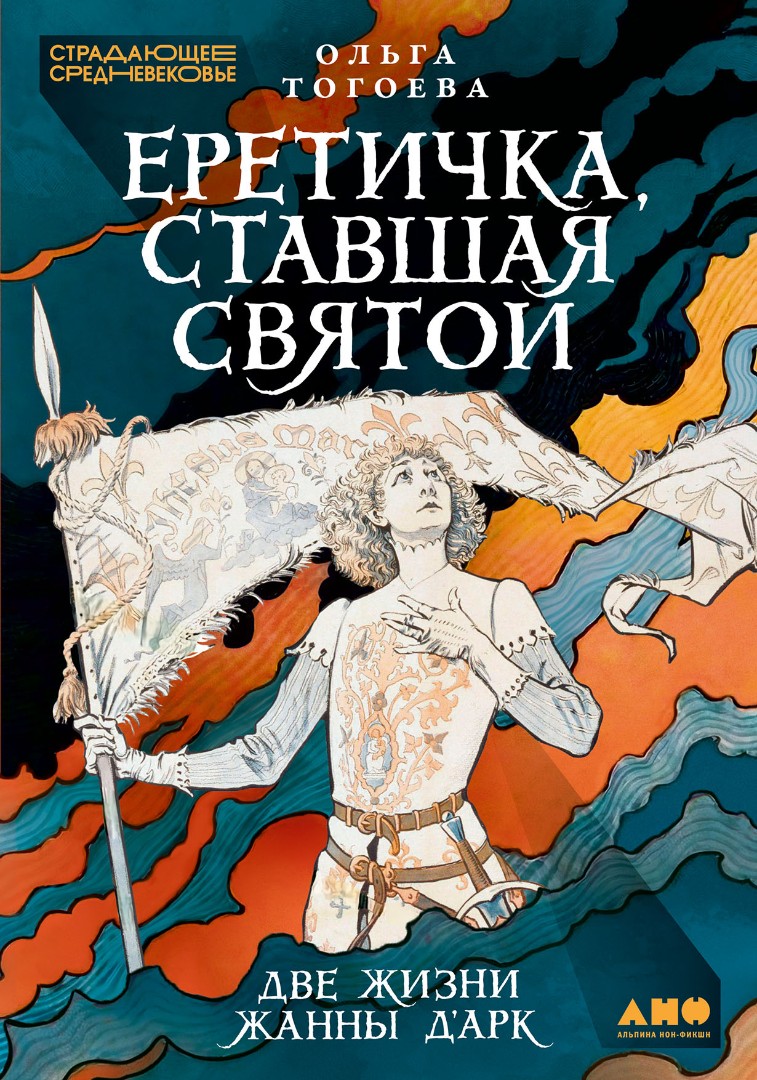
Olga Togoeva. The Heretic Who Became a Saint: The Two Lives of Joan of Arc. M.: Alpina non-fiction, 2026. Contents
The rapid transformation of the Virgin of Orleans from a simple divinely inspired shepherdess into a folk heroine leading the nation was associated primarily with the French Revolution of the late 18th century - the main political event of the era, which left a strong imprint not only on the development of the country, its social and state institutions, but also on historical works, the authors of which tried to comprehend the experience they had experienced. As G. Krümeich noted, it was the revolution that became the turning point when the historiography of Joan of Arc split into liberal and Catholic directions. It seemed quite obvious to representatives of the first direction that it was the upheavals of the revolutionary era that turned the French into a single nation, and the Maid of Orleans into its leader. Thus, in “The History of the French Revolution,” Jules Michelet put into the mouths of the Parisians storming the Bastille the same words that Jeanne allegedly addressed to her soldiers during the capture of Fort Tourelles in Orleans. A similar view of the events of the late 18th century was preserved in liberal French historiography at the beginning of the 20th century. In 1920 (that is, the year of the official canonization of the Virgin), Maurice Barrès wrote: “Joan of Arc is a product of our time. Until the Revolution, this shaking of the foundations [of society], we did not understand who this girl was. We despised her, we dressed her in antique clothes. [In reality] she was the discovery of democracy (une trouvaille de la démocratie), of the people taking the floor. Voltaire was the first to talk about this, and after him the French Revolution.”
Such enthusiastic assessments, however, did not correspond well with the few facts that we know about the perception of the image of Joan of Arc during the years of the Revolution. Indeed, in 1790, in preparation for the celebration of Bastille Day, the municipality of Paris received a request to honor the memory of the “French heroine known as the Maid of Orleans,” whose merits made it possible to call her the “French Judith” (Judith française), but the request was rejected. In 1792, the municipality of Orleans was asked to completely destroy the monument to Joan of Arc and Charles VII, erected on the bridge over the Loire in honor of the lifting of the siege of the city on May 8, 1429, as “offending the sense of freedom of the French people” (qui insulte à la liberté du peuple français). The authorities in Orléans tried to resist this decision, insisting that the monument was not “an insult to the French people” because it represented a “glorious testimony” to the ability of “our ancestors to free themselves from the English yoke.” Nevertheless, the monument was destroyed, and representatives of the municipality were only able to ensure that one of the cannons, for the production of which all the metal was used, bore the name of Joan of Arc. In the same year, the memorial fountain installed at the site of the execution of the French heroine in Rouen was also demanded to be demolished. The city authorities, however, managed to prove that Joan was a child of the third estate, and agreed only to remove the “royalist” inscriptions containing references to Charles VII from the pedestal. Finally, in 1793, the traditional "Feast of the Virgin", which was celebrated every year on May 8 in memory of the lifting of the English siege in 1429, was canceled in Orleans. Only in 1803 were the celebrations restored on the direct orders of Napoleon I, who wrote to the residents of Orleans: “The famous Joan of Arc proved that there is no miracle that the French genius could not perform when the independence of the nation is in danger. Once united, the French nation was never defeated."
Thus, the connection between the Maid of Orleans and her “folk” origins, rather poorly represented in the fragmentary evidence of the revolutionary era, was developed only in the first half of the 19th century. This was primarily due to the emergence of the romantic trend in French historiography, a distinctive feature of which was increased attention to both the stylistic features of historical presentation and the history of the “lower classes” of society and the role of the masses in historical processes.
In France, the beginning of the romantic turn in historical writing was associated with the name of F. R. de Chateaubriand (1768–1848) and his “Genius of Christianity,” published in 1802. Not being a historical work in the strict sense of the word, this work was rather a free account of the most outstanding events of the times of the “old monarchy” and enjoyed great success among the reading public: in less than two months its first edition of four thousand copies was completely sold out. Chateaubriand managed to influence the perception of history not only by Catholics, but also by liberals: in his interpretation of the events of the past, there were practically no hints of the monarchical ideals of the author himself, and frank admiration for the people of “ancient France”, their daily life, the sufferings and victories they experienced came to the fore.
However, Chateaubriand paid little attention directly to Joan of Arc in his works. In “The History of France,” he, trying to once again emphasize the role of Providence in the destinies of people, mentioned that the miraculous appearance of the girl “saved the homeland” from the invaders, and briefly dwelled on the characteristics of the Virgin, which, in his opinion, combined “the naivety of a peasant woman,” “the weakness of a woman,” “the inspiration of a saint,” and “the courage of a heroine.” Jeanne’s “simplicity,” the author noted, did not prevent her from giving “impeccable answers” (des réponses sublimes) to the questions of the judges in Rouen. When she ascended the fire and accepted martyrdom, even her executioners could not hold back their tears.
Despite the fact that the idea of the “folk” origin of the Virgin was borrowed by Chateaubriand from the authors of the Enlightenment, he spoke extremely harshly about Voltaire’s “The Virgin of Orleans,” which he called “the crime of genius” (crime de génie). He was sincerely glad that in his time, that is, in the 1820s, the influence of the works of the outstanding thinker was no longer felt, since “public morality,” which replaced “private interests,” no longer allowed “insults to the motherland.” He then repeated these words in a critical analysis of the “History of the Dukes of Burgundy” by P. de Barante, whose main merit he considered was the rebuff given by the author to the “slanderous insults” (insultes diffamatoires) inflicted on the memory of Jeanne by Voltaire.
Chateaubriand's ideas were picked up during the tightening of the Restoration by the liberal school of historiography. In his “Letters on the History of France,” which began to be published in the late 1820s, A. Thierry formulated the main tasks of the new historical science, which, from his point of view, consisted of studying the “formation of the French nation” and the “communal revolution.” At the same time, following the requirements of romanticism, he believed it was necessary to build a story about the events of the past naively, but impartially, so that it would not feel the monarchical or republican sympathies of the author himself, which could influence the perception of history by future readers. Knowledge of the past would be very useful for them to strengthen the patriotic spirit. However, a real national history (la vraie histoire nationale), according to Thierry, did not exist: it was still nothing more than a collection of chronicles of individual privileged families and needed revision. The main attention should have been paid to the common people, their roots, feelings and thoughts. In other words, history was supposed to tell not about individual outstanding personalities of the past, but about the entire French nation (la nation toute entière). It was from these positions that A. Thierry viewed the actions of Joan of Arc, to whom he dedicated a short passage in the first of his “Letters...”: for him, the girl was the embodiment of “patriotic fanaticism” (fanatisme patriotique) and “national spirit” (l’inspiration populaire) - the only force that was capable of saving the country and Charles VII from the British.
O. Thierry's call to update science and study the history of the “lower classes” was heard by his colleagues. One of them was J.-S.-L. Simond de Sismondi, a professor at the University of Geneva, who in 1821 published the first volumes of his monumental History of the French. The very title of this work indicated a radical paradigm shift. Sismondi’s work was later relied upon by J. Michelet, who believed, however, that the demonstrative “hostility” of the Genevan scientist towards royalty and the Church was a tribute to the traditions of the 18th century.
In fact, as a true republican, Sismondi decisively broke with monarchist historiography: for him, the main engine of history was the people who fought for their freedom. That is why he was especially interested in the personality of Joan of Arc, who with her own hands decided the fate of an entire country. Following Voltaire, Sismondi believed that the girl was the product and embodiment of the “national spirit” (zèle populaire), which inspired her compatriots to the “great revolution” (une grande révolution) - the liberation of France from the invaders. It was he who, for the first time in the 19th century, set out in detail the version about the origin of the heroine from the “lower classes” of society and about the feelings of patriotism and sympathy for the Armagnac party that she inherited from her parents.
This idea was developed in the works of T. Lavallee, whose “History of the French” was published in 1830–1840. Unlike Sismondi, Lavallee not only saw the Maid of Orleans as the embodiment of the national spirit, but believed that it was Jeanne who awakened this spirit. She, in his opinion, stood at the origins of French patriotism: thanks to her exploits, the French united into a nation and rushed to defend the country from an external enemy. “This holy girl (la sainte fille) revealed to the people who they really are, she lit a sacred fire in them, she taught them to suffer, to be devoted, to die for their homeland!.. Her sense of patriotism was the deepest! It was France itself, France incarnate!”
The concept of “people” was used to view the history of Joan of Arc and Jules Michelet, who constantly returned to it throughout his long scientific career. Shortly before his death, in 1869, in the preface to the next re-edition of the “History of France”, the famous historian noted that his main goal was always to prove that the appearance of the Virgin on the historical stage should not be considered miraculous, because it was due to very specific, “natural” circumstances, the main one of which was her origin - the fact that the girl was part and the very essence of the French people. The “genius of the people” (génie du peuple) present in her allowed her to fulfill her own mission. At the same time, Jeanne, as a true heroine of the past, made her contribution to the creation of the nation: by leading the resistance to the invaders, she “forced France to become free and realize itself.”
The image of the Virgin of Orleans as a “virgin and pure embodiment of the people” (sous sa forme virginale et pure) was also developed in the “Picture of France” of 1833, which became the introduction to the second volume of the monumental “History of France”. In this work, Michelet, true to his original thesis about Joan - a folk heroine, compared her with Jesus Christ himself, another embodiment of the popular spirit, and contrasted both with priests, representatives of the official Church. Only the people are capable of comprehending this difference, the historian reasoned; only in his mind there is an ideal, embodied in the figures of Louis the Pious, Godfrey of Bouillon, Thomas Becket, Saint Louis, and in the 15th century - in Joan of the Virgin: “It was she, the one in whom the people died for the people, who became the last figure of Christ (la dernière figure du Christ) in the Middle Ages.”
Since 1834, when Michelet began to create the History of France, Joan of Arc began to interest him primarily as a historical character. Already in the course of lectures given at the Sorbonne in 1834–1835, he presented to listeners the image of a national heroine, which then practically did not change in his writings. He saw in her the embodiment of the French nation, “the first patriotic figure” (la première figure patriotique) of the country, with the help of which the people realized their strength and their rights. The tenth chapter of the “History of France”, work on which began in 1840 and which, starting from 1853, was repeatedly republished as a separate book called “The History of Joan of Arc”, reflected all the author’s main ideas concerning his heroine: her peasant origin and “mentality”, commitment to popular piety, the correspondence of her actions with the secret aspirations of the “lower classes” of society and the contradiction of these actions to the political goals of the elite.
Without a doubt, the works of J. Michelet determined the views of French liberals on the actions of the Virgin for many years to come. The influence of the outstanding historian on his own research was emphasized, in particular, by Jules Quishra, who was connected with Michelet not only by creative interests, but also by a friendship maintained by many years of correspondence. In a review of Gabriel Monod’s biography, Michelet Kishra called his colleague the “founder” of new historiography in France, whose representatives contributed to the “renewal” of all areas of historical knowledge.
For Quichere, just like for Michelet, Joan of Arc was a folk heroine, far from the king and his entourage. This circumstance, from his point of view, determined all the girl’s failures, for those in power did not miss an opportunity to “contradict her, interfere with her, harm her.” It is interesting that the famous Chartist did not try to support his thesis about the contradictions between the Virgin and the royal entourage with more rigorous scientific arguments: it was enough for him to state the elite’s dislike for the girl, whose main goal has always been not only the defense of France - this “holy kingdom”, the “kingdom of Jesus” on earth - from an external enemy, but also the “awakening of the humiliated people.” That is why, wrote Kishra, only the “experience of the Revolution” (expérience de la Révolution) allows us to correctly understand the story of the Virgin - a simple peasant woman who came “from the very bottom”, who, due to the envy and opposition of those in power, gave her life for her country and for the united French nation born through her efforts as a true martyr - a saint who was not recognized by the Middle Ages, but which modernity is obliged to recognize.
Michelet's influence was equally noticeable on the work of another liberal French historian of the first half of the 19th century, Henri Martin. His merit, of course, should be recognized for popularizing the personality of Joan of Arc: his History of France, first published in 1833, was then published until 1855. In 1857, the first separate edition of the chapter dedicated to the Maid of Orleans was published, and in the same year five more reprints appeared. The book was then regularly reprinted from 1864 to 1880, and an illustrated edition was published in 1885.
It was to Martin's work that French readers were obliged to become acquainted with new sources discovered by J. Quichere, and with the positions of liberal historiography regarding the personality of Joan of Arc. Despite the fact that the author’s own views changed somewhat over time - in particular, this affected the problem of the Virgin’s revelations - in the question of the peasant origin of his heroine and in contrasting her with the world of the nobility, he always remained faithful to the ideals of liberalism. For Martin, as for Quiche, the key to understanding the deeds of Joan of Arc was the French Revolution, since, as he noted, “history is written only by a free people.” The “new society” created in France after the events of the late 18th century was ready, according to the author, to perceive the Virgin as the “messiah of the national idea” (le Messie de la nationalité) and the very “soul of France” (l’âme même de la France), and also to understand the purely negative role that Charles VII and his immediate circle played in the fate of the heroine from the people.