
Translated material
Mayakovsky-133
For the birthday of the 13th Apostle
Did Mayakovsky love cars? Probably yes: even though he didn’t know how to drive himself, in 1928 he bought a Renault sedan for personal use, paying a considerable amount for it by Soviet standards. But we know for sure that the poet loved the number 13 and even called himself the thirteenth apostle. Partly sharing the belief in the magic of numbers, on the occasion of the 133rd anniversary of the birth of Vladimir Vladimirovich, Gorky publishes a short essay by avant-garde researcher Andrei Rossomakhin, compiler of the upcoming book “Mayakovsky and Finance.” In this essay, the connection between the poet and the car is traced at the level of one cartoon, the attribution of which requires the help of our readers.
All of us, since February 24, 2022, have found ourselves in the face of advancing barbarism, violence and lies. In this situation, it is extremely important to preserve at least the remnants of culture and support the values of humanism - including for the sake of the future of Russia. Therefore, the editors of Gorky will continue to talk about books, reminding our readers that there is still a place for thought and fiction in the world.
July 19 marked the 133rd anniversary of the birth of Vladimir Mayakovsky.
This completely non-round date deserves anniversary status - if only on the grounds that the poet himself has repeatedly, explicitly and implicitly, demonstrated special attention to the number 13. It is impossible to overestimate the fact that the version of the title of his first and main poem “Cloud in Pants”, which instantly reformatted the very concept of lyrics, was the title “The Thirteenth Apostle” - this self-attestation was also present in the text of the poem, let us recall it textbook lines:
“I, who glorify the machine and England,
maybe just
in the most ordinary Gospel
thirteenth apostle..."
And it is all the more no coincidence that Mayakovsky entitled his early collected works in two volumes nothing less than “13 years of work” (M.: VKHUTEMAS, 1922) - and for the sake of the “thirteen-digit number” he needed, he mystified the public by shifting the start of his literary activity from 1912 to 1909.
In this year of the poet’s “thirteenth anniversary,” a group of researchers from the Institute of Literature of the Russian Academy of Sciences, preparing the 20-volume “Complete Works” of Mayakovsky, completed work on the collective monograph “Mayakovsky and Finance: How did the poet earn and spend money? (Economics of poetry vs poetry of economics)" . The book has been put into production and, hopefully, will be published before the end of this year. The life and work of the most important actor of the 1910–1920s, Vladimir Mayakovsky, will be examined for the first time through the prism of the economic realities of his literary work and life. Based on a variety of archival materials, Mayakovsky will be shown as a highly effective participant in the book market, journalist, lecturer, theater and film figure, and creator of Soviet advertising. Taking into account not only poetry, journalism, correspondence, newspaper polemics, but also financial, judicial and tax documents, the book will reveal the unexpected Mayakovsky - an author whose creative energy was inextricably linked with the economy of the new era.
As a small preview of this collective work, we are publishing a forgotten cartoon from early 1929. To date, the place of publication of this cartoon has not yet been attributed - a clipping from a certain magazine is pasted into the album of Alexei Kruchenykh, stored in the Russian State Archive of Literature. It is possible that this is a clipping from the Journalist magazine, a set of which remains unavailable for viewing. We would be grateful to our readers for possible attribution of the source of the cartoon (messages can be sent here ).
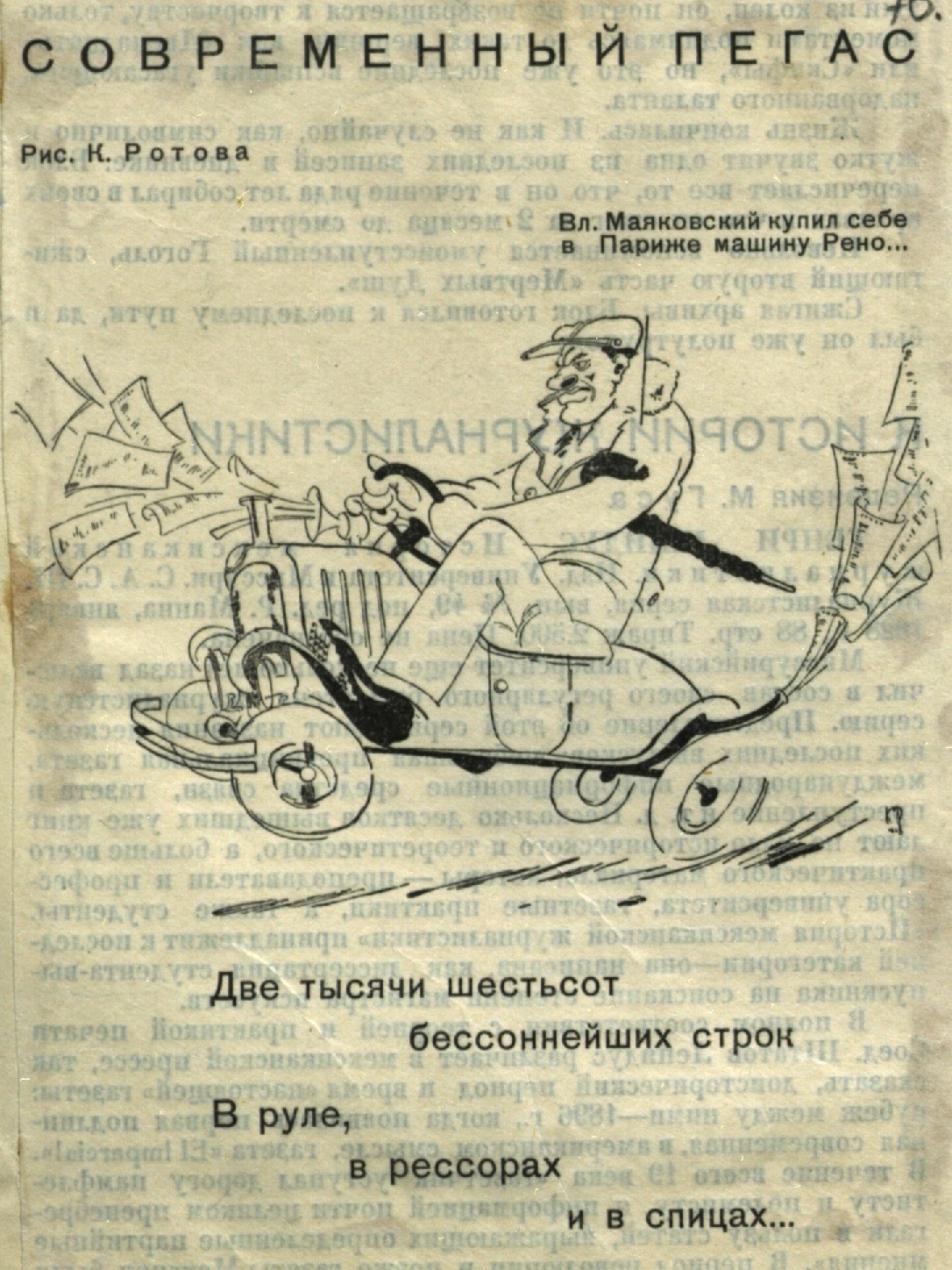
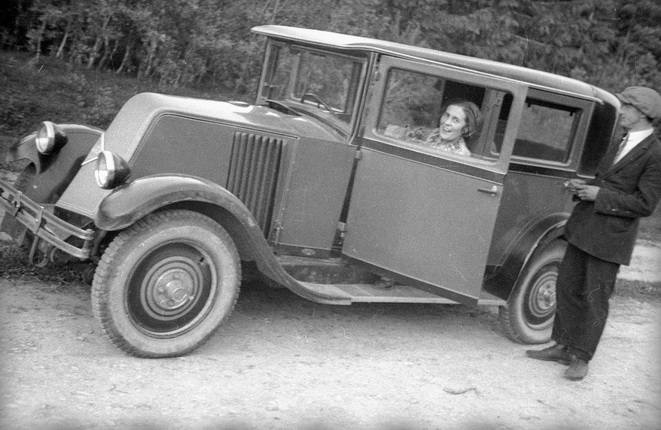
The plot for the cartoonist is sensational news included in the epigraph to the picture: “Vl. Mayakovsky bought himself a Renault car in Paris.” The purchase took place in November 1928 - the poet, at the repeated requests of Lily Brik, purchased a Renault NN2 (GCV) car. It was a four-seater sedan, light gray in color, with a black roof and fenders. This most inexpensive model from Renault cost 20 thousand francs, which in terms of the exchange rate of that time amounted to about 1,600 rubles. Mayakovsky himself informed readers about this incredible purchase for any Soviet citizen in a poem with the characteristic title “Answer to Future Gossip,” published in the January issue of the magazine “Behind the Wheel” (1929. No. 1).
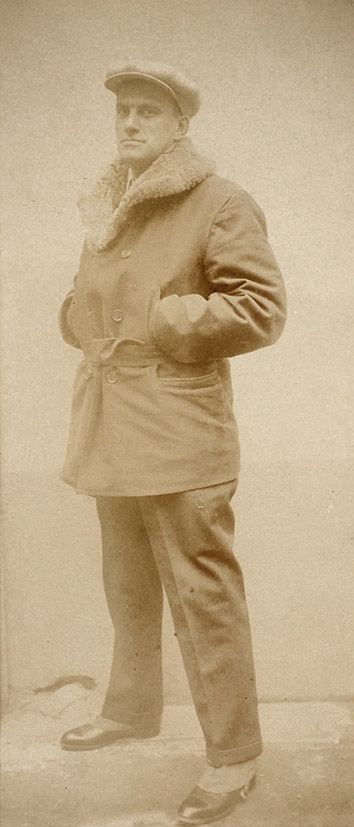
In the title of the caricature, the artist ironically contaminates the winged horse Pegasus from ancient Greek mythology (an attribute of poetic creativity) and a passenger car. The huge Mayakovsky is depicted saddled and spurring a small car like a horse. Poems fly out of the horn and the exhaust pipe, that is, poetry is literally the fuel of the car. It is noteworthy that the caricature portrait accurately depicts Mayakovsky’s American winter jacket with a fur collar (purchased in the USA in 1925) and his recognizable cap - perhaps the artist Konstantin Rotov was guided by personal impressions or a photograph of the poet of the same year, taken in the studio of P. I. Shumov. Moreover, the car itself is depicted in a very authentic way: vertical air intakes, wings over the wheels and headlights correspond specifically to this particular model.
Below the caricature is a quote from the poem, which the caricaturist tried to literally visualize:
"I rhyme
mowed down
almost a haystack,
right on time
the accountant will go astray.
Two thousand six hundred
sleepless lines
in the steering wheel,
in the springs
and in the knitting needles..."
Dividing the cost of the car (1,600 rubles) by 2,600 “sleepless” lines, we get Mayakovsky’s average fee per line: 61 kopecks. However, apparently, to the cost of the car you need to add the cost of numerous car accessories ordered by Lilya, the cost of spare parts and transportation of the car from Paris. Mayakovsky probably meant an average fee of 50 kopecks per line. For example, this is exactly the fee indicated in his contract with the Zakkniga publishing house for the publication of the program poem “Conversation with the Financial Inspector about Poetry” (“Gorky” has already written about it ).
The volume of 2600 poetic lines is quite large - for example, it is one and a half times more than Mayakovsky’s famous poem “About This” of 1923 (however, without breaking the lines into “ladders”, which the poet began to use precisely from this poem, the volume of 2600 lines would be equivalent to approximately three such poems).
To the Soviet public, who hardly had information about the cost of a French car, Mayakovsky’s purchase of a Renault (!) in Paris (!) undoubtedly seemed like yet another evidence of his sky-high income. But in fact, the amount of 1,600 rubles was very significant - it approximately corresponded to the annual salary of a Soviet engineer, but for an ordinary Soviet worker, Mayakovsky’s constant self-certification as a “proletarian poet” could lead to cognitive dissonance due to the huge gap in their income.
It is worth adding that “Behind the wheel,” the bi-weekly magazine of the all-Russian society “Avtodor,” four months earlier published another poem by Mayakovsky, “One’s story about one dream” (Behind the wheel. 1928. No. 6. September. pp. 22–23), advertising tickets for the first Avtodor lottery and anticipating the future purchase of a car:
"To me
with horses
it's hard to compete.
Animal
(which has four legs)!
However, I'm cunning
bought bonds:
will -
I am waiting -
Avtodorov lottery.
Many refuse
They say:
"These lotteries
set the teeth on edge."
And I bought
and I'm very glad
and started daydreaming
about the car..."
A lottery ticket cost 50 kopecks; the main prize was a car with a two-year fuel supply.
It remains to add that Konstantin Rotov (1902–1959) is a brilliant cartoonist and illustrator who collaborated with a variety of magazines and newspapers, but his main platform was Krokodil. In 1925, 1928 and 1929, the artist illustrated three poems by Mayakovsky: “Yalta - Novorossiysk” (in the magazine “Prozhektor”), “Uncle Emespeo” (in “Komsomolskaya Pravda”) and “Itogi” (in the magazine “Sobriety and Culture”).