
Translated material
Petka in Goa
Ivan Shcheglov - about the “beach series” of the publishing house “Amphora”
Our travels through the most bizarre corners of world and domestic literature continue: this time Ivan Shcheglov, exploring the bins of the Amphora publishing house, got acquainted with its “beach series” - novels published in the 2000s about the life of popular resorts, and primarily Ibiza. Read about what thoughts these strange and long-forgotten works can inspire today.
All of us, since February 24, 2022, have found ourselves in the face of advancing barbarism, violence and lies. In this situation, it is extremely important to preserve at least the remnants of culture and support the values of humanism - including for the sake of the future of Russia. Therefore, the editors of Gorky will continue to talk about books, reminding our readers that there is still a place for thought and fiction in the world.
Since the publishing house “Amphora” came to my attention (three of my articles reviewing the “Generation Y” series were published on “Gorky”), I haven’t forgotten about it, but I haven’t made any special dives either. So, a book or two will slip through : something about music, for example, the unique “Psychattack” by Ermichev about the Leningrad psychobilly scene or DJ Elephant’s book “Revolution” about the first DJs of St. Petersburg, then some stupid youth prose of those times translated by Vladimir Kozlov (“Soon Thirty” by Michael Gale), then something countercultural on a tip rapper Kaspersky, called “Morvern Callar”, was in conjunction with a pleasant film of the same name. I even got to “Sinners” by Ilya Stogov, and it seemed to me that this was the best thing he had written (and my separate article was devoted to his review). Often these books were found somehow by accident, and I did not even know about their existence until I came across them. Such non-obviousness of the back catalog is one of the advantages of Amphora, but there are others. For example, prices: many of their books are sold on marketplaces for 200–300 rubles; against the background of frenzied modern figures, such modesty seems charming. Sometimes books came across in person on the shelves of second-hand booksellers, primarily in my favorite shop “Arbat, 20”, where they were even cheaper. Actually, several finds made there caused a new wave of interest in the “Amphora”. It all started with the book “Room of Flower Pollen” by Zoe Jenny, whose design reminded me of the works of wonderful artists - “Littles 18:22”. Then it turned out that Zoe Jenny had another book with this kind of design, “The Call of the Sea Shell.” After two, I already wanted to continue and for some reason delve into old youth literature. There was a stream of unknown art. Books of modest size were read in a day. Another advantage of the Amphora publishing house was their interest in European literature - they came across many British authors, but not only. I chose some books by description, others by design. I liked the pop art design of the book and bought it for 200 rubles. It turned out that it was a science book about the epidemic of excess weight in humanity; strongly reminiscent of the modern line of books published by individuum (The Hungry Gene by Ellen Rupper Schell, 2004). One of the books (“The Twelve” by Nick McDonell, 2006) was even adapted into a Hollywood film starring rapper 50 Cent. And then the “beach series” caught my eye.

A characteristic element of the “beach series” were covers of a photographic type; they depicted women and men in swimwear, mainly with erotic overtones. They looked so vulgar that it was even awkward to read these books on the subway. Young adult fiction about beach parties, resorts, warm days... It reminded me of the MTV channel I watched as a teenager. He conveyed a certain image of heavenly life, contained in eternal youth, a flow of music, parties and pleasures, including an easy change of sexual partners and abuse, when all this remains a simple game, devoid of drama. I can’t say that this image resonated with my ideas about life even at that time. In any case, in music I was interested in the musical component, if I went to some clubs, then only to concerts to listen to music, and even then a little later... Youth as youth: the inability to take responsibility in relationships, let’s say, I coincided with this image; Of the excesses, the only thing that aroused my enthusiasm was alcohol. Dancing, parties, and entertainment were somehow not interesting. In general, even then it all seemed somehow superficial and outlandish, of little use in life, but the idea of such a “paradise” remained in the subcortex: for some it existed in such a form as a social phenomenon or a collective dream. “The Beach Series” seemed to encourage him to look at him with fresh eyes. For some reason, the idea seemed attractive, that is, not the original one, but its detached interpretation.
But first we had to figure out what it was all about in this series. The first book was “Resort” by Kevin Sampson (2005), really dedicated to a resort holiday, but in some unpopular place, deliberately chosen by the characters instead of mainstream ones. The novel records the simple romantic experiences of a number of characters, everyday realism without much depth and with moderate piquancy. The book was not particularly impressive, but it turned out that the author of “Resort” became more famous for the book Awaydays (not translated), on which the film “Bygone Days / Football Gladiators” (Pat Holden, 2009), known to domestic audiences, was filmed. I watched this with pleasure; the stylish drama with a successful soundtrack has stood the test of time. The second book in the “beach series” was “Vodka + Martini” (2007) by Paul Raisin. It was mainly devoted to a person’s attempts to engage in mischief, as well as the work sphere - the hero here is a television worker. The book was built a little stronger, but here, as happens with Amphora, something had already gone awry: the text had nothing to do with resorts and beaches. I will talk about this feature in detail below, and now I’ll move on to the central issue of the series, three books by Colin Butts with the word “Ibiza” in the title (which in fact was not there, more on that below). I came across Butts’s books more than once on the shelves of the second-hand bookstore “Arbat, 20”, but then the thought that there might be a reason to pick them up and open them did not occur to me...
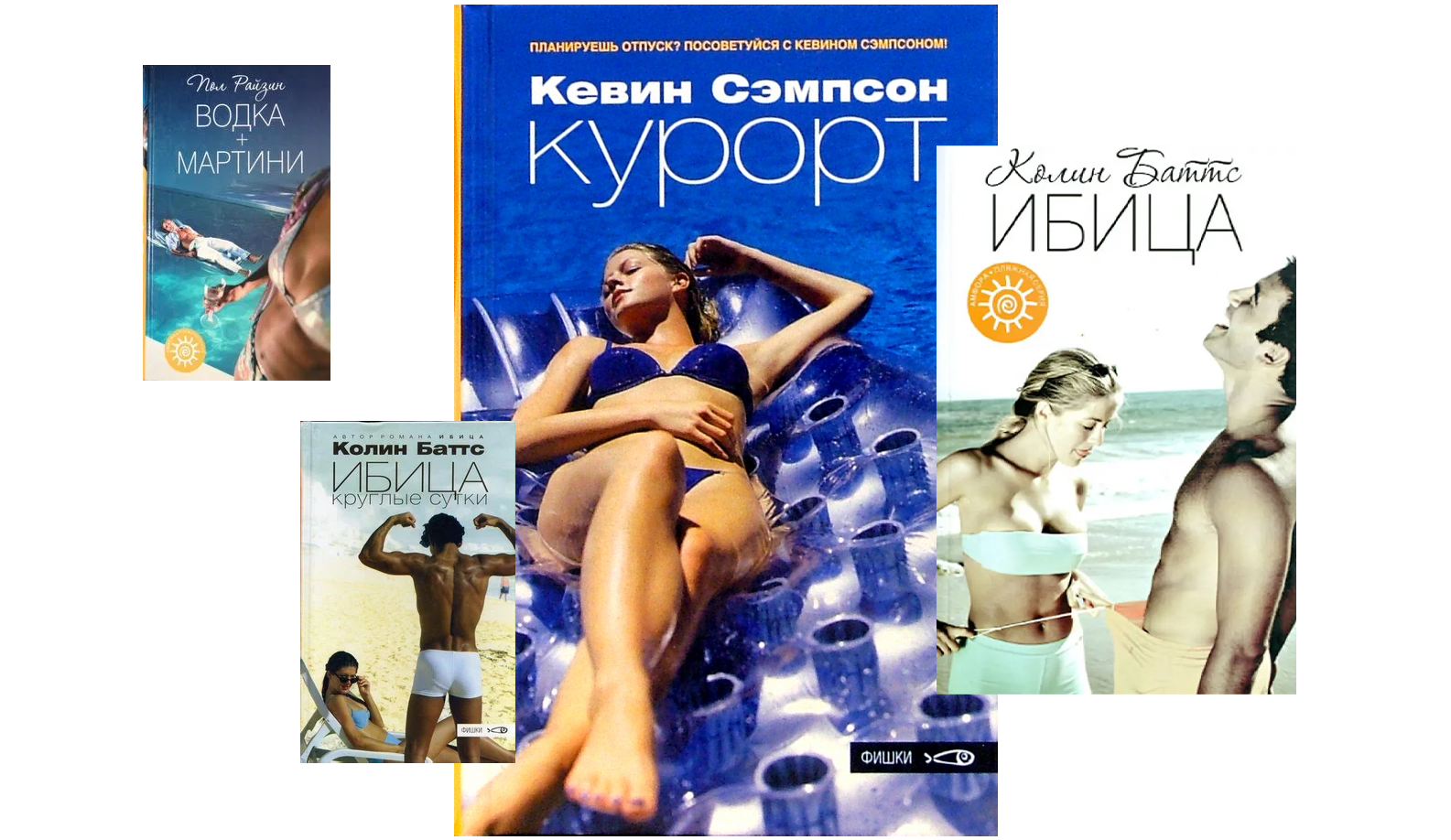
Suddenly Butts found himself close to John King (Football Factory etc.) and early Irvine Welsh. His debut novel “Ibiza” (2004, orig. 1997) incorporated extensive life experience in the tourism sector in Ibiza. The book has the features of an industrial drama - the entire work process of a guide is carefully recorded in everyday life, various force majeure situations are presented, typical patterns of behavior of guides and clients taking into account psychological motivation, different levels of management are touched upon, what is happening is given with the background of the company and its employees and reflections on the future, that is, in long-term dynamics. The book itself is quite voluminous and is structured like a series, with colorful characters and cheerful dynamics; genre - cynical realism. The central themes of the plot are sex competition between guides and financial fraud within the company. As part of the first theme, Butts notices what mental deformations this all leads to, but then the heroes easily escape from the whirlpool with the power of love, which looks naive. The book contains tough scenes and wild flights of imagination of the author, but in the end the book begins to fall apart due to pianos in the bushes and a strange happy ending. This spoiled the impression, but not critically: Butts carefully processed too much real-life material. The second part, “Ibiza is a Verb” (2004, orig. 2003), came out more strained; Butts got carried away with constructing comic situations, but the dynamics and style were preserved. His third book, “Ibiza around the clock” (2006, orig. 2004), is not connected with the previous ones in anything except the location. More sluggish, with a boring action-packed element and already predictable authorial moves, with mostly cardboard characters - it seems that Butts had nothing left to tell us, and he didn’t say anything else: the years of his life are 1959-2018. The first book was filmed twice in the early 2000s, first as a TV movie and then as a TV series. The movie (“Is Harry on board?”, Menhai Hada, 2001) was found in a comical VHS transfer. This is a teen comedy: all the elements of industrial drama and Butts' anthropological research are thrown into the trash, leaving only humor and racy themes. The series is not available in Russian. In addition, Butts worked a little as a screenwriter - his greatest achievement was the film “The White Island” (Benjamin Turner, 2015), for which he adapted his third novel. On the screen, this plot looked more convincing: the film, shot with a sufficient budget, looks like a normal English crime comedy.
Interestingly, the island's electronic dance music scene is not particularly represented in Butts' work. Several of his heroes work as DJs and play in bars, but the main rave remains behind the scenes, tourism is separated from it, and a large plot of the second book is devoted to this separation. But Ibiza is famous as a hotbed of electronic music and interested me in this context. Not too long ago I read Hacienda by Peter Hook, formerly of Joy Division. This is the story of a leading Manchester club that existed from 1982 to 1997 (and a little of the Factory Records label; the film “24-Hour Party People”, 2002, directed by Michael Winterbottom, is dedicated to the same realities). One of the themes of the book is the change in the musical agenda in connection with the discovery of Ibiza and its new dance genres by the British. The music taken from the island captured the Hacienda; according to Hook, it was on the cutting edge of time. I hadn't thought much about it before, and it was hard for me to imagine a time when electronic dance music sounded like something fresh. At the beginning of the 2000s, when my experience as a music lover began, all these genres were already perceived as something musty; depressing electronic crafts of the chanson-self-playing level were heard on radio and TV, but only with thump-thump-thump... As the years went by, I deepened my knowledge of the history of music and realized that once such a sound was new, but only recently I thought about this moment thoughtfully, listened to all sorts of DJ things with a fresh ear. This coincided with an interest in audio cassettes - a lot of this was released on them, and you can still get them for next to nothing (spoiler: the music remains mostly bad). Hook also mentions a visit to Ibiza, the Manchester people's romance with it; In the context of Ibiza, the singer Nico also appears with her death, Hook was almost the last person to see her - she fell from her bicycle and died from her injury.
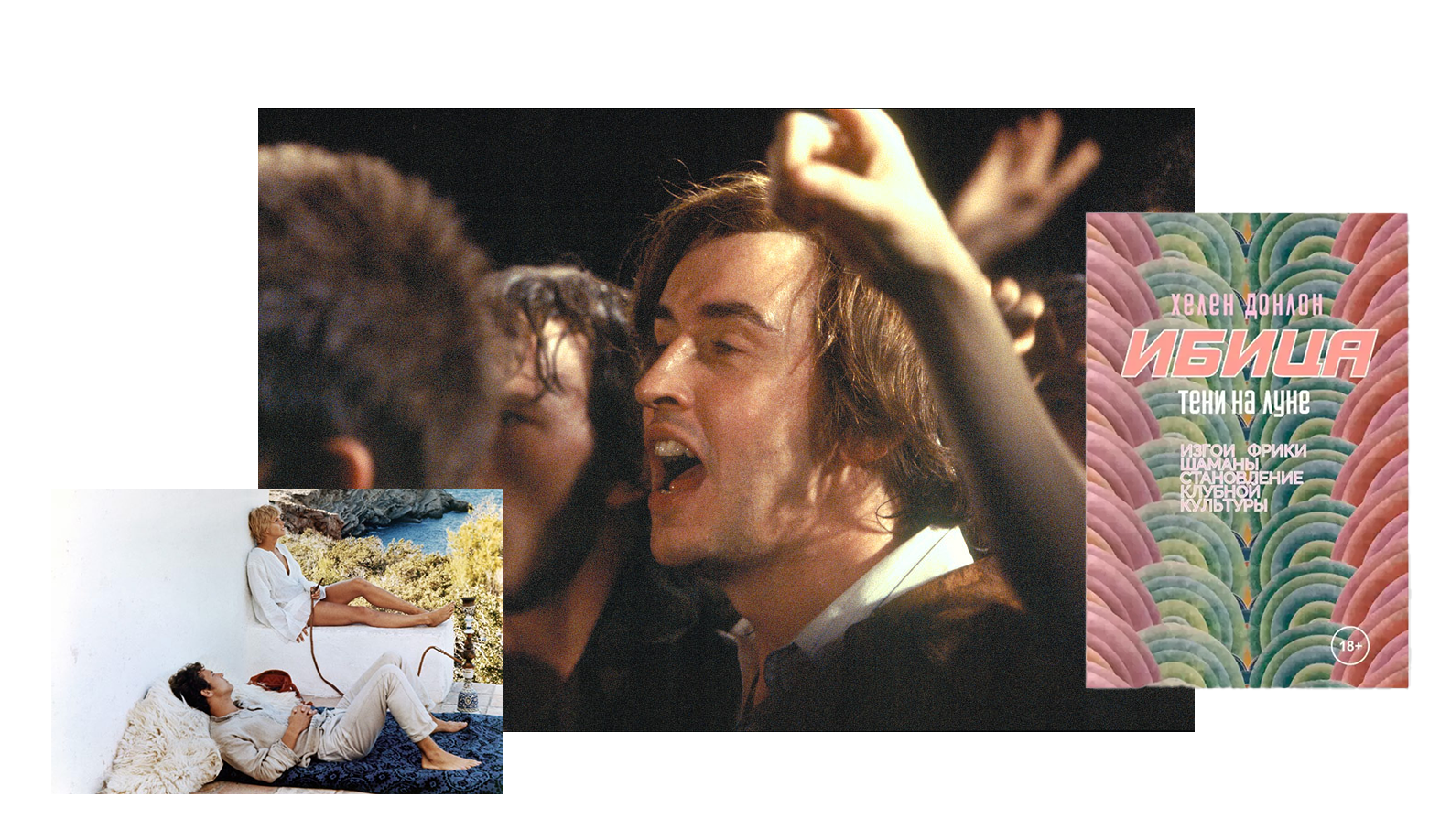
The book “Ibiza” began with Niko. Shadows on the moon. Outcasts, Freaks, Shamans and the Making of Club Culture by Helen Donlon (2022, orig. 2016), which I read after Butts' trilogy. This is not “Amphora”, like “Hacienda”, it was published by the Yekaterinburg publishing house “Cabinet Scientist”. The book deals with a huge amount of information, but in a confusing way, jumping strangely between time periods. There are a lot of valuable leads, but you have to restructure the information inside your own head. First of all, Donlon embeds Ibiza in a broad context of various topics, immediately playing the trump cards and noting that the word party is consonant with pirate - there was a time in history when Ibiza (like Goa) was a refuge for pirates. A brief historical and anthropological excursion begins with the abyss of times, reaching the 20th century, when Ibiza was visited by beatniks (although in their context Tangier is better known) and hippies, and before them the author mentions that the Dadaist Raoul Hausman lived on the island. And indeed! It had slipped my mind that his autobiographical novel Hyle (which Donlon is silent about) takes place in Ibiza. It was recently published by the Gilea publishing house, in 2023, and was written in 1949–1958. Thus, it is Hyle, within the framework of my review, that opens the Ibizan text. One of Donlon’s heroes notes that within Spain, Ibiza remained an island of freedom where one could hide from the dictatorship of Franco (d. 1975). Two films mentioned in the book turned out to be valuable documents from the pre-club and even pre-Hippo period. Hallucination Generation (1966, Edward Mann) is still a black-and-white film with classic theatricality, a picture of the drugsploitation genre. It has not been translated into Russian, but here everything is clear even without translation. The most striking impression of the film are the hallucination scenes. There are cinematic sketches of Ibiza, city and beach. The second film deals with a similar theme, but it is harsher because the central substance is harsher. Shot just three years later, More (1969, Barbette Schroeder) looks like a film from a different era - well, the film language has changed. In terms of visuals, it is closer to Italian giallo and dramas, in which the main actress of “More” Mimsy Farmer actively starred. The island is shown well; in many ways it remains a setting for what is happening, but in some aspects its features are the engine of the plot.
The beginnings of musical culture come from the older generation, gradually the scene began to take shape, and the plot described in Hook’s book is the emergence of the “acid house” genre, brought to England from Ibiza, in general, an already established legend, “The Second Summer of Love,” 1988. Neighboring styles also have such legends: Chicago house, Detroit techno, goa trance, musically for me they continue to merge into one heap, but formally the differences were spelled out... The information given in the book is inconsistent and incomplete, but enough to generally clarify the picture and satisfy my curiosity. The next stage in the development of music is described from a different angle, this is the history of Ibizan clubs and party lines. Here you can learn about the development of some successful projects, the passage of time and the improvement of infrastructure. The story was told in a similar way in a book about the Berlin scene (“Lost in Sound: Berlin, Techno and EasyJet” by Tobias Rapp, orig. 2009), which I recently read. It seems that journalists have developed their own lens to describe each period of music. It turns out that in this sense Ibiza no longer had any fundamental features; these chapters are similar to a description of the development of the club scene in any capital or large city, the differences are localized within this framework. If this is so, it turns out that over decades of active tourism, the free spirit with a touch of savagery could easily fade away, and everything turned into an ordinary European place. Who knows? I don’t intend to test it live, I didn’t experience anything alluring and intriguing while reading, or rather, I have enough of it in everyday life, I don’t need to go anywhere... The last time period is described through complaints about the bourgeois degeneration of clubs and the emergence of a vertical structure of consumption instead of a horizontal one (a la before everyone was together, but now there are solid VIP zones of different stages), and the book ends with problems of noise and discussions about rest from rest and silence (which is good coincided with my mood).

Interestingly, Butts is not mentioned at all in the book; there is Kevin Sampson (the first author of the “beach series” I read) - it turned out that he subsequently lived in Ibiza and devoted moments of inspiration to it. Helen Walsh appeared next to him (as his “partner” and fellow countryman) - her novel “Inferiority” is recommended here as a book from the acid house era; Kervi once released it here. We are returning to the “beach series”. The next book from it was “Indiscreet Bet” (2006) by Jamie Holland. It turned out to be painfully boring prose at the level of fan fiction, with repetitions and lengthiness, again about people’s romantic relationships and without a resort theme. After such a book, Stanley Morgan's works became more vibrant, although in themselves they are trinkets. These were “Advertising Star” (2006) and “Ole, Mallorca!” (2004). Surprisingly, both texts were written in the early 1970s, which gives the series a historical perspective. Film actor Stanley Morgan wrote a whole series of about 20 books about the adventures of the erotic mutant Russ Tobin, of which Amphora published three (although it’s easy to think that there were five: the two mentioned were published later under changed titles and in another series). As the writer Stuart Home, who reworks pulp literature with postmodernism, admitted: “When I write a book, I write out all the sex scenes first and then insert them every few pages, so that 20% of the work is done right away.” Stanley Morgan's books look like they were made according to a similar pattern, the plot falls apart, but the outdated language and superficial psychology of the characters differ from similar products written later (not in the sense that later the psychology became deeper, but its superficiality changed). The description of Mallorca was surprising in that a number of cliches about working as a guide here coincide with those described by Butts. The hero here meets arrivals at the airport, sells them excursions, and shifts occur once every two weeks as 20+ years later.
This is where my love affair with the “beach series” ended, although it was not exhausted. However, it’s time to document the peculiarities of the “Amphora” approach, its familiar style; with the “Generation Y” series, things were similar. On the one hand, recognizable “beach” covers (the same ones that make books awkward to read on the subway) do not determine whether a book belongs to a series. I chose them as a determining factor, but in fact, technically, some of the books mentioned were not part of the “beach series”. The series has a logo - a sun, in some cases there is a fish inside the sun, because inside “Amphora” there was an imprint Redfish, which was responsible for these books. Other similar ones were published in the “Chips” series, and some books were published several times both in the beach series and in the “Chips”. Помимо книг с пляжными обложками, половину «пляжной серии» занимают книги, визуально не имеющие ничего общего с этими, — вплоть до «Дневника Бриджит Джонс». Видимо, издатели не могли определиться и представляли серию то как «романы про курорты», то как «ненапряжное чтение для отпуска». Но и если книга выглядела как «роман про курорты», обложка могла оказаться обманкой. Мой обзор не захватывает все издания с фотообложками, как минимум две такие книги кажутся романами про курорты: «Пляжный ресторанчик» (2006) Криса Манби и «Ураган» (2007) Пола Кворрингтона. Несколько других книг «Амфоры» кажутся вполне подходящими, например «Семь солнечных дней» и «Солнечный удар» того же Криса Манби (они вышли в серии «романтическая комедия»). Я не ставил себе задачей сделать полный обзор, и мой энтузиазм был исчерпан.
Дополню о фильмах про Ибицу. После упомянутых я сначала нехитрым поиском нашел пару документалок и что-то более современное: х/ф «Ибица» (Алекс Ричанбах, 2018) — незатейливую картину о том, как женщина учится говорить «нет». Ибицы в ней не так много, из местных персонажей есть водитель-растяпа, его дочь тусовщица, музыкальная тусовка богатеньких да успешный диджей. Следующей стала немецкая «Вечеринка на Ибице» (Гернот Ролль, 2004), удачный материал для статьи — с одной стороны, она буквально дублировала некоторые элементы Баттса, а с другой, являясь молодежной комедией, олицетворяла тот самый MTV-шный дух, позволяя взглянуть на него после всех размышлений. Во время просмотра сложно было отделаться от легкого обаяния пикантной беззаботности. При дальнейшем осмыслении увиденного на первый план выходила инфантильность. Вывод оказался самым банальным… Идея вечной молодости легко разбивается о быт, потому что с возрастом человек сначала растет, а потом стареет. Тогда он сталкивается с выбором: преодолеть инфантильность или остаться с ней — тогда окружающая действительность начинает все больше расходиться с поведением человека. Кому-то удается продержаться долго (в самых редких случаях — почти до конца), но обычно происходит маргинализация великовозрастного подростка, постепенно усиливающая вынужденную аскезу — физическую или эмоциональную… Как раз об этом оказался следующий фильм про Ибицу — про оглохшего диджея — «Глухой пролет» (Майкл Даус, 2004). История о том, как главный герой достигает дна, выглядит вполне реалистично, а вот то, как он отталкивается от дна и выплывает, отдает сказочкой. Эта картина стала наиболее классической и признанной из всех упомянутых тут. Под конец я нашел длинныйсписок фильмов про Ибицу, он показался толковым и ценным, но мой интерес и тут уже был исчерпан. В вишлисте оставалась буквально пара позиций…
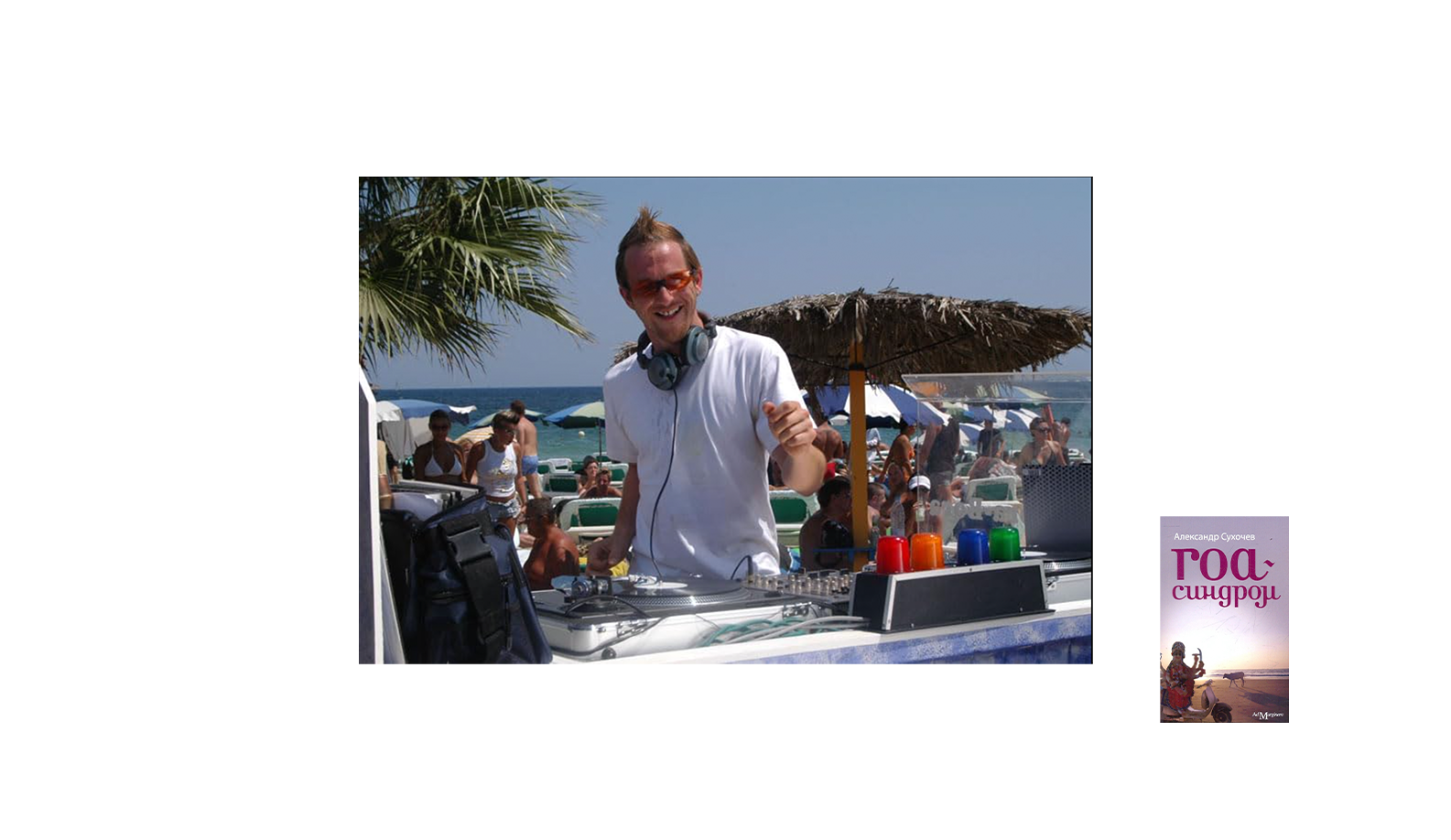
Когда-то я писал обзор , получивший название «Фикшн-десятилетие Ad Marginem», об издании ими современной отечественной прозы в нулевые годы, к которой позже издательство потеряло интерес. Отдельные книги из их набора я тогда не решился прочитать, например «Гоа-синдром» (2007) Александра Сухочева. Пришло ее время — благо на книги «Амфоры» она оказалась похожа не только темой, но и ценой в 200 руб. С одной стороны, это остросюжетная литература с темой наркоторговли, с утяжеленным стилем и лишними деталями, с другой — книга вбирает авторский опыт жизни в этой части Индии и его осмысление. У главного героя метафорический Гоа-синдром проявился примерно как в «Петьке на даче» Леонида Андреева, только Петька здесь великовозрастный, а вместо дачи — Гоа. На задней обложке книги расположен комментарий режиссера Буслова о том, что и он испытал на себе Гоа-синдром и надеется воплотить его в своих работах. Я припомнил историю из книги продюсера Сельянова, главы кинокомпании СТВ, о том, как он поддержал режиссера Буслова в его начинании снять фильм про Гоа, мол, эта работа была особо важна для Буслова. So what? Результат заставил себя ждать, но был явлен миру в 2015 году в виде х/ф с названием «Родина». Им-то я и решил «шлифануть» курортную тему. Поначалу фильм, наполненный примелькавшимися отечественными актерами, позволяющими себе некоторые странности игры, выглядел как капустник на курорте. Но постепенно панорама расширялась (фильм позиционировался как «притча»), возникала то какая-то тарковщина, то легкая мрачняша (в рецензиях зрители жаловались на чернуху, для меня это вредный штамп в мышлении кинозрителей, мешающий работе киноискусства), то индийская мудрость, ну и тема веществ сохранялась и тут. Такой разухабистый коктейль показался мне весьма ловким, а в конце фильм и вовсе покорил меня обезоруживающей и наивной банальностью главных идей, что-то в духе «цените своих близких», «не все покупается за деньги», «берегите детей» (включая нерожденных). Думаю, даже из этих кратких описаний видно, в чем различие между отечественным и западным подходом к схожей теме, так что не буду формулировать это сам. Вдогонку отмечу, что в отечественном контексте тема еще освещалась: например, книгу «travel-агнец» (2001) Анастасии Гостевой я обозревал в статье про «Поколение Y», или вот на маркетплейсах в рекомендациях высветилась некая работа «Бом Булинат. Индийские дневники» авторства Ващенко А. Ю., там даже термин «Гоа-синдром» есть в описании. Ну и на деле все это оказывается ближе к хиппи-литературе типа мемуаров Ринго Зеленоградского или «Господина ветра» Дмитрия Григорьева (вновь «Поколение Y»), таких книг есть множество. А один из интернет-комментаторов «Вечеринки на Ибице» закономерно подметил: «Выглядит как Геленджик».
На этом мое путешествие подошло к концу. Обильное чтение литературы сомнительного качества меня притомило, с музыкальной темой я разобрался, интрига неизведанного исчерпалась, какие-то выводы я сделал. Основной темой Ибицы, очевидно, является свобода. В 2026 году этот флер свободы очень ощутим: сейчас такие книги издаются со всякими предупреждениями, изъятиями черным маркером, а то и не издаются, чтобы не рисковать. Но это локальные особенности момента, хочется смотреть шире. В середине века Ибица оказывалась временной автономной зоной, но эти времена прошли (кстати, в «Поколении Y» похожим образом описывался советский Таджикистан, см. книгу «Тропой Священного Козерога» Джа Гузмана). К моменту, описанному Баттсом, выходило, что Ибица — это пространство, где люди выпадают из привычного ритма жизни и охотнее нарушают табу. Социологически эти модели поведения понятны и описаны даже в исторической перспективе в рамках антропологии. Такое проявление свободы двояко: с одной стороны, оно позволяет взглянуть на рутинную жизнь со стороны и как-то ее исправить, с другой — тут легко просачивается деструктивный элемент. Если немного абстрагироваться от конкретных мест, то мы получим просто тему туризма и отпусков. Постепенно туристический поток Ибицы увеличивался, дойдя до нескольких миллионов в год; элемент «свободы от цивилизации» постепенно усыхал. Если же понимать свободу как свободу от греха (а это понимание кажется мне чрезвычайно важным, хотя со стороны, наверное, покажется довольно странным, к чему тогда вообще обращаться к рассмотренной литературе в моем случае), то польза курортов весьма ограничена, но выпадение из привычной жизни — это всегда способ взглянуть на нее со стороны, и этот опыт вполне может быть использован с пользой. Вообще, на самом деле, зоны различной свободы рассеяны и в бытовой жизни; их можно сконструировать самостоятельно. Думаю, в современности похожие типы пространств можно встретить в других местах. Были бы желание и воля.
29.06–17.07.2026