
Translated material
Whoever wants to get married will sin
From the book “Knight, Woman and Priest” by Georges Duby
In the book “Knight, Woman and Priest,” French historian, representative of the Annales school, Georges Duby (1919–1996), studies the institution of marriage in medieval Europe and the conflicts it generated between the secular nobility and the clergy. We are publishing an excerpt about why heretics of the 11th century opposed the church sanctification of marriage, accepted women as equals, and how their views threatened the emerging feudal order.
All of us, since February 24, 2022, have found ourselves in the face of advancing barbarism, violence and lies. In this situation, it is extremely important to preserve at least the remnants of culture and support the values of humanism - including for the sake of the future of Russia. Therefore, the editors of Gorky will continue to talk about books, reminding our readers that there is still a place for thought and fiction in the world.
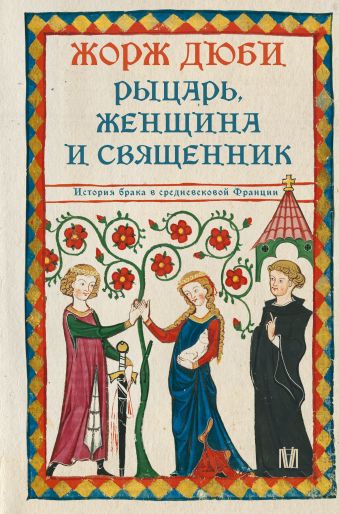
Georges Duby. Knight, woman and priest. History of marriage in medieval France. M.: AST, 2026. Translation from French by Denis Golovalenko, edited by Tatyana Sergeeva. Content
I am surprised by the coincidence: in the 20s. In the 11th century, at the very time when the matrimonial practices of chivalry were undergoing such obvious changes, various movements arose, called heretical by the heads of the Church. These movements and the Church represent two sides of the unrest that gripped France in that era. Undoubtedly, the rise of heretical movements cannot be considered separately from the “horrors of the thousandth year” - a wave of religious fear that swept across Europe on the eve of the millennium of the Passion of Christ. From all sides there were calls to repent and be cleansed of sins; Ascetic brotherhoods were formed everywhere, and some of them aroused suspicion. It is also indisputable, however, that heretical movements were one of the forms of protest against the imposition of “feudalism” - a new system of distribution of power. They united those who felt oppressed: wealthy peasants, for whom the road to knighthood was closed and on whom the burden of seigniorial duties fell; the townspeople who raised their heads and, of course, women, oppressed more than others, deprived of their rights by men. Isn't the spread of sects to some extent connected with the worsening position of women?
Heresies were persecuted and eventually destroyed, or at least forced their followers into hiding - therefore, like any other protest ideology, they left few traces in the sources. They are all indirect. We learn about the existence of heresy at the moment when it is defeated, reading ridicule and condemnation. It could have appeared anywhere. From our sources we learn of three outbreaks in Northern France. The first is Champagne, where the heresiarch preached near Vertue. The second is Orleans: accusations of heresy were brought against one of the most capable priests and theologians who served in the royal chapel and the Cathedral of Saint-Croix. The third is Arras: from there the heresiarchs fled, leaving behind several “illiterate” followers, that is, laymen, not all of whom were poor.
The members of the sects themselves considered themselves narrow groups of the chosen ones, transformed, like monks and penitents, who had radically changed their lives and “transferred from the bad world to the society of saints.” They sought to move away from evil, from the carnal, to leave the vicious world and get closer to the world of the spirit - and in this desire they were no different from the monks. The main thing that distinguished them was their reluctance to obey the Church. This is precisely what the heretics were primarily accused of, as is clearly evident from the questionnaires used to identify them: they did not agree that piety is impossible without an institution, that communication with God requires the mediation of priests. They believed that the Church should not exist and that priests were useless. The Church defended itself by scattering heretics and burning them. Nevertheless, the heresiarchs behaved - they sought salvation and angelic purity - in a manner very similar to the orthodox rigorists: nevertheless, the “color” of the priesthood was part of the Orleans sect. Both saw sex as a source of evil; Both of them, like Eriugena, were disgusted by the concept of marriage. The heretics simply expressed this disgust in a more radical way. According to John of Ripoll, the Orleans sect “blasphemed marital union.” Gozlin, Abbot of Fleury, suspected of sympathizing with the sect, had to swear that he “did not forbid marriage” - “marry” in the sense of bodily union, and not the union of souls that were bound in the course of the sposnalicium. In Champagne, the “mad” Liutard, about whom Raoul Glaber writes that a swarm of bees took possession of his body, “drove away his wife, claiming that he had divorced her, honoring the virtue of the gospel.” Over the text of the XIX chapter of the Gospel of Matthew, where to the words: “If this is the case between husband and wife, it is better not to marry” - Jesus answers evasively, talking about the eunuchs: “Whoever is able to receive, let him receive,” everyone thought, and not just the heretics. Was it not this small group of the chosen ones that the adherents of the persecuted sects tried to portray themselves as opposed to the vicious world? Reading in the Gospel of Luke that “the children of this age marry and are given in marriage; but those who are found worthy of the future age and the resurrection from the dead will neither marry nor be given in marriage” (Luke 10:34–35), the heretics were convinced that marriage did not allow them to achieve grace. In preparation for the return of Christ, they sought to get rid of everything that was in any way associated with sexuality. Thinking in this way, they accepted women and treated them as equals; they claimed to live together, united by caritas - that same love for one's neighbor that, in perfect purity, unites the heavenly creatures in paradise as brothers and sisters. It was this practice that no doubt shocked everyone the most; it threatened the foundations of the public edifice. The heretics were defeated because their contemporaries perceived them - or, more precisely, their contemporaries convinced them of this - as women's movements. Monk Paul from the Abbey of Saint-Perre in Chartres, describing the trial of the Orleans sect, persistently convinces the reader that among its members there was a certain nun; in the same way, Raoul Glaber accuses the woman of bringing the “poison” of wrong teaching to Orleans. Thus, it was easy to discredit heresy: isn’t a woman treacherous and malicious? Doesn't Satan himself work through her?
In addition, the persecutors of heretics accused the latter of hypocrisy: they allegedly renounce physical relations, but at the same time men live together with women. How, they asked sarcastically, can men, laymen, who do not possess the grace of priests, which they receive after undergoing sacred rites, live with women and not commit fornication? This is a lie, a pretense: in fact, they are all mired in depravity. Far from prying eyes in the forests at night, where women can fully demonstrate their witchcraft skills, they indulge in the sin of slaughter. All our authors agree: the prohibition of marriage among the laity leads to fornication and incest. According to Raoul Glaber, the Orleans heretics “did not consider debauchery a sin.” Paul of Chartres writes, retelling the rumors circulating around the monastery, that at the end of their meetings, it was the custom of the heretics to unite with the woman who was closest at that moment, be it even a mother or sister. They ritually burned the children born from these monstrous unions, and made amulets from the ashes.
Let's return, however, to reality. At the same time that stricter restrictions on marriage are being introduced to protect inherited property, radical forms of protest against marriage also arise. Here, however, as in the case of heresies, it is necessary to distinguish between two levels. The first is the level of learned people, to which all attention was focused: this includes the Orleans clerics, confident in themselves, going to the fire with their heads held high. I will not call the other “popular”, rather “unlearned”, worldly: those convicted in Arras behaved much more modestly during the episcopal proceedings, they were scared, submissive and renounced everything without much resistance. One should not confuse, as church propaganda deliberately did, the views on the institution of marriage of representatives of these two levels. A narrow group of “chosen ones” with their dreams of an angelic life and calls for general abstinence, maybe even absolute, stood quite far from the vast ranks of those who sympathized with them. The latter did not at all strive to renounce the earthly world and its pleasures; for them, the protest of heretics was a means of limiting the intervention of the Church in matters of marriage. The morality preached by the clerics created more and more inconvenience in conditions when the changed configuration of social relations forced the ruling class to take a more strict approach to issues of reproduction. Talking about the Orleans sect, Andrew of Fleury does not say, like John of Ripoll, that its members simply “denied marriage”: according to him, they argued that “there should be no blessing of marriage; let everyone take whatever wife he wants, no matter who she is.” This formulation is much more accurate than the rumors retold by the monk Paul - it contains a requirement that was poorly understood or deliberately distorted by the priests, which gave rise to rumors and gossip. The heretics were not satisfied with the sacralization of carnal relations: priests, in their opinion, should not interfere in matters occurring in the marriage bed. If we keep this in mind, their position becomes coherent and understandable: condemnation of the excessive privileges of the priesthood, condemnation of ritualism, condemnation of the carnal. Since marriage is a work of the flesh, its sanctification is sacrilege. Marriage is part of the “wicked world”, and therefore it does not concern the “perfect” at all, they have no desire to control it: in any case, it is a bad practice - whether it involves incest and infidelity or not. Let the one who wants to get married take a wife, “whoever she may be”: he will still sin. All calculations of degrees of kinship and penalties for bigamy imposed by priests are meaningless. By proclaiming that the union of bodies should not be sanctified, the heretics, in essence, opposed the formalization of the sacrament of marriage. Their words were listened to by all those who were concerned that the inclusion of marriage in liturgical practice drew a clear line between legal marriage and cohabitation, and that as a result of this the latter was devalued and relegated to the sphere of the illegal, along with incest and bigamy. It is not surprising that the first supporters of heretical movements were those priests who were not ready to give up their concubines, and the nobility who wanted to freely choose wives - and freely drive them away if a better party was found. In this regard, I believe it is appropriate to again ask the question posed by Francesco Chiovaro: did not heresies arise most actively in those regions where priests first tried to establish control over marriage rites, and did these processes not coincide in time? By heresies I do not mean their ideological core, but those waves that different types and qualities of preaching carried widely throughout the minds. When asking this question, one must keep in mind this social fact: the heads of clans could not allow priests to manage marriages, because in this case control over the power of the nobility would pass into their hands.
The heretical movements were eventually suppressed. This was achieved primarily through the efforts of the Bishop of Cambrai and Arras Gerard. At the end of the trial in 1024, he ordered the compilation of a short essay in which arguments, supported by references to Scripture, were presented, with the help of which he prevailed over the heretics. Together they form a kind of doctrine of faith, covering, among other things, issues of marriage. This work is extremely valuable for the researcher, since it clearly sets forth the views of the leaders of the Church.
Gerard is keen to emphasize the importance of the Church as an institution, as well as the importance of the sacraments; he proves that only priests are capable and should be involved in arranging relations between the faithful and God. Next, he proceeds to the fact that in society it is necessary to distinguish a number of classes (distinctio ordinis): in his opinion, all people are divided by divine command into functional categories that are in hierarchical relationships with each other. Those people who in this world are destined to serve God are at the top of the hierarchy, and directly above them are the angelic ranks. Their dominant position, therefore, obliges them to strive for angelic purity. The thought of the Bishop of Cambrai was further developed by his Lan colleague Adalberon in a poem composed between 1028 and 1031 and dedicated to King Robert. Here the social hierarchy is presented in a clearer form. Members of the “church class” are subject to “divine law.” This “holy law exalts them above all the vices of the world” and commands them to “keep purity of spirit and body.” Since they are chaste, the Lord “entrusts the human race to their power,” and in order to preserve this chastity, they are forbidden to marry. The ban, however, applies only to them, because if marriage is banned for everyone, humanity will not live to see the Last Judgment. “Nobles” and “servs” must reproduce, impregnate women - Adalberon in this regard makes sarcastic remarks about the Clunians who preach monastic abstinence to large lords. However, they must perform their reproductive function in as organized a manner as possible: in other words, unions are permissible only with representatives of their own “class” - the functional group into which the Lord assigned everyone. No misalliances. Moreover, the only form these unions can take is legal marriage. It is not only not forbidden to the laity, but they are supposed to enter into it: if the marriage is correct, if the spouses live in accordance with Christian principles and under the supervision of priests.
So, this is what Bishop Gerard says, refuting the heretical teaching on marriage. According to heretics, “those who have entered into marriage can in no way be counted among the faithful,” and spouses who do not want to end their carnal relationship should be expelled from the sect into the darkness of the outside world. Salvation in marriage is impossible. What is the answer to this? One must be careful, says Gerard, not to fall into either extreme: one should not turn everyone away from marriage indiscriminately, but one should not push everyone towards it either. “Since there is a difference in class between the clergy and the laity, it is fitting that there should also be a difference in behavior between them”: Gerard’s views on marriage are supported by his ideas about society - stratified and hierarchized, in contrast to the egalitarian ideas of the heretics. The bishop’s arguments are addressed exclusively to men: he does not introduce women into his reasoning quite consciously, since for him it is important to emphasize first of all the distinctio - the insurmountable boundary separating the two sexes, so obvious and fundamental that he does not even consider it necessary to mention it. So, “a spiritual husband, having left the ranks of the laity and become a man of the Lord, cannot, without harm to the cingulum [literally - “belt”, part of his vestment, but figuratively - “chastity”] surrender to the marriage bed” [in this case, he would lose exclusive freedom, since he would leave the sphere of the “divine law”, which, as Adalberon repeats, frees from all “slavery” of the earthly world]. As for the “secular” person, “neither the Gospel nor the epistles of the apostles forbid him to enter into legal marriage.” True, on one condition: “marital pleasure (voluptas) must always be under his control (subjecta).” At one time a husband can know his wife and unite with her bodies, but at another time this is prohibited. “Marriages are not pleasing to God in which people give themselves over to voluptuousness and pleasure, like animals, and incessantly seek pleasure, like horses and mules.” And on the contrary: “Whoever lives in marriage fearing God, out of love for children rather than for the pleasures of the flesh, cannot be excluded from the community of the faithful because of sin in marriage (culpa conjugii).”
Gerard adds: marriage belongs to the realm of the “law of human custom.” “Law” and “custom” - the outstanding rhetorician knew perfectly well that these two concepts are not identical, primarily thanks to Cicero’s De inventione, as well as the recent collection of canons by Abbo of Fleury. He deliberately uses these concepts together, trying to emphasize the difference between the two laws - divine and human - and to point out the subordinate position of the latter, that it is just a “custom”. Gerard's speech is addressed to heretics: he intends to expose them, but at the same time, knowing how the word lex is used by the intellectuals belonging to the sect, he wants to speak the same language with them. He admits that the divine “law” excludes the possibility of marriage: therefore the clergy, “the people of the Lord,” cannot marry. Marriage is subject to another normative system, lower and more precarious: custom. Gerard presents his point of view very clearly and skillfully, but what is more important is what his words lead to: they suggest that marriage, while belonging to the sphere of the carnal, does not belong to the sphere of the sacred, is not a sacrament and is not established by the Church.
Gerard, like Adalberon, refers to the authoritative texts of the Church Fathers: Gregory the Great, Augustine, as well as Dionysius the Areopagite and Eriugena, whose works were part of their cathedral libraries and supported them in their aversion to the carnal. The disgust of Gerard and Adalberon was no less than that of their opponents. В этом отношении Герард и те, кого он наставляет, были особенно близки, ведь их «мэтры» читали те же самые тексты. Герард также считал, что брак нечист по самой своей природе, являясь частью «порочного мира»; что он был уделом низших людей, рабов земного мира, подчиненных материальному. В идеальном браке не должно быть никакого телесного удовольствия — но этот идеал недостижим. Удовольствие можно разве что подчинить, контролировать. Поэтому брак всегда порочен и миряне, в том числе короли, должны подчиняться непорочным — священникам. Я не считаю вместе с тем, что Герарда можно отнести к доавгустиновской традиции. На мой взгляд, правильнее поместить его в ряд предшествовавших ему епископов: Ионы Орлеанского, Гинкмара Реймсского. Подобно им, он опирается на сочинения Августина, утверждая, что «любовь к детям» оправдывает брак; подобно им, он завершает свои рассуждения, говоря, что «закон человеческого обычая» подкреплен, «подтвержден» божественным «авторитетом». Бог не давал этот закон, но утвердил его. Герард цитирует здесь Новый Завет, Евангелие от Матфея, послания Петра и Павла, чтобы указать на необходимость подчинения жены мужу, чтобы показать, что господство мужа в браке, основе всего социального порядка, было установлено самим Творцом; наконец, чтобы убедить, что, сверх того, брак нерасторжим, что «неверующий муж освящается женою верующею» (1 Кор. 7:14). Между супругами, таким образом, происходит своего рода обмен услугами, и поэтому брак в известной мере полезен, способствуя циркуляции благодати. Именно в этом отношении еретическая доктрина ошибочна в наибольшей степени. «Если бы брачное состояние было причиной погибели человека, почему Спаситель, явившийся исправить то, что было извращено, не оставил ни предупреждения, ни предписания по поводу этого греха (culpa)?» — брак неизбежно порочен, и это обстоятельство придает манихейский оттенок концепции Герарда. Этот порок, однако, можно исправить, можно от него избавиться, как и от всех прочих, что взял на себя Иисус. Рассуждая весьма схожим с Ионой Орлеанским образом, Герард помещает брачную связь в число простительных грехов, которые вполне можно искупить.
Проявляя неординарное «благоразумие», епископ Камбре в то же самое время, что и епископ Лана, перед лицом беспокойства, охватившего север Франции, возвращается в своих рассуждениях к каролингским порядкам. Матримониальная мораль, что он проповедует, ссылаясь на Новый Завет, в соответствии с требованиями времени фокусируется на покаянии, требует соблюдать воздержание в положенные дни и не поддаваться плотским удовольствиям. Вместе с тем Герард отмежевывается от аскетических крайностей, полагая, что Бог не ждет от человека превращения в ангела, и, подобно Гинкмару, отводит на второй план все то, что касается браков мирян.