
Translated material
“Obstacles are our wings”
About Patti Smith's memoir "Bread of Angels"
Another book of Patti Smith's memoirs has been published in Russian, and in it the American rock singer and poet again talks to readers about her childhood, the difficult path of professional development, relationships with friends and the elusive - almost mystical - essence of human existence. Anastasia Rybitskaya wrote specifically for Gorky about “Bread of Angels.” We invite you to familiarize yourself with her material.
All of us, since February 24, 2022, have found ourselves in the face of advancing barbarism, violence and lies. In this situation, it is extremely important to preserve at least the remnants of culture and support the values of humanism - including for the sake of the future of Russia. Therefore, the editors of Gorky will continue to talk about books, reminding our readers that there is still a place for thought and fiction in the world.
Patti Smith. Bread of angels. M.: AST: Corpus, 2026. Translation from English by Svetlana Silakova. Content
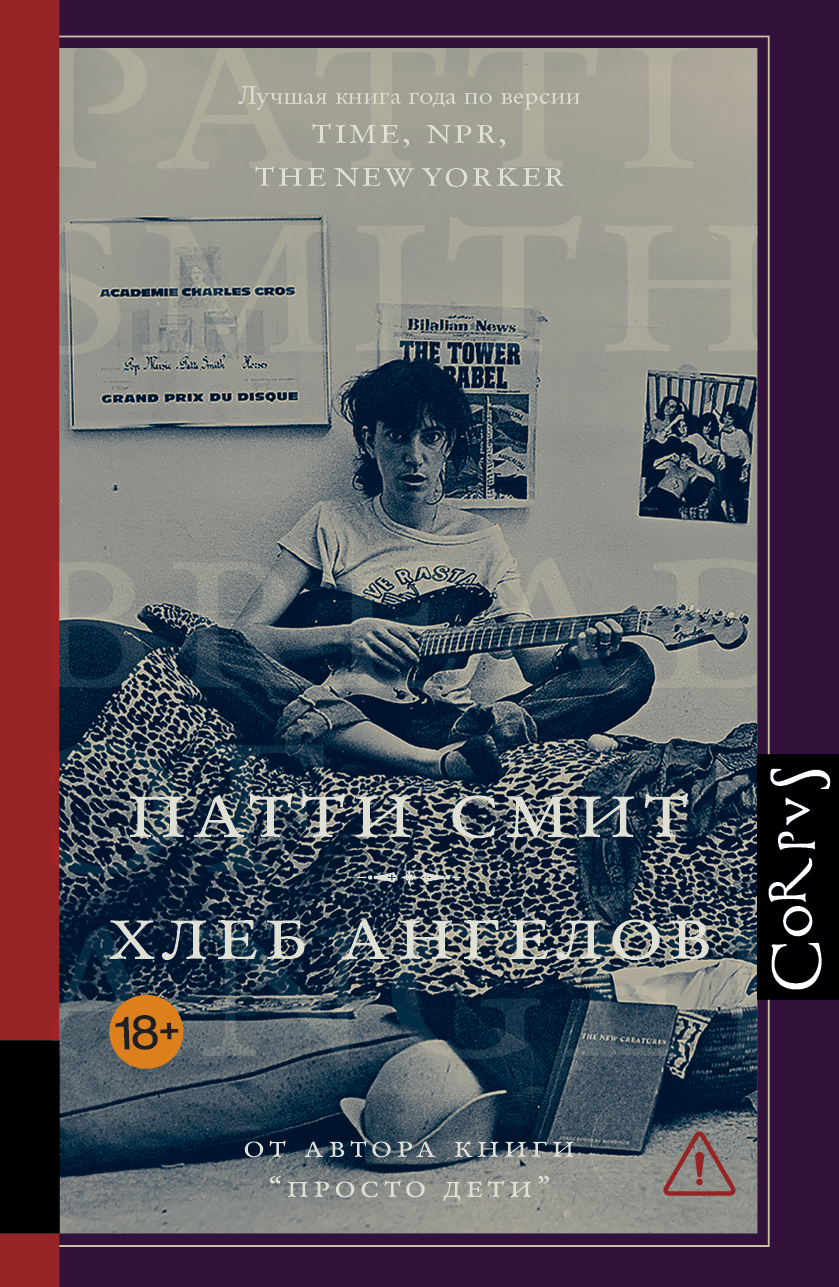
Patti Smith's memoir, Bread of Angels, was released on November 4, 2025, the day her husband Fred "Sonic" Smith died and the birthday of her close friend, photographer Robert Mapplethrop. This date is the key to Smith’s books: from her early youth, she looks at the world through the optics of coincidences and signs. The text was created over ten years, and its appearance now, of course, is not an accident: the singer is celebrating the 50th anniversary of the release of the legendary Horses album on tour. Smith communicated with beatniks Allen Ginsberg and William Burroughs, was friends with Susan Sontag, spent summers with hippies, acted with Annie Leibovitz, was able to find her own path in the bohemian world of New York and continues to perform concerts and receive awards at the age of seventy-nine.
Her memoirs “Just Children” (2011), “M Train” (2016) and “ Devotion ” have been translated into Russian by the Corpus publishing house . Year of the Monkey" (2020), and in 2026 the book "Bread of Angels" appeared. Just Kids grew out of a promise to Mapplethrope, who was dying of AIDS, to tell their shared story, and won a National Book Award. The following books lost their former clarity of concept, the writer was accused of looseness of the narrative, but in a strange way this attracts readers to them. In the new book, Smith writes about a poor childhood with frequent moves, a difficult youth, an unplanned pregnancy, leaving for New York, a music career, family life, but when it comes to loss, he resorts to stream of consciousness and non-linear storytelling. The charm of the author's voice remains the same, as always. Bread of Angels is both memoir and elegy; reflection on how the world around me mystically rhymes with everyday everyday life, how dreams help to find or anticipate answers, how sudden insights happen on the most ordinary day. The beauty of Svetlana Silakova’s translation is admirable: she managed to convey Smith’s ability to find the beauty of a moment. Little things like talismanic objects collected on a desk, or sorting through things, among which a linen concert dress is discovered, which seems ready to crumble at one glance, daily, sometimes unremarkable events turn into a touch of higher powers, a hint, a sign.
The book is preceded by a quote from Nikolai Gogol’s letter to the artist Alexander Ivanov: “Obstacles are our wings.” This is the formula for Smith’s own life; she faced many obstacles. She talks about eleven moves in the first four years of her life; encounters with sudden death in early childhood - a dog, a familiar boy from the first floor, first girlfriends; writes about “Proustian childhood” - constant illnesses and long recovery from them; about the loss of her beloved husband and the secret that is revealed at the very end of the memoir: why is Olive Lily Hart, "Grammy", cold towards her granddaughter, Patti, and her mother? The question that worries young Smith and asks herself (“Who am I?”) at first seems like a typical teenage musing:
“...from birth I seemed to be of a different breed... I wondered why I was so different from my relatives - both in appearance and in disposition. Peering into their faces, I couldn’t find my own features.”
At the end of the book, there is an explanation: on Smith’s seventieth birthday, the results of a DNA test will come, which will once again turn her entire previous life upside down. This is the strength of the book, which periodically loses clarity of outline: the solution turns out to be a real plot twist.
The center of young Smith’s life is poetry; it has accompanied the future post-Beat star since childhood. The collection of poems “Silver Pennies,” a gift from her mother and a family heirloom, will tell her that it is possible to hack reality and capture the divine glow:
“I reasoned that to find a silver penny, you need a two-pronged strategy. Let your heart open to other worlds, and let your eyes notice everything, but not judge anyone.”
Other Worlds began with a photograph of Arthur Rimbaud on the cover of a collection of poems, Illuminations, found among books sold near the Philadelphia Academy of Arts, and later continued with lyrics by Bob Dylan. She writes that she can easily imagine Rimbaud, lying on the field, listening to “It's Alright, Ma. (I'm Only Bleeding)” :
“One can clearly feel that the words of both poets are addressed to a tribe of black sheep, outcasts, trying to survive in the times that befall them. And also that both poets are imprisoned in their viscous present, but distinguish between the prospects of the future - a polyhedron that unfolds and folds, turning in different directions.”
Smith, like Dylan in her memoirs, avoids details of family or personal relationships; she is generally characterized by understatement: for example, it is not entirely clear what kind of feelings connect her with Mapplethrop, but she notes that “providence” led her to her “spiritual compatriot.” This is not an accidental gap in the narrative; Smith deliberately mythologizes the past instead of directly explaining events. Rimbaud's texts once shocked her:
“In this two-facedness I recognized myself - demonicity hand in hand with mercy. I was amazed that he wrote this at the age of nineteen, put his suffering into the book - as if he sealed it, preserved it. I wanted to believe that confession saved him from the abyss of internal discord; I tried to walk with him on his sizzling spiritual path.”
And this influence is noticeable: the non-linearity of the narrative, the confessional form, dreams, appeal to inanimate objects - Smith adopts the techniques that Rimbaud uses in the collection “One Summer in Hell”. While the 19-year-old boy looks contemptuously at the bourgeois world, rebels and mocks Christianity, takes his chosen techniques to the destructive limit and abandons poetry forever, she uses the same discoveries as a method by which she can talk about the past with gratitude.
Christian motifs appear already in the title of Smith's memoirs. The image of bread, a symbol of life and Divine grace, is transformed: high poetry, rock and roll drive and religious attitude are in an organic connection. She creates her own religion, in which, instead of abstract biblical imagery, concrete gestures appear:
“A sudden glimpse, a specific moment of life vibrates within. Johnny Stahl ties my shoelaces. Butchie Magic's fingers pull out the sting. An untarnished memory of spontaneous acts of kindness. These actions are the bread of angels."
So Smith expresses gratitude to the people who were next to her, and endless surprise at the movement of inexplicable forces, and the process of writing itself becomes a ritual action (“Everything flowed, the mental current circulated through the corridors”). Reflection on the lives of saints and their sacrifices is associated with the process of the creative act: Smith cites the example of the story of Saint Bernadette, whose all efforts and sacrifices were rewarded only by “appearances of the Blessed Virgin and promises of happiness in the next world.” John the Apocalyptic, who writes down prophecies under invisible dictation, and Jackson Pollock, who creates “Blue Pillars,” know how to freeze a moment. Smith recalls studying the Bible in school taught by a follower of Jehovah's Witnesses * . Her mother was also a converted, “devout” Witness, while her father strived to regularly read and analyze the Scriptures, but did not go to church. In my opinion, this is an important introspection: Smith grew up within a strict religious system, but is outside the religious institution and is trying to reappropriate the language that religion speaks (think about the legendary words of the Horses album recording: “Jesus died for somebody's sins, but not mine” ). She is always attentive to the calendar: the Horses album was supposed to be released on October 20, Rimbaud’s birthday, but due to a shortage of vinyl, the release was delayed, and the release date of the record fell on the day of his death - November 10. Everything around, from rosary beads given by a friend to sudden personal discoveries, succumbs to the call of mystery, is a wink from higher powers, “inviting us to perceive the world at a still unfamiliar… frequency.” The invisible unsettles Smith, but also “marks the heart with the sign of deep-rooted hope.”
A similar logic informs Smith's thinking about politics. An episode from childhood appears in the book: one day she found a toy gun at a church charity bazaar, which her father later noticed in her hands.
“We have never seen dad so angry. Later, his mother explained that he most likely remembered the war... Many of his colleagues died under the fire of their own troops... He was not wounded, but returned with a mental breakdown and a broken heart: the atomic bombs dropped on Hiroshima and Nagasaki cooled his patriotism forever.”
Smith's memoirs are imbued with a pacifist mood. She feels the violence physically: a severe migraine for many hours during the bombing of Baghdad, a nightmare about the future of Jerusalem, never told to her father. Recognizes the "shameful Vietnam War, racial injustice and sexism" and celebrates the "rock and roll, jazz, civil rights movements, abstract expressionism, beatniks" born in America. These reflections turn into a stream of thoughts, sometimes turning into poetic form. Smith wanders around Trieste, the city in which there was a camp for Jewish prisoners, remembers the Hiroshima Peace Memorial Museum, and anxiously reads news about the situation in Israel. Her, in a good sense, naive faith in simple human values - love, loyalty, friendship, courage, freedom - is especially comforting now. The optics of premonitions and dreams through which Smith looks at life are devoid of illusions: the 21st century leaves no chance for them. However, it is possible to “unite and face turbulent times together.” And hope that good omens will appear soon.