
Translated material
Post-apocalypse forever
About the re-release of Eduard Verkin’s forgotten novel “Hello, brother, die!”
Eduard Verkin, known to readers as the author of post-apocalyptic novels, first turned to this fantastic genre fifteen years ago in the pentalogy “Inferno”. But that attempt went largely unnoticed: Verkin wrote under a little-known pseudonym, and the topic, as they say, did not take off at the beginning of the prosperous 2010s. It’s a different story today: publishers extracted one part from “Inferno,” a work with an independent plot, and published it a second time. Read about why the novel “Hello, Brother, Die!” is interesting in the material by Vasily Vladimirsky.
All of us, since February 24, 2022, have found ourselves in the face of advancing barbarism, violence and lies. In this situation, it is extremely important to preserve at least the remnants of culture and support the values of humanism - including for the sake of the future of Russia. Therefore, the editors of Gorky will continue to talk about books, reminding our readers that there is still a place for thought and fiction in the world.
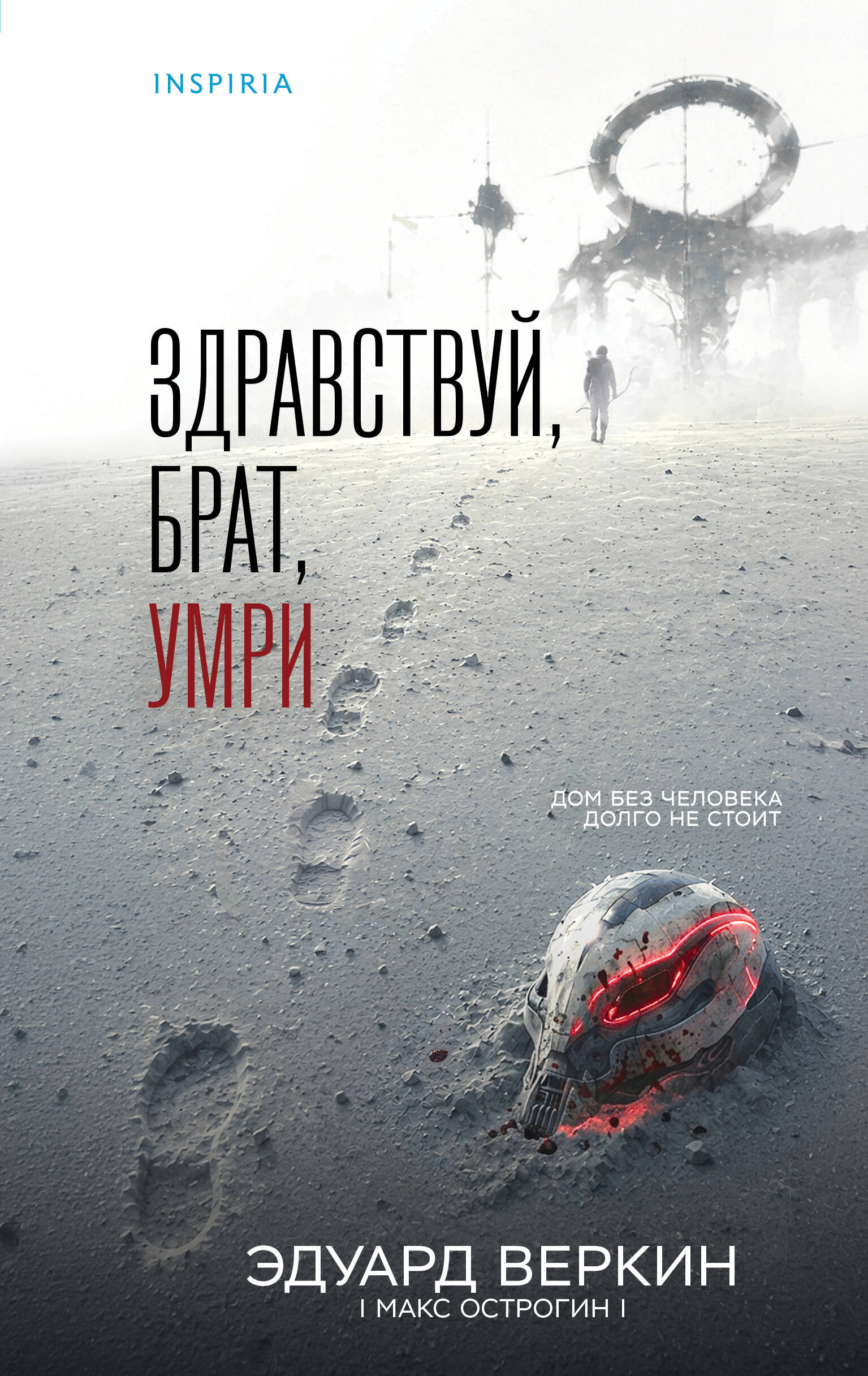
Eduard Verkin. Hello brother, die! M.: Inspiria. Eksmo, 2026
The action of “Sakhalin Islands” (2018), one of Eduard Verkin’s most famous books, takes place on an Earth devastated by a global epidemic. The mobile rabies virus (MRV) has turned most of the world's population into zombies; the last centers of civilization are glimmering only in the Far East; The only country that managed to survive the apocalypse was Japan. But “The Island” is not the first approach of the “Big Book” laureate to this projectile. In 2010–2011, Eduard Verkin, under the pseudonym Maxim Ostrogin, released the pentalogy “Inferno,” in which humanity was wiped out from the face of the earth by a virus that was superior to MRD in many respects: mobile rabies, at least, is not airborne and does not cause mass mutations.
“In two thousand two hundred and twenty-three, an international Arctic expedition operating in the area of the Rual base reached the lens of the subglacial lake Vostok 18. A retrovirus dating back to the Early Paleolithic period was discovered in water samples. Upon accidental contact with the atmosphere, the virus became active; despite the measures taken, the spread could not be contained. Within a year, a pandemic of fulminant cancer, which began among humans and great apes, destroyed more than ninety-five percent of the population. It was not possible to find a vaccine..."
“Hello brother, die!” just from this five-volume set. More precisely, this is a separate, plot-complete novel, the action of which takes place in the same post-apocalyptic universe, but many decades after the disaster, a sequel, an addition to the main tetralogy.
In 2011, “Inferno” did not have a resounding commercial success; few readers knew what kind of writer was hiding under the pseudonym Maxim Ostrogin - as a result, the series sank into oblivion without a splash and has never been republished since then. But today, when dystopia in Russia is again at the peak of popularity, and Verkin is a prize-winning writer, the idea of reviving the forgotten cycle seems obvious. At a minimum, republish one novel from the series—one that can be read as a standalone story. Remove from mothballs, shake off the dust, wipe with a damp cloth, replace the frankly trashy picture on the cover with an intelligent illustration - it will sparkle like new! Everything is clear here without further ado. The question is: does the novel expand on Hello, Brother, Die! does the context add anything to the overall picture that has formed in the minds of Verkin’s regular readers, from “April’s Friend” to “The Magpie on the Gallows” inclusive?
The book “Maxim Ostrogin” is the story of two teenagers who live in a post-apocalyptic world of the distant future, when a malicious virus has already done its job and has disappeared from the historical stage. Two internal monologues, two voices, “confusingly” similar - in principle, both of them could belong to the same person. But the fates of these characters are very different. One hero is a descendant of the inhabitants of a base on Mercury, which was able to survive the disaster thanks to strict quarantine; the other wanders through endless forests and deserted, slowly decaying earthly cities. One grew up in cramped, overcrowded compartments, constantly on the verge of starvation; another, at the age of thirteen, had met only one person who spoke articulately and was able to read and write, but there was plenty of unafraid game around and well-preserved buildings where one could while away the night or spend the whole winter.
But there is something that unites them besides the manner of expressing their thoughts. First of all, the empty world around, once simple and understandable, is full of secrets and mysteries, anomalous phenomena and irrational prohibitions. Where did elephants and jaguars come from in European forests, and how did they survive? Why are residents of the Mercurian base allowed to watch cartoons filmed before the epidemic, but feature films are strictly prohibited? Who left the only footprint of a shoe on the wet ground - did the earthling hero see it with his own eyes in early childhood?
“What happened to the Sol research station, located between Mercury and the Sun? “They said that the scientists at this station went crazy from the proximity of the star and ceased to be people, that instead of doing scientific experiments, they started practicing witchcraft and summoned some demons...”
Both teenagers don’t really believe in horror stories about alien invaders (and, in general, they’re right: the reality is much worse), but they constantly dream about meeting other survivors, about the return of humanity to a cleansed Earth, and about other impossible things. Well, both of them are named Alex, and in honor of the same historical character - which, of course, is also symbolic in its own way.
It seems that everything here is quite simple - but this simplicity is apparent. In the first chapters, Verkin-Ostrogin confidently sets the plot vector, makes it clear what, in principle, the reader of this book should expect, but in the last thirty to fifty pages he sharply turns to the side, doing an acrobatic somersault with a flip over his head.
“Fear autumn,” I say. - Be afraid of autumn. When the leaves turn yellow, the waters clear, and the air blue, the creatures arrive. Because in autumn the animals are fat, sweet and lazy, and the creatures need meat..."
Perhaps this desperate rebellion against the genre formula, against unambiguity and predictability is the main thing for which it is worth reading the novel “Hello, Brother, Die!” fifteen years after the first (and only) edition.
And protest manifests itself not only at the plot level. In principle, all post-apocalyptic films, from Jack London’s “The Scarlet Plague” to the “Metro 2033” franchise, can be divided into three conditional categories. Firstly, a classic Robinsonade, where the main character alone (less often with a couple of companions) tries to survive in the ruins, and complete desolation reigns around. Secondly, stories about attempts to at least partially recreate a lost civilization, restore former institutions, and raise culture from the ashes. And finally, books about how a completely new society is being built, without connection with past traditions, literally from scratch, from scratch - a rare, exotic variety, but this also happens.
In “The Island,” Verkin turns to the second option: the world is teetering on the edge of an abyss, but humanity is still ready to flounder. (And, stepping aside, the heroes have a chance: in 2025, the population of Japan was 123 million people, approximately the same number as lived on Earth in the era of Alexander the Great, quite enough to preserve and develop civilization.) The novel “Hello, brother, die!” in this sense it is more cunning. The author pays tribute to both the “Robinsonade on the ruins” and the history of the revival of an almost extinct culture, and at the very end he starts talking about creating a fundamentally different society from scratch. At the same time, every plot scheme in this book has a cunning twist, with a noticeable deviation from the generally accepted canon - otherwise it would be uninteresting, not at all like Verkin. Robinsonade is not quite Robinsonade, the keepers of traditions from the Mercurian station have in fact long ago (and radically) broken away from their roots, and a new civilization, built on the denial of previous experience, is yet to emerge - if you are very lucky.
“Sakhalin Island” is, of course, a more complex, multi-layered and ambiguous book. And yet, one cannot dare to say that in the “Inferno” cycle Ostrogin-Verkin was simply training on cats, but in “Island” he finally got down to business seriously, like an adult. Despite some external similarities, “The Island” is constructed completely differently: a different conflict, different trigger points, a different selection of visual means. Both novels are experimental—but experimental in different ways, and one approach does not exclude the other. Like reports on expeditions to two randomly selected points on a huge continent. Here - heat and palm trees, there - ice hummocks and polar bears; one landing involves whalers on an eight-oared whaleboat, another involves the best minds of the Royal Geographical Society. Whose observations are more important for history?
Both are valuable, considering that most of the continent has not yet been explored and is inhabited either by tigers, or dragons, or people with dog heads and tattered volumes of SF under their arms.