
Translated material
Russian Rodin
Fragment from Ekaterina Skorobogacheva’s book “Stepan Erzya”
Before the revolution, the Soviet and Erzya artist Stepan Dmitrievich Erzya (Nefedov) studied at the Moscow School of Painting, Sculpture and Architecture and managed to become famous for his works, including at international exhibitions. After 1917, Erzya sought to participate in the formation of new revolutionary art, but faced a lack of understanding from the authorities and resistance from futurists and other representatives of leftist movements in art. As a result, in 1926 he had to leave the USSR and go into exile. Read about this in an excerpt from his biography written by Ekaterina Skorobogacheva.
All of us, since February 24, 2022, have found ourselves in the face of advancing barbarism, violence and lies. In this situation, it is extremely important to preserve at least the remnants of culture and support the values of humanism - including for the sake of the future of Russia. Therefore, the editors of Gorky will continue to talk about books, reminding our readers that there is still a place for thought and fiction in the world.
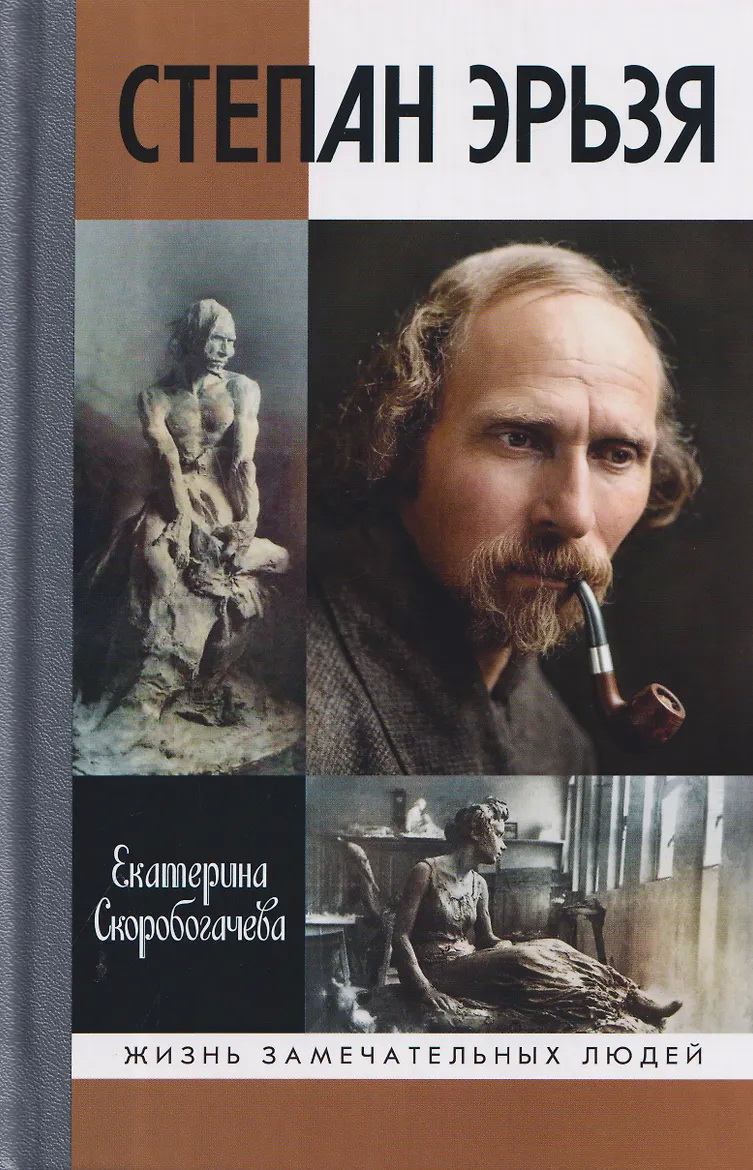
Ekaterina Skorobacheva. Stepan Erzya. The tragedy of triumph. M.: Young Guard, 2026. Contents
His letter to A.V. Lunacharsky is dated precisely 1926. However, the sculptor’s projects once again, for the umpteenth time, remained only on paper. Stepan Dmitrievich did not find a place for himself in the USSR; he was constrained by the regulations that were powerfully dictated by Soviet reality. Trying to break out of these “shackles,” he, having doubts, nevertheless accepted the offer of the People’s Commissariat for Education, or rather Lunacharsky, on a foreign business trip to accompany an exhibition of his works in France.
However, his departure was again preceded by dramatic events in the sculptor’s life - the final separation from his faithful friend, in fact his wife, with whom they had been inseparable for ten years, Elena Mroz. Their explanation took place one of the homeless winter evenings of 1926 in the former workshop of the emigrated Konenkov, which has now become Erzya’s refuge.
It was cold in the room, and therefore, as usual, Elena did not take off her cotton wool cap and warm scarf. The sculptor walked from corner to corner, inadvertently touching an orange lampshade hanging low on a long cord. He pondered the difficult conversation ahead. On the floor, from an open gramophone where a record was spinning, the recognizable voice of Fyodor Chaliapin sounded:
“You took everything with you,
And sunshine, and love, and peace,
Everything that breathed only you
Oh, you days of love..."
He began to speak, as if throwing out his negative emotions, recalled the scandalous insulting reviews of the museum and showed Elena a crumpled newspaper, which he took from the sculptor Shadr, where the article “Erzya is self-taught”, humiliating for Stepan Dmitrievich, was placed: “At first they persuaded me to attend this exhibition at the Historical Museum. I didn’t want it that way, I didn’t want it that way: there were only futurists and avant-gardists there. We persuaded..."
There was a heavy pause, which Stepan Dmitrievich interrupted by quoting fragments of the article:
“Erzya is not a professional. Instead of Marx, he slipped his grandfather, a Mordovian shaman... Erzya, in imitation of the medieval Michelangelo, works in an outdated manner, which is philistinism and vulgarity, harmful to the proletarian class. We need the creation of a special proletarian culture, not connected with past feudal cultures...” The sculptor opened another newspaper with an article about himself and again, with no less indignation, quoted: “Unworthy use of prohibited techniques in plastic art - “What Zeus can do, a bull can’t!”.”
Elena Mroz, whom the sculptor affectionately called Morozka and Mozochka, tried to console him and showed him the magazine “Sun of Russia”, which she had kept for more than ten years, since 1914, when an objective and detailed article by A. Roslavlev about Stepan Dmitrievich with his large photograph and photographs of his sculptures was published. Erzya listened to her attentively, glanced at the magazine, seemed to calm down for a while, but again began to walk from corner to corner in the cold workshop and seemed to be calling out to someone:
“It’s not the revolution with its positivity that’s pressing me. Everything that comes after it depresses me. You and I miraculously survived both in Mramorskoye, and on the road to Gelendzhik, and then in Baku and Yerevan. From one end of the country to the other, but everyone endured, did not give up, worked and did a lot of good. Now what? Am I alien and unnecessary? I am a hostile element! How do they write? I am an element! Frost..." Memories came flooding back to him. It was as if living pictures were passing before Erzya’s eyes, replacing each other with lightning speed in a kaleidoscope of days, years, decades. Images of childhood and adolescence in the family, youth at icon painting and mural painting in churches, young years at the Moscow School of Painting, Sculpture and Architecture, first meetings with Europe, trials in the Urals, his already terminally ill mentor Sergei Volnukhin. Stepan Erza managed to take him to Gelendzhik, but he could not prevent the death of Sergei Mikhailovich there. Having barely recovered from pneumonia, Volnukhin received a new blow - his heart could not stand it.
Erzya paused and spoke to Elena again:
“—Not only were they not invited to the AHRR exhibition “Life and Life of the Peoples of the USSR”, nor to the “Exhibition of Contemporary Sculpture”, they were not even informed. Everything on the sly. Shu-shu-shu. They are afraid of me. Why?
- Don’t you understand? They are afraid. They are afraid and jealous.
- But why?
- Yes, because you are Erzya...
- Let's leave. I spoke with Lunacharsky. We have known each other since we were 12, from the “Autumn Exhibition” in Paris. He likes my work. He advises us to go to Paris for a while with an exhibition, and promises a good workshop in the center of Moscow upon his return.
- I can’t, Styopa.
— Exhibition at the Jean Cherpentier Gallery. All of Paris will come. Like Paris, half of Europe will come running.
- I can’t, Styopa.
- We'll leave. I'm sick of everything here. Everywhere there are either psychos, or fools, or bandits... They either point their fingers at me as if I were an enemy, or it’s as if I don’t exist at all. And then... I'll get down to business. Let's go! "
Erza never managed to persuade Elena to leave. It didn’t help that he cited as an example the emigration of Sergei Konenkov and his wife to the United States, whose workshop they occupied. Elena Mroz could not leave the Soviet Union, her parents and younger sister Maria, she feared for their fate. Her mother was unwell. My sister, a talented ballerina, could have been deprived of her place in the theater, and her parents could have been arrested by the Cheka. The sculptor understood her, did not want to part with her, but also could not give up his decision to go abroad. He created a sculptural portrait of his faithful friend, who was always with him in his Argentine studio. They were destined to meet only 28 years later, as strangers.
So, Stepan Erzya left the Soviet Union alone in November 1926, having received the consent of the French authorities. He, already a well-known sculptor in France, who had previously lived here for quite a long time, was given permission to return. The difficult preparations were crowned with success. In November 1926, Stepan Dmitrievich went to France by ship through Novorossiysk. He took with him about thirty sculptures, fourteen of them were very large in size, which he reported with his characteristic laconicism in his Autobiography: “[In] November 1926, he went abroad and organized an exhibition in Paris. It was a success. I sold a lot of works.” Emigration was a completely conscious, albeit difficult, decision for Erzya. Years later, Erzya said to his good friend, the Soviet ambassador to Argentina, that “he himself was surprised at how he ended up in this distant country, located almost at the end of the world.”
Already in February 1927, about thirty of Stepan Dmitrievich’s best sculptures were presented in the Parisian gallery of Jean Cherpentier, and later in other exhibitions. In the newspaper L'Humanite of February 5, 1927, the following was written about his works:
“Before us are 20 works of amazing purity and color. Marble, wood, plaster, cement - everything is done brightly, imaginatively, soulfully, with shades and echoes of the simple, broad life of modern Russian peasants. There are also nudes with smooth lines of strong and gentle charm, women from the people, Tatar and Mongolian peasant women, taken straight from life, in the prime of their years. For Erzya never fell into conventionality, bad taste, or pretense. A living connection with the common people saved him from the boudoir beauty of our Clodiano, which to this day still finds imitators. Stepan Erzya, on the contrary, is closer to Egyptian and great Roman sculpture in his work and composition and in his magnificent architectural flair. With his impulse he resembles Rodin, and with his insight and skill he resembles Bourdelle.”
He remained in France for five months. After many years of wanderings and instability, the sculptor was finally rewarded with the opening of his personal exhibition in Paris at the beginning of the next 1927. In addition, his works were exhibited at an international exhibition at the Jean Cherpentier Gallery and were highly appreciated at the House of Fine Arts Workers in Paris, where they were presented until the end of March 1927. The famous sculptor showed his new works both at the IV exposition of the “Art World” and at the “Salon of Independents”. Both vernissages were successful and brought Erza significant funds. Critics spoke positively about the works of the Russian-Mordovian sculptor, who also received flattering comparisons with Rodin and Bourdelle, which, undoubtedly, was justified, as evidenced, among other things, by the memoirs of V. G. Suteev: “His god was Michelangelo. Stepan Dmitrievich spoke with admiration about the work of Meunier, Bourdelle, and Maillol. When I asked him what he thought about Rodin, the one whom many still call “Russian Rodin” suddenly laughed, waved his hand and muttered indistinctly:
- Uh... You know... arms, legs...
I didn't understand anything. Stepan Dmitrievich immediately explained. It turns out that Rodin kept casts of parts of the human body in the shed at his workshop - arms and legs in various turns, torsos, heads... Combining them in every possible way, Rodin, according to Erzya, was looking for a composition for his future sculpture. Obviously, this technique seemed somewhat artisanal to Erza and the approach to work was not artistic enough.
Nevertheless, Erzya highly valued Rodin’s art and considered many of his works, such as “Hostages from Calais,” to be masterpieces.”
Long before his French visa expired, the sculptor applied to the embassies of a number of countries, namely Belgium, Holland, Denmark, Sweden, in order to obtain entry visas. However, he was refused everywhere, mainly due to the difficult international political situation - Western European countries did not want to host exhibitions of a native of the USSR. Erzya reported this: “I wanted [to] London, but England did not give a visa, and they also refused to go to North America.” Finally, he was able to obtain a visa to travel to Uruguay, and also secured a letter of recommendation from one of the Argentine politicians who lived in Paris to the editor of a famous Argentine newspaper with a request to assist Erza in leaving Uruguay for Argentina. It is very paradoxical that the Argentine embassy in Paris then refused to issue a visa to the sculptor.
So, in April 1927, the sculptor left Paris for Uruguay by boat, and sent his works directly to Argentina, hoping to quickly receive a visa. The Uruguayan journey lasted about a month. Immediately upon his arrival in the capital of the country, Montevideo, Stepan Dmitrievich, like a true artist, was inspired by both the beauty of the local nature and the originality of South American architecture.
The country greeted him with torrential rains, and the grandeur of the pictures of the restless elements amazed him. As soon as it rained, the clay roads turned into bottomless swamps. Then the local carrets on high wheels remained under their awnings. Even with them, harnessed by twenty oxen, it was not possible to ride. It took two days for the roads to dry out a little. However, the ride was still dangerous - the wheel could get stuck in the mud so much that the carriage had to be pulled out by fastening an additional six-pair team of oxen. In this case, the wheel tracks cut into the road sometimes to a depth of three quarters of a meter, and the rut depth gradually increases to two meters. When Stepan Dmitrievich made his way along such a road on a carriage, he reminded himself of a balancing tightrope walker with a holey net stretched under him. The carriage on which he and his driver were traveling still got stuck in front of a particularly high clay crest of the rut. One of his fellow travelers, a local resident, got off the cart, assessed the scale of the disaster from the side and tried to prompt the driver:
— Five centimeters to the left, quietly, drive the right wheel into the furrow, turn a little, okay.
Having got out of this dangerous furrow, the travelers soon almost fell into a trap, where two trenches turned into a tangle of holes, passed it and overtook a caravan of lumberjacks. Ultimately, the obstacles were overcome, and the carreta more or less safely passed several kilometers to the capital, which finally appeared before the sculptor.
The city of Montevideo was founded in 1726 on the day of St. Philip and therefore received the characteristic local compound name Ciudad de San Felipe del Puerto de Montevideo - “the city of St. Philip of the harbor of Montevideo.” To date, only the word “Montevideo” has survived from the original version of the name, regarding the etymology of which discussions continue. Gradually, an opinion developed that the “Monte” component in the name refers to the mountain or hill of Cerro de Montevideo, which is located on the shore of the bay of the same name.
Even then, in the 1920s, it was one of the most modern cities in South America. Although the capital of Uruguay was inferior to the stunning Rio de Janeiro, like the exotic vegetation of a greenhouse. However, Stepan Erzya fully appreciated the original charm of the capital of Uruguay - with the picturesqueness of its avenidas, which are partly characterized by the panache of Parisian boulevards and the marble splendor of palaces similar to Italian palazzos. Thanks to them, the sculptor remembered both his European travels and the Black Sea embankments of Russia with similar palaces. Erzya’s memory also brought to mind views of Italy: Rome, Florence, Venice, Milan.
Before his inner gaze appeared images that could not leave the artist indifferent: a view of the Capitoline Hill in Rome with the buildings of the great Michelangelo. St. Peter's Cathedral and the square of the same name with the famous colonnade, the Palazzo Farnese, built according to the design of Antonio da Sangallo the Younger and Michelangelo, with paintings in the gallery executed by Annibale Carracci, stood proudly; the inspired creation of the architect Vignola - the Church of Il Gesu (Church of Jesus) and the Villa Farnese in Caprarola, the memorable solution of Piazza del Popolo (People's Square) designed by Rainaldi with three streets converging here with rays to two identical temples.
He also remembered the words of Johann Wolfgang Goethe, written about Rome during his trips to Italy for his travel notes “Italian Journey”: “Here you see a life that lasts two thousand years, or even more, such a diverse force of changing eras and has changed radically, but the soil remains the same, and the mountains are still the same, and often the same column and wall, among the people - still the same character; you become an accomplice in the great decisions of fate, and at first it is difficult for the observer to understand how Rome is replaced by Rome, and not only the old Rome by the new, but how different eras are layered on top of one another.” In addition to Italian impressions, Stepan Dmitrievich’s associative memory also included architectural images of the Black Sea coast, where he saw many buildings in the style of Mediterranean palazzos. They were often located outside urban land holdings, near the sea or on the banks of small rivers that dried up in the summer. Their exteriors were remembered for their respectability and monumentality. The central facades, as a rule, were decorated with marble and ceramic sculptures, which could be brought from Italy by order of the owners. The interior spaces echoed the decoration of a Renaissance palazzo. The visiting guests were not left indifferent by the interiors, functionally thought out, logically replacing each other, among which one of the central places was usually given to the state living rooms, intended for crowded official receptions. In the capital of Uruguay, Erzya saw many similar buildings in the classicist style, which had long ago acquired an international character.
The city could not boast of the ancient Inca fortresses of the Viceroyalty of Peru or the Aztec treasuries of the era of ruler Montezuma. The history of Uruguay was full of political upheavals and military skirmishes, and therefore pompous Spanish-Moorish palaces with characteristic patios - open courtyards entwined with greenery - and ornate patterns were never erected on the ruins of Indian buildings. Thus, Montevideo belonged to the temporary space of the twentieth century, and only individual ancient buildings could be judged about its history. The city, ordered by urban planning, soberly rational in its figurative interpretations, was still far from being close in all respects to the artistic preferences of the Erzya sculptor.
In Montevideo, Erzya met with Argentine journalists and, showing them a letter of recommendation, expressed hope for his speedy arrival in their country. Such a step by the sculptor was very risky, since at that time the USSR did not even have diplomatic relations with Argentina. The sculptor communicated with local residents, having the opportunity to fully appreciate their identity, primarily the gauchos, a socio-ethnic group in Uruguay close in spirit to the American cowboys. Они являлись своеобразным «краеугольным камнем» столь многонационального, пестрого по нравам и традициям населения. Такова историческая специфика Уругвая — такая же прихотливая и порой неожиданная, как фантазии местных архитекторов. Население Монтевидео объединял испанский язык, однако за этой общностью скрывалось множество диалектов. Жители столицы Уругвая отличались и от испанцев, и от аргентинцев — криожьё. Потомки испанских переселенцев здесь смешались с волнами колонистов из стран Старого Света, как романоязычных, так и других языковых групп. Это многообразие нашло отражение как в языке, так и в местной культуре, например в горьковатой лирике креольского танго.
В Уругвае ваятеля вновь ждал громкий успех, ибо его выставка в Монтевидео была исключительно высоко оценена зрителями, несмотря на своеобразие творческой манеры, не всегда простой для восприятия и в силу многоплановости смысловых звучаний, и из-за специфики образных трактовок. Довольно часто в этот период Эрьзя продолжал применять технику намеренной неоконченности произведения: non-finito — особый подход в искусстве, известный со времен Ренессанса, актуальный и столетия назад, и ныне. Столь разные скульпторы контрастными средствами выразительности решали одни и те же творческие задачи: передавать сиюминутность впечатления, состояние и настроение модели или движение мгновения; сохранять подвижную, словно дышащую, поверхность в глине, гипсе, даже в дереве, имитируя пальцами или стеком раздельный импрессионистический мазок. Метод работы нон-финито при повышенной эмоциональности Степана Эрьзи был ему, несомненно, по-прежнему близок. Работая над своими композициями, он словно вел диалог со скульпторами итальянского Возрождения и современности во всем мировом пространстве, ибо по-своему интерпретировал не только манеру исполнения, но и композиционные трактовки и неустанно варьировал образные решения, менял фактуру скульптурной поверхности.