
Translated material
Operation "War and Peace"
Putin and Blair appreciated the products of the Mariinsky Theater
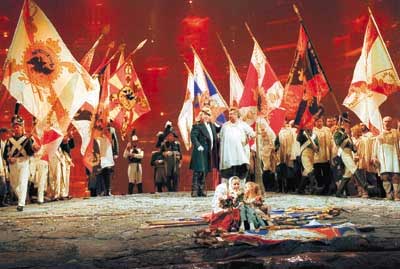
The final of the performance, in which the defeated French banners find themselves at the feet of Field Marshal Kutuzov, caused revival in the royal box (photo: Victor Vasiliev )
At one of the press conferences before the premiere, the director of the War and Peace, Andrei Konchalovsky, flirtingly complained about the “excessive excitement” around the upcoming performance. “I hope it is caused by interest in Prokofiev’s opera, and not just the arrival of Putin and Blair for the premiere,” he remarked. The director had every right to show off. Of course, the excitement was caused by the arrival of high guests, but it was also well -guided. Rehearsals were guarded as a military secret; No "unaccounted" correspondent penetrated them. The performers learned about the two compositions from the two compositions almost on the day of the performance. The theater artistic director and the musical director of the production Valery Gergiev flew to St. Petersburg a few hours before the opening of the opera (the day before he conducted in America). Prices for tickets to the ground rose to 1,500 rubles, and the box cost up to $ 1,000.
As a result, Konchalovsky received full satisfaction: the premiere was no less pomp than a year ago the first viewing of the film "Siberian barber" of his brother Nikita Mikhalkov. There were government banquets, and a masquerade in the lobby and corridors of the theater with fake guns, mannequins and statists in costumes of the last century.
Mariinsky, presumably, was also satisfied, taking the attention of the heads of state as a well -deserved reward for a ten -year -old stormy activity, during which the theater put almost all the operas of Prokofiev. “War and the World”, perhaps, is the greatest of them, but also the most difficult for stage incarnation. Verogeneous episodes - from classic arias and dancing to movie music and dialogue dialogues - are soldered into a single whole. The terrible sound "paintings" of the battles - explosions, moans of the wounded - coexist with touching lyrical themes, colorful genre scenes, magnificent hymns. The music of "War and Peace" requires an equally flexible and rich theater language connecting the stage of the twentieth century with the classic directorial techniques of past eras. But our modern opera directing so far does not know such a language.
The Mariinsky Theater honestly did everything he could for the Prokofievsky masterpiece. In 1991, he first put and recorded his full version and thereby fulfilled the duty to history. It remains to create a performance not too tiring for the public on the basis of “War and Peace”, and make him a loud advertisement. Which was successfully implemented in partnership with the New York Metropolitan Opera.
Scenographer George Tsypin made an action into the "cosmic" space. The floor of the stage is covered with a dome -shaped structure - a vault of the globe. The sky extends over it - either black star, then covered with thunderstorm clouds or smoke with flashes of conflagration. If necessary, the decorations are supplemented by details - glass columns at the ball, armchairs in the office of Bezukhov, guns in battal scenes.
The behavior of the characters is amusingly contrasting with such a strict and magnificent situation. Their gestures are fussy, the actions are hasty, feelings are superficial. There is no question of epic. Due to numerous bills, the action seems chaotic, hasty, and sometimes even lightweight. The shy prince Andrei (Vladimir Moroz), before inviting Natasha (Irina Mataeva) to the waltz, drinks for courage and goes to her with a “wooden” step. But, having played like teenagers, the heroes are lying to the floor and Natasha joyfully chatting in the air with legs, demonstrating children's pantalones. Russian regiments pass in front of Kutuzov to music with a difficult rhythm for march. The troops can not get in any way, or even at all, in the fun of the public, walk in a differently. Grotesque strokes Konchalovsky reduces the pathos of large -scale episodes. Then he releases a pot -bellied man with a caricature club, representing on behalf of the people in front of Kutuzov (Sergey Aleksashkin), then in the episode of the fire of Moscow, elevates over the crowd of a booth red rooster.
Thus, instead of the play-marshmallow, demonstrating the greatness of the folk spirit, a story is about miserable, unreasonable people, passionate about small adventures and incapable of feeling the approach of the universal disaster. Konchalovsky instructs the characters to emphasize this topic, over whom the director does not ironize - Pierre Beryov and Moscow Baryn Marya Dmitrievna Akhrosimova. Nervous Bezukhov performed by Gegaam Grigoryan throughout the entire action suffers from vulgar croaking of others. Reporting Kuragin, he contrasts him with unnatural-plaquisite intonation, sincere and noble. The good -natured, charming Akhrosimova - Irina Bogacheva - demonstrates enviable vocal skills and truly great -leading splendor of manner, combined with home simplicity and naturalness. It turns out to be in the play the center of stability and sanity, a caring mistress, who rests in order in her house and in a society who does not divide children into her and strangers. Holding Natasha from the escape with Kuragin, Bogachev - Akhrosimova reports her not angrily, but softly, almost mockingly, sincerely marveling, as an adult girl could reach such stupidity.
The heads of Russia and Great Britain did not tell the press about their impressions of the performance. Only in one of the news releases did a fragment of Putin’s phrase from a conversation with Gergiev sounded, something like “thank you for the quality goods”. Perhaps the creators of the play would prefer to hear the words “discovery”, “event”, “shock”. However, the acting apparently thought in the categories of raising production. However, the "product" turned out to be really of high quality.