
Translated material
Business in Lenten oil
Investments flowed into the domestic production of vegetable oil
(Photo: Max Novikov )
Last year, a record harvest of sunflower seeds was harvested in Russia - 4.2 million tons. This is 1.2 million tons more than in 1998, and almost a million than in 1990. One of the reasons for such a rapid growth in the production of seeds, apparently, is due to the fact that in the second half of the 90s, the seeds became a profitable product of export. According to various estimates, in 1997-1998, 1-1.2 million tons of seeds were exported from the country, that is, about a third of the crop. From this amount you can prepare about 500 thousand tons of vegetable oil. About as much (400-600 thousand tons) of oil and imported into the country from abroad, and the lion's share of imports is not some exotic such as palm or olive, but a banal sunflower oil. Meanwhile, Russian oil plants were idle due to a lack of raw materials.
To protect the interests of national manufacturers, the government entered a 10 percent export fee for seeds last year. It has become unprofitable to export the seeds, which was supposed to stimulate domestic factories, which have mastered the product that have been an unfamiliar domestic production in recent years - refined oil.
We still love to smell like
According to the Union, oil -processing and oil processing enterprises (MMPR Union), in Russia there are few more than 80 large factories. They are mainly located in the chernozem lane. According to the Swiss company "Oleina", only 20% of Russian equipment meets international standards. The system of elevators is not developed, many simply have nowhere to store the amount of raw materials that are required for a year.
Today, as in Soviet times, Russian plants produce an unrefined (so -called raw) sunflower oil, which has not been eaten in the world for a long time. Talking that in Russia traditionally love oil with a smell is only an excuse for Soviet poverty. Equipment for refinition (cleaning) and deodorage (destruction of the smell), extracting (destruction of waxes that are found on all plants) and bleach is expensive, because the oil plants were not equipped with them. There were practically no full cycle enterprises in the USSR. Extraction enterprises (oil production from seeds) produced raw oil, and equipment equipment was mainly located at food enterprises that used oil for other products. That is, oil plants worked mainly for food plants, no much attention was paid to retail trade.
The oil in the bottles was in short supply, it is enough to recall the devices installed in food stores, to which it was necessary to come with their bottle. You can also recall the sediment with a finger with a thickness that settles at the bottom of the bottle. At most enterprises, since then, little has changed. And today the lion's share of oil plants is still specializing in oil supply to food enterprises for further processing. If where there are lines on the roser of oil into bottles, then they do not occupy a large place in the production structure. "Unrefined oil for food enterprises and for bottles is the same thing, with the only difference being that the cleaning standards of the bottle oil, so to speak, are higher. Food enterprises still refine the oil," explains the representative of the plant, where bottled oil is 20% of production volumes.
“So far, Russian industry cannot fully provide people with vegetable oil, since it is not able to offer customers in sufficient quantities European class goods, that is, refined oil, which is mainly imported,” AGD representatives (Argentinean firm supplies Oil “nature”) and Oleina are convinced.
The factories cannot be handled by themselves, to equip the production of the full cycle with approximately $ 25 million. So, investments are needed. And recently, investments in the oil production industry have really appeared. Moreover, unlike Ukraine, where foreign companies are investing in the oil like, Russian firms themselves began to modernize production. "The consumer has more and more stringent requirements, and over the past years, we have had large -quality changes, and enterprises have been able to offer European class oil," emphasizes the President of the MMPR Union Nikolai Nesterov. Such companies develop their own brands, advertise their goods. Since the industry is just beginning to truly develop, there is an opportunity to gain a foothold in the market.
According to the Union, among companies equipped with modern equipment and offering the European class goods, four - EFCO (Sloboda trademark), Russian seeds, Russian bachelors (Zlato) and South of Rus' are allocated. "Sloboda" can be considered the old -timer of the market (representatives of the company "Efko" refused to talk with "results", and information about it had to be received from other sources). "Sloboda" is carried out on the basis of a modernized oil plant in Alekseevka of the Belgorod region. Power is designed for the processing of 430 tons of seeds per day and cleaning and packing 200 tons of oil per day. About half of the products are unrefined oil (but its production standards are higher than the average in Russia). According to Nikolai Nesterov, this enterprise is not the largest in the country, but it sells oils more than others and its capacities are completely loaded.
“The South of Rus'”, on the contrary, is a completely new enterprise built from scratch, the presentation of which took place in the second half of April (according to some reports, its owners used to be exporting seeds), located in Rostov-on-Don. This is the largest plant in the country, its capacities are designed to process thousands of tons of seeds per day and cleaning and packing 150 thousand tons of oil per year.
The company "Russian Bachelor" began with the trade in Argentinean oil "Ideal". “But we decided to engage in production ourselves and were going to build a new factory that meets world standards,” says the President of the company, Alexander Startsev. In 1998, the company developed a brand of refined Zlato oil and, while there was no capacity, placed an order for its production at one of the Argentinean enterprises. The first batch of Zlata came to Moscow exactly to the crisis - in mid -August 1998. The company "Russian Bakalea", which invested its savings in the GKO, had to part with the idea of building a new factory and seek capacity in Russia.
The choice fell on the Labinsky oil -extraction plant (MEZ) in the Krasnodar Territory. According to Alexander Startsev, this plant had a joint project with one of the companies close to Gazprom, which has already installed at the enterprise a full complex of equipment for cleaning 100 tons of oil per day. The Russian Bachelor has bought a share from the Gazprom company in this project, and then became a co -owner of the plant itself. Now reconstruction is in full swing, equipment is updated in the extraction workshop (it will increase the percentage of oil production). The new workshop, which should earn in September of this year, will be able to process approximately 300-330 thousand tons of seeds per year. At the next stage, which is planned to be completed by May next year, the oil cleaning and packaging workshop will be reconstructed. Its capacities will allow 500 tons of refined oil per day.
We would have more seeds
The appearance of large oil processing enterprises should increase the demand for raw materials. After all, the seeds were exported to a very large extent due to the inability to sell them within the country. The production of seeds, like any other agricultural products, is a seasonal business. The harvest begins in late August and lasts three to four months. During this period, plants should purchase raw materials for the whole year. "The plant, processing 330 thousand tons of seeds per year, needs to immediately pay $ 50 million for raw materials," says Alexander Starktsev. This is a large enterprise, but also half the plant should have colossal means.
Most enterprises did not have such money and did not. Therefore, some plants purchase seeds for several months (and, having worked from September to March, at best for April, stop), others work on long -time raw materials. Now any company, even any businessman can place an order for the production of a batch of oil under their own name (hence the appearance of a large number of oil names), and pay with the enterprise, leaving him part of the products, or money. Therefore, some experts even fear that a shortage of raw materials may occur: export has become disadvantageous, and there is a danger that peasants will reduce production. “This year they can cut out the sown area of thirty percent, then next year we will find a shortage of seeds,” the President of the MMPR Union Nikolai Nesterov does not exclude us. “As if not to import them, not to mention the import of oil itself.”
Representatives of Russian oil production enterprises and Western supplier companies argue that oil imports are at the pre-crisis level. He recovered quite quickly after the collapse of 1998. The reason for this is both a lack of vegetable oil and the backwardness of the Russian oil production. According to experts, imported oil in retail trade during its seasonal deficit (that is, in the summer, when most domestic factories are idle), is still approximately 50% (given all types of oil, including sunflower, soybean, corn, and olive).
At the same time, last year, oil production in Russia, according to the Ministry of Economy, increased slightly and amounted to 845 thousand tons (in 1998 there were 782 thousand tons). But there is still deficit: somewhere around 500-600 thousand tons. “I believe that Russia is able to fully provide itself with oil. There is everything for this: traditions of consumption and production, raw materials, and processing enterprises,” emphasizes Alexander Starsev. In his opinion, in order to replace imports, the country needs to have six large modern factories. Although today the capacities of modernized enterprises (taking into account the new "South of Rus'") are theoretically able to squeeze imports.
Most likely, the share of imports will be reduced as the production of European class oils in Russia increases. “So soon, it will happen, since modernization is in full swing,” Carlos Perez is convinced by the director of the Russian representative office of AGD. Today, the refined oil is half the market of bottled products. Actually, no one considered the need for refined oil. According to polls conducted by the marketing company "Validate", unrefined oil, which retains the natural smell of seeds and has natural yellow, consumes many. It is used for the preparation of salads, and not only the older people, but also young people. And therefore, representatives of the "validates" believe, it is unlikely that unrefined oil will completely disappear from the market in the near future.
“But over time, the situation will change,” Alexander Startsev is convinced. “They eat purified oil around the world, and we will have.” In large cities, where people who have seen enough advertising are striving for a healthy lifestyle, they are already accustomed to refined oil, considering it more useful. You can not discount food plants, which are much easier to purchase already refined oil.
“Russia has great prospects for the growth of oil production,” admits Carlos Perez. “If you plant empty lands with sunflower, you can collect tremendous yields. After all, the demand for vegetable oil in your country is growing, its consumption will increase in the next 10 years.” Indeed, growing sunflowers in Russia is not a problem. In the Black Earth Region - Voronezh, Belgorod, Lipetsk, Kursk, Tambov regions, Krasnodar and Stavropol Territories - seeds ripen no worse than in Ukraine or in distant Argentina.
So the development of the industry will certainly continue. According to the "results", some commercial structures are bought by oil plants, they think about installing equipment equipment on them. Probably, trying not to lose the Russian market, Western oil suppliers are thinking about their industries in Russia. "For us, this is a resolved issue, this year it will finally determine whether we will build a plant from scratch or acquire some Russian enterprise," Oleina said. AGD also thinks about production in Russia. So far, Russian manufacturers have a chance to gain a foothold in the market. Because when factories of foreign companies appear in Russia, a new stage of competition will begin. In the coming years, the weather in the market of vegetable oil will be made by modern large factories. Well, most of the old enterprises, which now work for two to three months a year, if they do not find an investor, will simply die out. 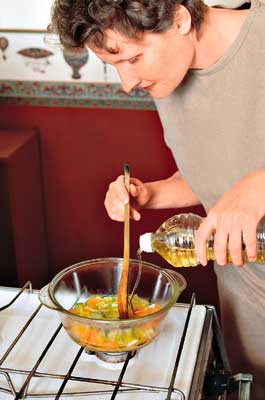
Many still love salad only with odorous raw sunflower oil, but the tastes are gradually changing: now the salads are often refueled. (Photo: Max Novikov )