
Translated material
Mark Pechersky. Paris, Conciergerie
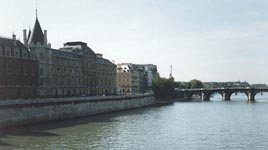
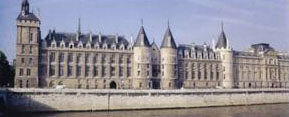
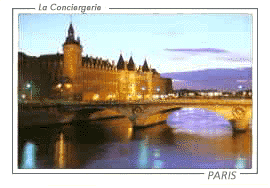 In the center of Paris, on the shore of the Seine, opposite the historical heart of the city, Cite is a three -story building with towers crowned by typically French black cones. Now is the Palace of Justice, in the distant past - an extension to the Royal Palace. In different eras, the view of Conciergerie caused envy, fear, amazement in the minds of people. By the density of historical events per square meter, this structure should take an honorable place in some books of records of the whole in the world; A rare educated European does not know at least one of the stories associated with this place. The kings of Philip the Second (August), Louis Ninth (Holy) lived here. At the end of the XIII century, Philip the fourth (beautiful) attached towers. In the XIV century, kings transferred the Palace of the Zamok (with a group of neighboring buildings) to parliament. But, remaining his nominal rulers, they entrusted him with the management of the palace economic service (from where the name is √ conciergerie).
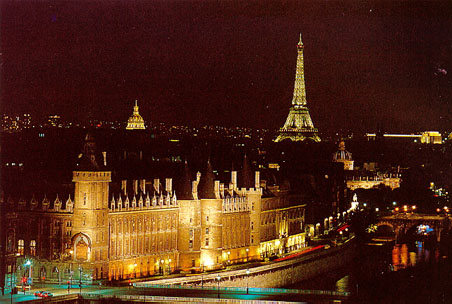 The current entrance, next to the Caesar tower, was built relatively recently - in the 1860s. Passing through a small courtyard and climbing the steps, you fall into the oldest (from the surviving!) Part of the royal palace - into the halls of the guard and St. Louis. According to a contemporary, "no one has seen anything more beautiful in France." Another hall, the huge La Grande Salle Basse, was intended for the palace servant; From it, a direct move to the kitchen, where the old hearth has been preserved.
But the early, palace, part of the history of the building has almost not been preserved in folk and cultural memory, for from the end of the 14th century the castle and the very word "concierge" were associated only with the famous prison. The chronicles conveyed to us the names of only the most noble prisoners of the early period: Count de Montgomery, who had carelessly deadly wound in the Knight Henry Second Knight's tournament; Gerara de Guette, a stained chief tax collector of one of the first Louis; Jean Shastel, who made an unsuccessful attempt on King Henry of the fourth (remember the "Queen of Margo"?).
Here on May 16, 1610, two days after the next and this time successful, they brought the killer of Henry of the fourth, Ravalyak. He was subjected to terrible torture, the description of which has been preserved, but the details are too naturalistic for easy tourist reading; It is enough to mention that Ravalyak often lost consciousness from pain and could not get the names of accomplices from him.
In the Montgomery tower, the Marquis de Brinwillier sat, a small, fragile woman with beautiful eyes and indefatigable ambitions. She tested her first recipes for poisons at the unfortunate patients of Parisian hospitals. After that, the best of them was treated by Papa, the Civil mayor of Paris. Then - two of their own brothers. An attempt to poison the sister did not pass with impunity: de Brinville was exposed. In a panic, she fled to England. From there to Holland. From the Netherlands to the neighboring Brabant, where she was going to ask for protection from the Spanish crown. But in those days, the news traveled more slowly than people, and, without suspecting anything, the famous poisoner entered Liezh the day before the transfer of the city to the Spaniards. The outgoing French army grabbed the fugitive and, upon returning home, handed over to Conciergerie. In view of the nobility, she was tortured only with water and, although the Marquise denied everything, sentenced to cut off her head. Which happened on July 16, 1671.
 In the same tower almost a hundred years later, Damien was imprisoned. Unlike Henry of the fourth, Louis XV, who was attempted by Damien, escaped with a slight wound. But the attempts of regicide were rare, the crime itself is extraordinary, and the arrested without any interrogation at the crossroads was urgently taken to Paris. Residents of the streets on which the carriage raced strictly was forbidden to leave the houses and even peer out the windows. Interrogations and torture lasted sixty -six days. Damien was tied to the floor with soft leather belts and regularly watered them ... After that, the sentence (quarter) should have seemed to him mercy ...
The people of my generation can remember the adventure comedy "Cartush", the prototype of the protagonist of which (according to some information - the French Robin Hood, according to others - just a successful robber) "walked" in France for a long time, until one day he was captured in the Pivnushka Pistol in the east of the country. As a particularly dangerous criminal, Kartusha was transferred to a "three -story building with towers", where they soon sentenced to wheezing. On November 27, 1721 he was brought to Grevskaya Square. The jailers did not know that during the imprisonment in Conciergerie, Cartush contacted his comrades and they vowed to rid him of the last torment. A huge crowd gathered in the square. The executioner was already coming. There are no friends. And at that moment, the cartoon, who denied everything under torture, spoke. And he said ... 18 hours in a row, calling the names of accomplices, listing the "Khazians", bribed royal officials. As an eyewitness wrote, not a single person left the square during all this time, there was a piercing silence, in which only one person was heard. While he said, the police arrested eighty of his accomplices. Then Kartush fell silent and did not make a sound during the painful execution.
The glory of the adventurer of Jeanne de Valois was even eclipsed! On the "necklace for the queen" novels were written. All Europe followed the ups and downs of this intrigue. No matter how disappointing to lower the details, the essence of the story is briefly. A kind of jeweler, having heard that Queen Maria Antoinette dreams of acquiring a decoration for some of the celebrations, bought extraordinary stones and made a beautiful necklace from them. But ... the queen abandoned him. Either that day was not in the spirit, or the jewelry did not like. The jeweler remained with a necklace in his arms and a huge debt. He shared his grief with a certain noble client, Countess de la Motta. So Jeanne enters the stage - of course, no countess, but an entrepreneurial woman who drew an acquaintance with a great master to fake any handwriting (he made Jeanne a "countess"). All further really resembles an adventure novel. The adventurer gets to the appointment of a secretly in love with the Queen, but who is afraid to admit to her love to the Cardinal Rogan and convinces him that Maria Antoinette was feeding mutual feelings for him. Jeanne is taken to organize a date and in farewell in passing mentions the necklace: the queen dreams of decorating, but ... it is too expensive. The cardinal "pecked" and gave a huge advance to purchase a gift. The matter could turn out differently, but the desperate jeweler by that time lost all hope and broke the necklace. He hoped to help out at least something from the sale of individual stones. And Jeanne took stones from the jeweler, the cardinal has more and more amounts and drove both sides by the nose for a long time. In the end, the intrigue opened, Jeanne de Valois and Cardinal were taken under arrest. Rogan was soon acquitted: he managed to prove that he did not want to offend the queen. Jeanne got into Conciergerie. She was judged and sentenced to punishment with a whip, stigma and life imprisonment in one of the distant prisons, in Salpier. No one knows how, but soon she escaped from there. Soon, Countess de la Motta appeared in safe London, where she died several years later in complete poverty.
***The fire of 1776 forced the authorities to rebuild a significant part of the complex of the Palace of Justice, including Conciergerie. As if the hand of providence sought to cleanse the deposits of the old story and prepare the prison for the new era.
Let's get back to the gate and the courtyard behind them. At the site on the left, at the stairs, during the revolution, women gathered in the morning, following the one who was brought from the will and who was taken out of the interior to the barred room (now a cafe for lawyers) with long benches. The latter were suicide bombers for whom a guillotine was built on that day on the Revolution Square (now Place de la Concord). Although in the 19th century the prison was again thoroughly rebuilt, general topography allows you to see some elements of the previous device, primarily La Grande Salle Basse. In the era of the revolution, nine rows of columns of the huge hall were blocked by gratings on the so -called "streets".
On the Parisian ("Rue de Paris") sat the poor. At the end of the central corridor (to the left of the mentioned modern cafe) was a room for women's suicide bombers, who were reduced here from different cameras on the night before the execution. At the very end of the corridor - the camera of Queen Maria Antoinette; Before the perestroika of 1816, when several partitions were removed, there was a camera nearby, where the revolution dictator spent the last hours of life, Robespierre.
From the corridor you get into the courtyard of common cameras. A small staircase in the tower of Bonbek leads to (preserved) rooms of the revolutionary tribunal.
Here, I think, a small historical exposition is appropriate. At some times, not so much people become expressors of the era as a place. The place under the stairs at the entrance to Conciergerie, which allowed to see who was brought today and who is taken away, was ideal for observing the progress of the revolution. If there were ever such a place for a third-party or interested observer, no newspaper, no “expert” in the world could more precisely determine the “Kremlin’s policy”. At the end of the XVIII century, such a lighthouse of history could have a place at the stairs leading to the revolutionary tribunal. Without any exaggeration, we can say that every morning there was a crossing of power lines of the entire European history of the beginning day and - as we know now - the future century.
 The tribunal was established in March 1793. At first, he included the prosecutor, lawyer, judge and twelve jury. (The latter discussed the case here, in the hall, publicly.) But soon a new law came out, which declared witnesses and jury unnecessary luxury. The tribunal moved to the consideration of cases and the sentences not on an individual basis, but on the lists - the terror machine turned on in full power. According to the law above the human, the former chief prosecutor of the Foecke-Windle revolution was the last victim of the revolutionary “justice”. He was taken away from Conciergerie on a date with the guillotine on May 7, 1795. And already on May 31, the Termidorian convention abolished the tribunal. This horror for every Frenchman, the institution lasted 718 days and sentenced 2742 people to death. Compared to millions of victims of the Stalinist terror, these numbers seem insignificant. After the Khrushchev revelations, they were often led to the place. But even more often, to show how "our paralysis is more progressive than their their own." Like, we would have such a revolution, such a tribunal ... Meanwhile, the figure is huge - both in demographic and historical calculus. For Conciergerie was mainly found by figures: politicians, military, outstanding revolutionaries and no less outstanding opponents of the revolution - in a word, figures . There are always much less of them than fellow travelers or salon grumbles.
Walking along the corridors and courtyards of the prison, where Queen Maria Antoinette, and the Girondins, who sentenced her to death, and Charlotte Corde, who had a dagger of the “friend of the people”, who sent the queen’s judges to Conciergerie, were sitting in a kaleidoscope. Where in the inexorable sequence of events the last days of life and the fan of the revolution Robespierre (1793), and the leader of the counter -revolutionary monarchist movement of Shuanov George Kadudal (1804), and General Male (1811), the organizer of the conspiracy against Napoleon in favor of the restoration of the “revolutionary immaculate”, and the Napoleonic marshal (1815), which is halting. This king’s oath to “bring the usurpator in the cage” joined the army of Napoleon and took part in the battle of Waterloo - you cannot help but feel the terrible power of the tornado, who changed the whole story, was thrown into the center. Ours with you as well.
Journal "World of Travel", Roman Travel, San Francisco