
Translated material
Parisian gut
The metro of the French capital is the same symbol as the Eiffel Tower or the Champs Elysees

Most stations, like the Montmartre station, decorate advertising shields (photo: RATP )
You can’t confuse the Paris metro with a single subway: here you can hear how the tropical rain is noisy, inhale the smells of lavender and cedar needles or meet people dressed in cows. Here, underground, they arrange holidays and masquerades. They also offer to try Moroccan couscous or Russian pancakes with Tarama (Greek Tarama - caviar cod - the French for some reason consider a typically Russian dish).
One of the oldest in the world (this year it celebrates its 100th anniversary), the Paris metro is not only a unique transport network: 380 stations and 14 lines with a length of about 300 kilometers, intertwining with the lines of electric trains - Rer (which allows, without leaving the ground, to get from the suburbs to any corner of Paris). This is also the Art Nouveau museum, and one of the last achievements of Haytek. And, finally, the most important thing is the place where the national character of the French can be best felt. Popures of one of the Parisian architects, the metro is a "window in the subconscious" of the nation.
Another French revolution
It is hard to believe, but the first projects for the construction of the Parisian subway, which appeared more than one and a half centuries ago, were at first met with hostility: the idea of underground transport seemed pure adventurism. It is not surprising that many in France found the plans of the Metrostroevtsy antimunicipal and even antipatriotic.
However, the thought of their own subway did not allow French architects to sleep calmly. In the project of 1881, it looked rather funny: a large tram raised to the platform, which was propped up by thick three -meter columns - not an subway, but an overhead.
The final project was adopted in March 1898. Two and a half years later, on a historical day for the Paris metro - July 19, 1900, from the station "Port Mayo" at a speed of 30 kilometers per hour, the first composition with 150 passengers departed. The audience, gathered in three wagons, was very motley: teacher of the university, bourgeois, owner of a wine store, a rim, housewife, a lady of a semi -light, the head of the ministry and an employee of a hat workshop. According to the creators, the Paris metro was supposed to become a universal means of transport, which all citizens would use, regardless of their social status. And their calculation was justified - by December 1900, the number of passengers was 18 million. 
The history of the Paris metro is not only the construction of new lines and the improvement of management systems. This is also the history of the city: bombed metro in 1942 (photo: RATP )
Democracy today distinguishes the metro of Paris from the metro of many other large cities in the world, let's say New York, where only people of a certain social status use the subway. In the Parisian subway, you can meet anyone: from neat clerks, who do not part with business papers in the subway, and I will ladies, as if coming from the pages of fashion magazines, to unshaven emigrants and brushed hard workers. Once I witnessed how young people arranged an impromptu performance on the occasion of the wedding of one of their friends. The bridegroom (apparently, from the Normandy, who is famous for its dairy products), changed his cow and began to mumble loudly, and the cheerful company began to throw a salad into it. This did not shock at all passengers.
A century later, the question of whether the metro is contrary to the spirit of the nation, it does not occur to anyone. 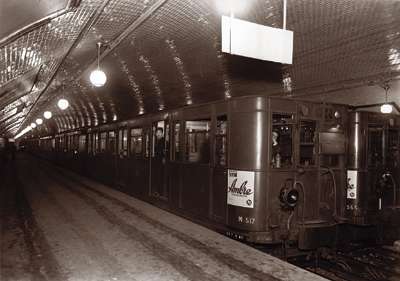
Metro half a century ago (photo: ratp )
In the halls of the underground museum
A hundred years ago, the Art Nouveau style reigned in European art. In French - Art Nouveau. This could not but affect the architecture of the metro and its interior. The builders from the very beginning sought to ensure that the entrance portals harmonize with the architectural ensemble of the city. The author of the first projects was a young, but already gaining fame, architect Ector Gimar, who was attracted to this work by the engineer Fulzhans Bianneus. Himaru Parisian subway owes its lamps, as well as boards with a metro plan, decorated with magnificent ornaments.
Today, one of those 115 portals made in the Art Nouveau style remained only 86. There is nothing to be done: the architectural appearance of the city changed, and the exquisite pavilions with "excesses" already seemed an anachronism. The old pavilions began to be changed to new ones.
This continued until 1978, when all the elements of the decor of the Paris metro, made in the style of Art Nouveau, were ranked for historical monuments. Now they are restored: carved doors, elegant balustrades and famous Gimarov lamps in the form of lily of the valley are disassembled, cleaned, freed from layers of paint and rust.
However, the Paris metro is not only ART Nouveau. At the Louvre station, for example, reproductions of paintings from the famous museum are exhibited. The walls of the Concord station (which means “consent” in French) are dotted with quotes from the “Declaration of Human and Citizen Rights”. The Bastille station is decorated with frescoes depicting scenes of the Great French Revolution, and at the Varenn station, located near Rodin’s House-Museum, there is a copy of the famous Rodinovsky “thinker”. What is not a museum underground?
An inexperienced tourist Paris metro plan may seem like a Chinese diploma. About four hundred stations cannot be reflected in signs in such detail as it is customary, say, in Moscow. Therefore, only end stations are indicated. In order to drive from point "A" to point "B", you must, firstly, determine the very end point of the line on which item "B" is located, and secondly, to correctly calculate the transfers. It is not surprising that at many stations the metro plan is rubbed with fingers literally to the holes. In addition, stations are not announced in the Paris metro. The distances between them are short, so you need to be very careful not to drive your stop. Similar, by the way, often happened in his youth with the famous French actress Jeanne Era. Even a very young actress, she often plunged in the script and recalled the desired station when she was already far behind.
To finish the story of possible trials, you need to mention the fading controllers who are common to literally grow out of the ground in front of the ridicule. According to statistics, the number of "hares" is 4 percent of the number of passengers. The most common way to penetrate the subway without a ticket is to jump over the turnstile. 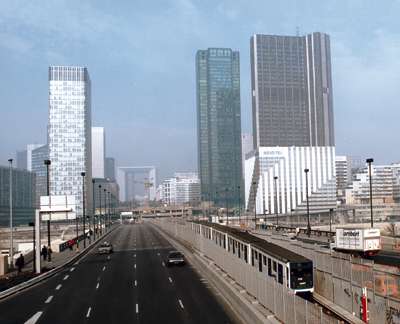
Metro in the new business quarter "Defans" (photo: RATP )
However, if you do not violate the rules and be attentive, then the Paris metro will not give you unpleasant impressions. Here, in the direction of movement, you can do a lot of useful things. Metro is a whole underground city, where there are boutiques of prete-a-port, cafes and even hairdressers (at central stations).
Unlike cities where it smells of burning and exhaust gases, underground Paris is fragrant with forest and meadow (unless, of course, it is littered with garbage, which often happens when those who are supposed to clean it up). Parisians chose a fragrance for their metro called "Madlen", developed by the same laboratory that creates perfumes for the famous couturier of Tiery Mugler. Since 1998, the floors of the lobs are monthly covered with 150 tons of flavored wax.
The line of the future
In 1998, a new, 14th line "Meteor" appeared in the Paris metro. This is a metro without a driver, controlled using a computer system. The creators of the "Meteor" call their brainchild only as a "technological miracle." Similar lines exist in a number of cities in the world: Vancouver, Toronto, Detroit, Miami, Chicago, Taibe, Kobe, Osaka. Each car has two camcorders for observing passengers, as well as a negotiation device. 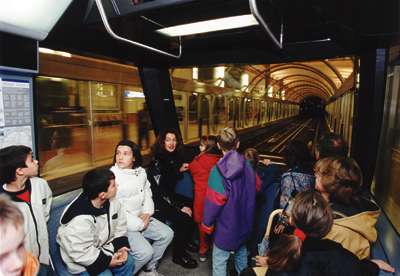
14th line. Rolling by train without a driver is a favorite occupation of adolescents (photo: Anna Shestopalova )
The miracles of the 14th line do not end there. At a depth of 12 meters underground it is raining: large drops knock on the leaves of tropical plants. This happens in the garden located at the Gar-de Lion station. The idea of the garden came up with Francois Saglie, the head of the project 14, during his trip to Singapore, where vegetation is widely used in the design of underground premises. The microclimate of the Paris subway turned out to be optimal for the tropical flora. So here there were palm trees, ficuses and another 950 species of plants, including rare ones. The picture is complemented by the backlight that changes depending on the time of day, and the voices of the birds recorded on the film.
Of course, no one guarantees visitors to this paradise garden a carefree life. When the metro workers and a two-hour delay in work are stopping to be something out of the ordinary, few people pay attention to the beauty of the subway. In a word, Parisians scold their metro as often as they praise, but they are no longer able to do without it.