
Translated material
Anton Dolin. Cinema-12: Find a witch!
To the premieres of American films "Witch from Blair - 2: Book of Shadows" and "What hides a lie"
I already wrote about the nature of the fears of a modern person, with a lesser or great success reflected cinema. There is no particular doubt that today we are afraid of ourselves and our neighbors much more than any misfortunes from the outside world. In any case, in relation to the constantly developing genre of the horror film (or, more precisely, a film-film) this is exactly the case. And connected not only and not so much with paranoia consciousness of the end of the century, but with the exhaustion of intimidation means in cinema. The capabilities of computers are too limitless, and since you can show anything on the screen and any schoolboy is able to observe on his monitor, playing some game, even Satan himself, not to mention strangers and Freddy Krueger, will not scare anyone today. However, the need to be afraid is too great and still carries too powerful commercial potential to refuse it. The rise in the popularity of the new wave of American horror films in recent years ("Scream", "I know what you did last summer", "City legends", etc.) is associated with this. This also explains the phenomenon of the "witch from Blair." And the fact that she has a continuation. And even the fact that one of the most titled genre chameleons of Hollywood Robert Zemeckis first shot a picture in the scarecrow genre.
Stylistically, the “Book of shadows” and “what hides lies” is not only not similar to each other, they are almost the opposite. The Book of Shadows was set by no one well -known documentary Joe Berlinger, “What hides a lie” - an omnipotent author “Back to the Future” , “Rabbit Roger” and “Forrest Gampa” . In the first film, unknown and not too expressive youths played, in the second - a brilliant duet: Michelle Pfaifer and Harrison Ford . The Book of Shadows is operating from the arsenal of old, cheap and terrible horror films - in short, blood and owls. "What hides a lie" is a new interpretation of the old genre of aristocratic film about ghosts and tribute to the Hitch of Hitchcock. "Book of shadows" of the flat and full of euphorbia humor. "What hides a lie" total serious and built on psychological nuances. However, in essence, both paintings speak of the same thing and teach the same one and the same, known among the people a long time ago: do not be famously, while it is quiet.
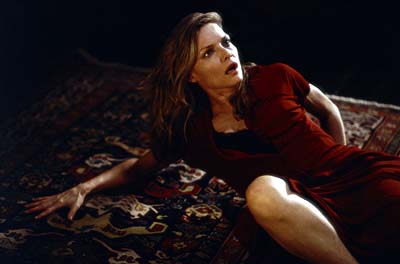 However, what to wake him up - he will wake up. The name "what hides a lie" quite exhaustively conveys the essence of intrigue. The heroine Pfaifer Claire, once a talented cellist, and now the wife of a successful scientist, doctor Spencer (Ford), gradually, faced with longing for his daughter’s college, begins to understand that not everything is in order in her life. She does not know whether to make a discount on age or on loneliness, or attributed strange qualities to the family house of spenesers, where they live, but everywhere she seems strange sounds to which visual phantoms are joined over time. The husband is worried, first turns to a psychiatrist, and then to the practices of exorcism, but in vain. Claire feels one thing: danger is somewhere nearby. At first, she tries to blame new neighbors - she is fanciful that the neighbor had killed a neighbor and drowned her corpse near the lake, but later it turns out that the neighbors live very amicably and all the problems have been resolved for a long time. Then the Claire is left - to believe in the reality of the ghost that penetrated their house.
The path made by the heroine is a gradual disclosure of truth. And the first step is the recognition of the reality of the irreal. From the moment she decides to believe in the ghost and on the advice of a psychologist (see "The sixth feeling" , on which "what hides a lie" is very similar) comes into contact with him, other sides of the true state of affairs begin to open. Claire has to recognize the fact that, in accordance with the canons of Gothic literature (and cinema), there are no ghosts to anyone. There is a secret that phantoms seek to tell her. When the secret becomes clear, the heroine faces an obvious fact: the worst thing is nearby, and has always been nearby. Too close to notice it. And the worst thing is a lie, the same self -deception that is fraught with the appearance of ghosts. Naturally, as in any "novels of secrets", it turns out that the ghost itself was once an innocent victim and it was not evil from it, but a warning about danger. The only modification of the classic plot scheme is that the system is closed. The ghost does not indicate someone from the side, it comes directly to its intended purpose, and no "extraneous villains" appear on the horizon.
According to a similar scheme , a "Book of Shadows" is built. It is clear that after the “witch from Blair - 1” the second time to catch the viewer will not be able to catch the same fishing rod. Moreover, the viewer, annoyed that despite all skepticism came to the trick of cunning PR managers and made his modest contribution to the success of the most profitable horror movie in the history of the movie, will be ready for any surprises. Therefore, the scriptwriters followed the example of Kevin Williamson, the creator of the "Scream", proclaiming: do not want to - do not believe, we laugh at stupid fears together, but if you are scared after that - blame yourself. At the beginning of the picture, the atmosphere of universal unbelief into a stupid invented witch is recreated extremely realistically: MTV news releases, telling about fan insanity around the place of filming of the picture, a thick local sheriff: "We went out of the forest, there is no fucking witch!" - Crowds of loafers in the cemetery ... and the main characters, five young people who went with video cameras (as expected) and other equipment to the place of the final scene of the first film for the modest happy name "Catch the Witch".
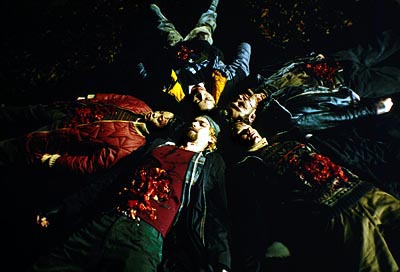 Joe Berlinger did everything possible so that the viewer did not think that they want to scare him and relax. The music of Marerelin Manson in the background, a normal film or television recovery, occasionally interrupted by purely parody video frames, constant jokes of heroes, familiar and already exposed scenery. However, the plot soon erases stupid grin from physiognomy for both heroes and spectators. Waking up in the morning at the house where their predecessors disappeared, young people discover that all the good is destroyed, the camcorders are broken, for some reason the cassettes survived into inviolability are hidden, and they themselves lost about five hours of memory about the night fun. One of the girls has a miscarriage, frightened youth goes back to the city, to the dwelling of one of them, a local merchant of Blair symbols (T -shirts, wooden little men, handfuls of stones). Then, looking at the film recorded in the "missing" period, the heroes find a lot of strange, and then find mysterious traces on their bodies. And this is only the beginning, followed by several deaths and collective madness ...
The first discovery and the beginning of faith in the reality of what is happening is the moment when it becomes clear that the witch is real (the process of awareness of the truth goes in the same way as in the film of Zemykis). Then an attempt to understand what she, the witch, wants and why she left the letter on the bodies, and why, with their participation, she left the forest to the city. And then - the most frightening solution. It turns out that evil is not outside, but inside. The witch was not angry, she was an innocent victim of a man who left her in the forest to die. And then the children came, beat her to half to death and began to dance around the tree, putting her palms in the bloodstream and leaving prints on her body. Not a witch at all, but those very children have mighted in our young hunters. But since the Blair witch has been destroyed for a very long time, now the heroes see the witches in each other and begin, without knowing it, merciless mutual reprisal. Only the only positive (extremely unattractive) hero - the Blair sheriff who does not believe in witches, but also believing in evil, as well as the ubiquitous video: cameras are placed around the house, and they continue to record what is happening and that for the time being is hidden from the eyes of characters and spectators.
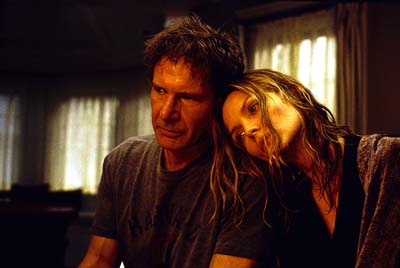 Two films scare the same, but frighten differently. Zemeckis technique is slow close -ups, quiet, but impressive Dolbi stereo door creak, splashing of water, clapping window shutters. Psychologism, the slightest nuances of small wrinkles on the faces of Ford and Pfaifer. Persons, so well studied by the viewer, so suddenly change in the finale that this cannot but act. Special effects in the person of the pale green drowned man only complement the overall picture. Berlinger contrasts the simplest and unobtrusive style of "Witch from Blair - 1" A strange mixture of documentary and cinema techniques. The naturalness of the behavior of the heroes contrasts with the bloated and scarlet effects - walking dead, strange abscesses on the bodies, blood streams. And everything falls into place only in the finale, where the truth is finally clarified: all the horrors were part of a terrible sleep in reality, seen by the characters. Oddly enough, the video remains no less effective than in the first part - it is just much less here, and the deliberate brutality of the video (many times repeated frame in which the knife turns in the body of an agonizing victim) against the background of fictitious mystical fears looks quite convincing.
And morality, meanwhile, is relatively banal. It is impossible not to believe in witches and ghosts, and - even more so - one cannot but believe and at the same time flirt with them. Because the main witches sleep inside you and wake up just when you are waiting for the least. Where does this evil come from ... no one knows. It is in a sense a priori. The thesis about the crisis of log centrism and any ideas about the feasibility of world order has already been beaten and outdated, but it is one thing to write about it in smart novels and philosophical research, and another to meet in exclusively commercial American horror films. In which there is no more revenge, no justice, no crime-order, but only fear of evil, which will inevitably come to you. Especially if you do not believe in it.