
Translated material
Pavel Rudnev. Theater sushi
The new production of director Elena Nevazhina and the artist Alexander Borovsky at the theater under the leadership of Oleg Tabakov "100 Yen for the Service" - a spectacle for gourmets. The small scene is hidden from the auditorium with a white curtain. On it - the broken lines of the branchy sakura, the sunset mandarin sun. A soft rod of drums, gong, rustling rubbing reed sticks against each other. A new performance, like a real Japanese picture, is impressive with laconicism.
Young director Elena Nevazhina is indefatigable in her literary searches. Wherever she put the performances (in the Satyricon, her “Jacques and His gentleman” Milan Kunders, “Servants and Snow” Iris Murdok, “Smugus” Patrick Zyuskind, and in the Mayakovsky Theater, “Mysterious Variations” by Eric Schmitt), nothing will force her to take her read off the book. Nenjina enriches the Moscow repertoire with unprecedented names, almost fictional creatures and forces theatrical critics to blush when he speaks of literature well -known to her.
Of the “one hundred yen”, faced with the material that is not too original, but still not known in Russia, ignoramus woven light, like hockey, adding from itself the share of dramaturism, which does not have enough of the Japanese absurdity.
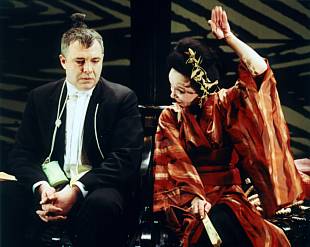
A man and a woman are found on a bench in a city park. He cannot find a job, but she does not see the meaning in her life. Most of the actions of the heroes have no sound motivation. The play by Batsuyak Minor is a Japanese absurdity, which the playwright has been engaged since the 60s. Pessimism, despair that reigned or still reigned in the souls of Japanese outsiders, the playwright passes through the templates of the absurd play born during the Crisis of the European Culture.
Evdokia Germanova plays a small aging Japanese woman (costume is a traditional kimono), along with the youth losing mind. She is a city crazy, living on a park bench, and all her tiny will focused on the desire to strangle the very sakura that flaunts in the center of the stage. What is oppressed by, we will never know, but it is clear that the meaning of her life is in these suicidal impulses. Suicide will never happen, but her hands, able to tie strong sea nodes, hold on to the rope as a saving straw.
Mikhail Khomyakov with a samurai crest on a grayled crown plays a former banner, a Europeanized "service worker". Now he earns a living with small services in the park. To show someone a toilet, someone is a way to the exit-and get 100 yen for this. He invented this form of special service, following the iron logic of capitalism: who has “Know How”, has money. But it turns out that he does not know where the public restroom is nearby. The “toilet topic” actors manage not to do vulgar: it is she who helps to notice the outlines of the reality hidden behind the standard and from this dead absurd composition.
Heroes who have met on a bench do not want to admit in life fiasco in front of each other. But they try to convince each other that their life has not lost its meaning. And asking for money for elementary assistance is as natural as hanging in Sakura. The unfortunate one is one lesson: reading the three -era. The play, the action of which lasts one day, includes four interludes - hockey about the seasons.
The performance does not end up with the abscess optimistic, but mysterious. The woman refuses the desire to strangle herself and puts her doll in a loop. But then a person who asks where the toilet is and reaches for a wallet is approaching her ...