
Translated material
Andrey Miroshkin. Ant with a thrombone
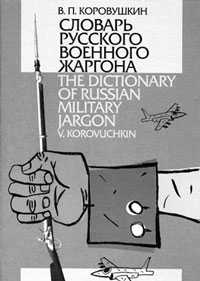 And by recently, the Rme's jargon was completely unnecessary and not a systematized form of oral Russian literature. And this despite the fact that jargon to one degree or another is used by all military personnel, and many jargonisms are mentioned in the literature of the Russian (Soviet) army. The reasons, in general, are clear: an “informal” army in Soviet times was a ban on all “informally”. In the official military literature of those years, samples of "correct", "patriotic" jargon and folklore came across, probably born in the bowels of Glavpur. Until recently, this could be found in the real, non -certificate jargon, only in soldier (sailor) letters and notebooks, "demobilization albums", or hear in the conversations of military personnel. In the last decade, genuine military jargonisms began to appear in the press. And now the first serious research work on this topic has come out.
Compiled by the professor of the Cherepovets Pedagogical Institute, Valery Korovushkin, "Dictionary of Russian Military Jargon" includes about eight thousand lexical units. The dictionary, work on which was conducted for a quarter of a century, covers the entire history of the regular Russian army. It described the jargon of military and militarized organizations that existed in the Russian Empire, the USSR, the Russian Federation from the end of the 17th century to December 1996. The words and phraseological units from the language of archers, hussars, midshipmen, gendarmes, partisans, sailors, scouts, cadets, cadets, KGB officers, air defense warriors, prisoners of war of the Great Patriotic War ... The dictionary was compiled according to all lexicographic canons, all words are equipped with clarifying litters. Some discomfort causes only a continuous arrangement of jargonisms of different eras and different branches of troops. Perhaps they should be divided somehow. In any case, this is a very valuable edition for linguists, and for historians, and, perhaps, for political scientists.
In soldier's jargon - as in any other - the features of the historical period in which it is used inevitably reflects. If the army to some extent is a model of society, then the army literature is the mirror of the army. In Russian "military language" the specific culture of its native speakers was reflected. For example, a significant layer of army vocabulary of 1917-1990 is borrowed from criminal jargon (and in the last few years - from jargon of drug addicts). Korovushkin’s dictionary is overloaded with thieves vocabulary (“striving”, “take on the Pont”, “Shalman”, “Shmon”), and this is a sad and convincing evidence that in the last 80 years, semi -appropriate morals reign in the Russian army.
It is curious that Korovushkin also attributes such purely “book” expressions as “Russian Vandei” (counter-revolution) and “patchwork blanket” (Austria-Hungary). It is clear that they were originated not in oral speech, but somewhere on the pages of newspapers of wartime and from there they were already oral everyday life (and then, presumably, very limited, "oratory"). There are other roughnesses in the dictionary. So, “Kerenke” and “five -star braid” is the very place in the political dictionary, the “Seine” is in the youth -blonde: the connection of these expressions with the army is very distant. On the other hand, such modern army jargonisms as "hazing", "black tulip", "zinc boys" have already become the property of literature and are known far beyond the professional military environment. Other dictionary exhibits delight non -banal imagery ("thrombone" - a sniper rifle with an optical sight). Many phraseological units from the Korovushkin collection gravitate towards folklore and, of course, deserve a special marking (“living and dead” - a marching, “consequences conduct experts” - morning examination).
Of course, modern jargonisms are the main “dish” of Korovushkin’s book: after all, words from the old, pre-revolutionary army vocabulary are already mostly recorded in the literature, but many pearls of the 1980-1990s were never published. Here, one again has to regret that the compiler did not single out modern vocabulary and phraseology in a special section. In its "modern part", the digit is impressive - although, like any dictionary of "current" vocabulary, it can easily be expanded and supplemented. Here are offhand, somewhat unaccounted for Coovushkin, jargon words from the personal collection of the reviewer (used in 1990-1992, at the time of military service in the air defense troops):
Coder is a coder.
A pigtail is a specially twisted belt used as a whip in a ritual “translation” of young soldiers to a higher level of a tireless hierarchy.
Ant is a soldier of the autumn call.
The lack of a soldier (usually young), experiencing a constant feeling of hunger.
The dog is a soldier of the guard.
To saw - cut veins in the hope of getting an exemption from military service.
The substitution is a replaceable form for dirty work.
Bending - a piece of fabric, folded in a certain way, used as a gateway.
Tomato is a soldier of internal troops (red shoulder straps).
Understand the service - with young soldiers: go through the first official trials.
Portup and an officer.
The buckle is the army.
A saber is a part of the belt that is not tilted into the coach (ring).
Standing is a method of fading collar.
Black battalion is a unit equipped with natives of the southern republics.
Chevron is a sleeve sign.
Shontopol - corporal.