
Translated material
Eternal Rome
A strange book that causes very controversial feelings. A lot of complaints can be presented to the compiler, but it should still be started with gratitude to him for the opportunity to spend some happy hours in Rome, captured in the soul of the characters and the main authors of the book-those very twenty “famous Russians”. We’ll turn to a detailed analysis. At first glance, it is not entirely clear what expressed Alexei Kara-Murzu, a person burdened with all kinds of regalia (Doctor of Philosophy, Professor, Master of Education of the Institute of Philosophy, Academician of the Self-Provided Academy of Humanitarian Sciences, a member of the political council of the Union of Right Forces, political scientist and publicist) and, probably, by deeds, to go to the bunch retelling of other people's memories and cutting from other people's collected works, that is, to perform work that does not require special intellectual stress. There is, however, one explanation that can justify more unreasonable acts - this is love. Love for Rome, forcing him to explain to him with the words of Gogol, Osorgin and Muratov. Another possible explanation is less poetic. The cutting is really capable of making any graduate student, but to publish it in the publishing house "Independent Gazeta" on excellent paper, in good design, and even with a circulation of as many as 3 thousand copies ... Image publication, personal PR. An inconspicuous inscription on the back of the title sheet - “The publication was carried out with the participation of the Moscow English Club” suggests. After all, Alexei Kara-Murza also seems to be the foreman of the Moscow English club-is it not true, the very sound of these words makes us assume something sophisticated cultural, elitist? The compiler author, it would seem, quite clearly formulates the task-to understand the phenomenon of "Russian Rome." However, he immediately declares this phenomenon incomprehensible, and only his specific manifestations are available for observation. The introduction does not contain any interesting ideas, although as such an universal thesis is proposed that Russia has not yet created a “comprehensive, consistent, whole and unified national culture”, and therefore the best in Russian culture often finds its alienation in the heritage of other peoples.
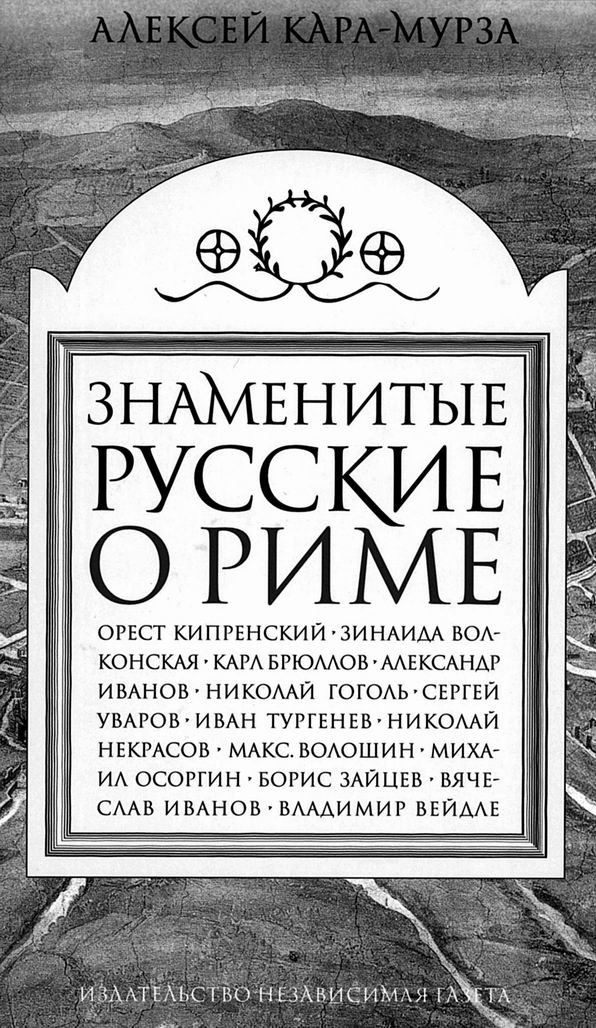
“A good half of the book,” writes the compiler, “occupy biographical essays, because outside the“ human context ”any quotes lose meaning.” I must say that in fact, these chapters are not related to the essay as a literary genre, because their author clearly did not face the task of artistic disclosure of the personality of the characters. In the case when, on his happiness, the library was a book that could be retold close to the text, the essay on a particular character grew, filled with many details and details - sometimes beautiful, like a muratic description of the night storm in the Roman campaign, sometimes excessive, such as manic counting of days and hours spent by Nekrasov at all stages of his paths from his paths from his paths Petersburg to Rome (which in itself is hardly able to exhaustively explain the unexpectedly painful and even hostile perception by the poet of the eternal city). In the absence of such a manual, a careless biographical certificate turns out to be scarce and completely incapable of fulfilling the compiler of the contextual commentary. However, the comment is already sometimes hanging in the air, devoid of the actual commented text. So, the essay on Zinaida Volkonskaya contains only one brief quote in which the voice of the princess himself sounds (everything else is the stories of her friends and contemporaries), but from these three phrases it is impossible to make an idea of how this “famous Russian” relate to Rome. “Volkonskaya in Rome” - yes, “Volkonskaya about Rome” - alas, no ... It seems that the presence of “North Corinna” in this collection is generally only an accident, a tribute to a stereotypical set of Russian Rome characters. After all, it did not belong to those who, with their word or brush, created this phenomenon. Rather, on the contrary, the fused religious bonds, tied to it, became part of the eternal city for Russian visits, one of its elegant attractions along with the Cathedral of St. Peter, the forum, villas in Tiville or the Trevi fountain, near which it lived. Dates confusion, not always firm knowledge of historical realities, careless handling of quotes, which sometimes, repeating on different pages, sound differently and even change the author (so Gogol’s statement, given on page 371, on page 14, is attributed to Vyazemsky), and in places and noticeable undercont vocabulaum-all these are annoying signs of haste The compiler, especially noticeable against the backdrop of the emphasized Roman bias of the design of the book (artist D. Chernogaev). The undoubted advantages of this publication include illustrations. Rome, captured mainly in photographs of the late 19th century, is drawn to consider as slowly and with the same pleasure with which the framing texts are read. The photos are somewhat diluted with the inclusions of ancient engravings, for an incomprehensible reason in the signatures of the called drawings. Unfortunately, the idea that the “drawings” and photographs (visual documents), as well as the text documents, have authors and exact dates , remained alien to the compiler. The texts are only seasoned with pictures as an optional side dish. Hence the striking strangeness: despite the fact that among the characters of the book there are three artists - Kiprensky, Bryullov and Ivanov - their Rome is represented only by letters and memories, but not a single work associated with this city fell into an illustrative series. It seems that the foreman of the English club sincerely does not know that the main statements of the artist are his paintings.
The essays on the Russian Romans follow the selection of their own statements, grouped on topics - tourist and philosophical. Much, of course, remains beyond this collection, many names and themes did not sound, but already this part of the book is an extremely pleasant and heartbreaking reading.
The book ends with a small note “About the author”, not signed and (sic!) In no way separated from its main text. The unknown author of this note (I want to think that it is still not Alexey Kara-Murza himself) to the curtain adds another biographical certificate to a number of stories about “famous Russians” who wrote about Rome. It is curious what kind of biographical data he considers necessary to present in this context: scientific regalia, official positions, party status (for those who do not know - the Moscow English club - and in fact an elite club organized as a CJSC; for several thousand dollars a year, his member has the opportunity to feel like a person not only remarkable, but even remarkable in all respects), a direction of professional interests. Amazement is caused by the last phrase, which completes not only the story of the author, but also the book as a whole: “He has repeatedly been on scientific business trips in Italy.” Here it remains only with your hands.
The necessary touch to the description of the originality of this book lies in the 10th issue of the free VIP-magazine “Stage Point”, close to the English club and such highly cultural and respectable organizations as the National Foundation “Public Recognition” (a prize that members of the English club award the necessary people and each other), the independent association “Civil Society” (the organization with which the Vipers satisfy the craving Civil virtue without harm to business and career) and CJSC Universal Service System [VIP services, naturally- N.S. ] "Execution Service". " I’m quit, because you won’t write better: “Based on materials from A.A. Kara-Murzi Moscow English club plans a large summer trip of the club members to the cities of Italy. A number of Russian and Italian travel agencies are waiting for the release of the book, who are interested in organizing special “Russian routes” of the VIP class in Italy. ” Like this…
But back to Russian Rome. So, is the phenomenon of the eternal city, the paradoxical homeland of the Russian soul, or, if it cannot be unraveled, is it outlined? It seems that the compiler in vain a priori refused any attempts to generalize. The material collected under the cover of the book gives the richest possibilities for this. I will express only one observation. For the Russians, whose ideas about time, life, death and immortality are formed by the northern nature with its alternation of seasons of deep fainting and brief prosperity, the image of the eternity of Rome was primarily plant images. This is noticeable by the reverent tenderness with which each of the authors of this book lists oaks and laurels, poppies and wisteria, admires ivy and porridge, aloe and palm trees and, of course, grapes. In which city do plants still remember that turned into signs, as significant as the Vatican or the Colosseum? For our compatriots, the eternity of Rome is the eternity of the flora; Roses, as if nothing had happened in December, February violets, evergreen mosses and kicking, unknown plants with carved leaves, as in a fairy tale, swelling of the rough marble of fountains - the whole life that breathes among ancient stones for many millennia, not stopping its quiet circles for a day. The Roman flora is a child of the Roman climate, causing naive surprise, unexpected, seemingly, for such educated people. The change of seasons in Rome, in the opinion of the Russian, is nothing more than a change in the shades of a single common heavenly state, in which time stopped a long time ago. In this motionless tagging, it crystallizes, leaving the vanity of the present, eternal beauty. Hence the sadness that permeates the image of Rome. It is similar to the antique Elysium, the foggy fields of asfodels, where life and death do not deny each other, but mutually look at each other as in a mirror. No wonder Rome is the birthplace of the Russian soul that shares such moods. The element of the infinite space is akin to the elements of infinite time. The tangible presence of both sets up the Russian soul in a philosophical way, forcing him to feel their own immortal essence. Is this not in the sensation of a living plant, and not dead stone eternity - the unraveling of the collective Russian “feeling of Rome”?
The Rome of this book, of course, is only part of the multifaceted image of the eternal city, captured in Russian culture. This is Rome, seen by the eyes of people of a romantic and constant culture. This image existed only a little more than a hundred years - from the first decades of the nineteenth century to the first decades of the twentieth. The famous Russians who visited the city before and after, looked at him with different eyes. The whole world fits between the concepts of “then” (silence, desolation, space, patriarchal herds right in the city line-in a word, the whole aroma of traditional culture) and “then there was no” (vulgarity, fascism, standard giant houses, everything that is erased from the physiognomy of Rome only inherent imprints of timeless greatness).
This Rome is no more. It is not said about this anywhere, but it is quite obvious that the bewitching poetic world has gone irrevocably, changed so much that it seems as if nature itself has gone with it, and there is no longer the blue Roman heaven, nor delicious water, running through the ancient Aquatic Mountains, no benevolent air, nor roses, nor glycine, nor black cypresses ... Mussolini, and it comforts.