Date
Author
Фонд «Общественное мнение
Source

Preserved copy
Translated material
About monarchical moods in Russia
I
In September 1994, just before the congress of the monarchical organizations of Russia, the public opinion fund conducted a survey of the population, posed to the respondents the question: “How much, in your opinion, is it possible and desirable to restore the monarchical rule (reign of the king) in Russia?” The result was interesting and puzzling. In a country where for three quarters of a century, the population since childhood was brought up in the ideas that the monarchy is a relic, a relic of the feudal system, that in a developed, progressive society there should not be such a form of government, 18% of respondents spoke out for the restoration of the monarchy. True, from those who express such a wish, several more than half do not believe that the restoration of the monarchy is possible, but they, in principle, make up a passive reserve of the monarchical movement.
How much, in your opinion, the restoration of monarchical rule in Russia is possible and desirable?
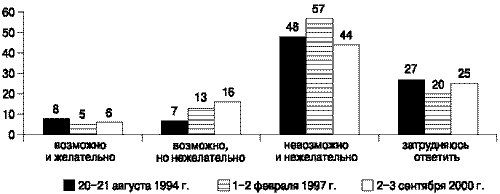
© Fund "Public Opinion", 2000
The first cliche that I want to try on this fact, answering the question of who these people sounds like this: this, of course, is backward people. Who goes to church? An illiterate old women (although they were not all illiterate before and they were far from always the old women, but the cliche is cliche). And about the prince-prisoners are dreamed of pensioners and rural residents. However, the survey data is defeated by such an idea. The village turned out to be the lowest percentage of people who wanted to restore the monarchy (only 11%), but in regional centers-20%, in St. Petersburg-23%, in Moscow-25%. The same “reverse” trend manifested itself in groups by education: among people with incomplete secondary education, there were 16%, in a group with secondary education - 19%, and with higher education - 20%. The same picture in groups by age: those who want to restore the monarchy among the elderly (55 years and older) - 16%, in the youth group (16–24) - 20%, and the same percentage in groups of actively working people (36–55 years). Thus, cliches are destroyed about backward old people and old women. But the most curious result was obtained when distributing surveyed classes. 42% (!) Of all the managers of the public sector and 28% of managers from the non -state sector, while among pensioners, students, unemployed and other groups of those, were only 16%, were of only 16%. Thus, the restoration of monarchical rule in Russia turned out to be most desirable for quite solid and realistically thinking people. And they are more than other categories of respondents, found this restoration possible.
Then we hypothesized that the main reason for the spread of monarchical moods among actively working representatives of the population was a very strong, but at that moment a very poorly conscious trend in public moods, already in 1993, marked by the famous economist V.A. Nayshul in an interview with the newspaper Today: "There is a huge demand by an order of magnitude." Indeed, both the head and entrepreneur are extremely necessary for stable power, working laws and a certain share of confidence in the government. All these respondents, apparently, somehow connected with the monarchy. In favor of such a hypothesis, the distribution of revenues surveyed by the level of income also spoke: in groups with income per capita up to 50 thousand rubles. (according to the then inflationary indicators, this was a very low income) The monarchs of the monarchs turned out to be 13-14%, and in groups with an income of 100 thousand rubles. And above - 25–27%, that is, almost twice as much.
Another trend that warms up these sentiments was a constant expectation of a coup with the subsequent establishment of a dictatorship or authoritarian rule, so that one sociologist, getting acquainted with the above data, said: “Yes, I, perhaps, also for the monarchy. All the same, the matter is going on to mating - so let the monarch be better! ”
II
A few years later, the descendants of the Romanov dynasty inviting the Romanov dynasty to Russia in order to decorate the existing system remained in the past, and the self -proclaimed applicants for the Russian throne were also forgotten. The power began to strengthen a little, and the atmosphere in the country began to gradually change for the better. Trust in power is now significantly higher than in 1994.
In September 2000, a survey that finds out the opinion of the respondents about the possibility and desire of the restoration of the monarchy in Russia was repeated. As a result of the survey, it turned out, in particular, that there were a little smaller to restore the monarchical rule in Russia (16% against 18% in 1994). There were few people who categorically declare that such restoration is impossible and undesirable (45% versus 49% in 1994). And the number of respondents who believe that this is possible: 22% versus 15% in 1994 increased markedly.
The following changes have occurred in the composition of carriers of monarchical moods. The new youth (18–24) is less subject to them, but the age group under 35 years old was a leader in this regard (23% - every fourth or fifth person). It was this group that was “youthful” six years earlier, now it has matured, but retained its moods. A little less, but higher than the average level, those groups that we called actively professionally work (36–55 years) are committed to such moods. And pensioners are still unimportant to this idea. A group of persons with secondary special education (20%) is distinguished, people with the formation below the secondary are still poorly reacted to the idea of restoring the monarchy. Among the Muscovites, the highest proportion of monarchically -minded Russians (22%) has been preserved, other settlements are weaker than these moods (except, perhaps, small cities).
But we remember that the most unexpected study in the past was that among groups in the family of classes the most committed restoration of the monarchical regime were leaders. Now, among them, carriers of such moods have been decreased (21%) - however, this specific gravity is higher than average. And the greatest specific gravity was given by a group of employees (23%). A small “increase” of new monarchists is noticeable among the group of workers and unemployed (15%each).
In general, the main carriers of the monarchical idea remained the same categories of citizens - managers and employees, people with high incomes and metropolitan residents. However, now the “sealing” of monarchical ideas has occurred in other spheres, covering part of the inhabitants of small cities, workers and unemployed, as well as a certain share of people with the lowest incomes, which in the last study seemed completely immune to such moods.