
Translated material
Anton Dolin. Cinema-27: the house that built the garden
To the Russian premiere of Philip Kaufman's film "Pero Marquise de Sad"
The line of centuries two hundred years ago. France . Revolutions , shocks , war . Battle of dinosaurs: The one that is larger will devour what is smaller and well -resistant, but he will be devoured in turn. And only one beast has been sitting in a cage for a long time - at the king , at the convention , under the emperor ; The one who is attributed to the merit in spiritual incitement and arson, the Marquis Donatien Alfons Francois de Sad . From prison to prison, and then - to a crazy house; From a landscaped camera - to torture. All this is true. And this is exactly what the film was shot by the film known to the general public by the "unbearable ease of being" Philip Kaufman. Nevertheless, the expectations of many spectators will be deceived, as Kaufman told his story, he said in his own way. He did not get a historical film, and not a conditional parable, and not a postmodern toy, but a certain arithmetic mean, designed to give an answer to the question - who is the marquise de Sad . One of the most relevant figures of the European culture of the New Age, inspiring the murderers and maniacs, authors of stories and horror films, but at the same time philosophers, poets, directors; The figure, which has long become a myth, in which Kaufman immerses with the head of his viewer.
The viewer of the film meets de Sad in Sharenton, a psychiatric hospital, where the Marquis spent the last years of his life. Here, the famous criminal is contained with all amenities, still writes his novels, and the manuscripts of the young laundress Madeline bring to the world, where underground printing houses continue to print a long-forbidden author. However, at the time of X, the news of this reaches Napoleon , and he orders to “finally cure” the Marquis. To this end, the famous Dr. Roye-Kollar, accustomed to daggering patients with their heads down in ice water, lock them in the "Iron Virgo" and practicing exclusively methods of this kind in the struggle for the patient’s health, is sent to Sharenton. Sended by the Doctor in Shatonon meets with the trustee of the hospital - a kind -hearted young abbot Kulmier, who sincerely believes in the therapeutic power of art. A home theater works in his hospital, all prisoners write paintings, play in performances, compose poems. Who is right - a kind or evil doctor? The Marquis de Sad is called to answer, he is forbidden to write; However, he cannot write, and the scribal feathers taken from him become a link in the future tragedy. Such is briefly the plot of the picture.
It is clear what the distributors were guided by, entitled the film "Perm of the Marquis de Sad" - the name of the protagonist in the name should attract the audience. In fact, the picture is easier - "feathers" , and in the original name there is much more meaning. Firstly, the center of history is not the Marquis itself, but the problem of writing and scripture, the relationship of literature and reality. Secondly, each character of the picture becomes a full-fledged participant and the “author” of this discussion, and at least four main characters here; Thus, everyone has their own pen, its own truth, which he is trying to protect with action. Anyway, before getting to know the de Garden himself, the viewer meets the other participants in the future drama: a doctor, an abbot and a laundry. Each of them, during the plot, should present its own system of evidence and its view on the phenomenon of the Marquis de Sad. Everyone believes in his system. In each case, this system is false. Actually, the key is given at the very beginning: the action takes place in a mental hospital. That is, in a place where everyone is something else that seems to him.
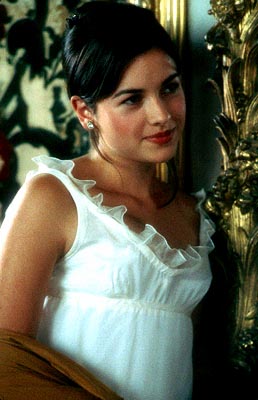 Let's start with the doctor. Roy -Kollar is an elderly, confident, experienced executioner and hypocrite. For him, there is one truth - the truth of the power that he, not really caring about the details, puts it in the form of morality. The doctor was played by Sir Michael Kane , one of the best Anglo-American actors of the century, and the static charisma of his character speaks for itself. If we take for the axiom the fact that in his creations, the Marquis de Sad examined the nature of the all -conquering evil, then Roy -Kollar is its embodiment. Ready to resort to any prohibitive measures and even torture in relation to others, he himself takes away from the monastery and forces himself to marry a minor novice - a pious and naive beauty. The doctor is hypocrisy itself, he is a typical character of any novel de Sade. He himself does not feel this, and this is his weakness. That is why the Marquis, almost never for the whole film, has not victory with the doctor, won: as a result, after his death, the doctor opens in the hospital, which has passed under his leadership, an underground printing house for printing de Sad's books. From the hero of Roy-Kollar turns into a reader and even a publisher, since reality proves him the correctness of a confident in the victory of the evil of the Marquis. The same transformation occurs with the staff of the hospital - from adherents of debauchery and lack of freedom, they become approximate typographs and distributors of de Sad's ideas. Yes, and Simon, the young wife of the doctor, having read the “Justine” , from an innocent sheep (the same average heroine of the Marquis) turns into a calculating “reader” - changes an unloved husband with a young architect and runs away with him.
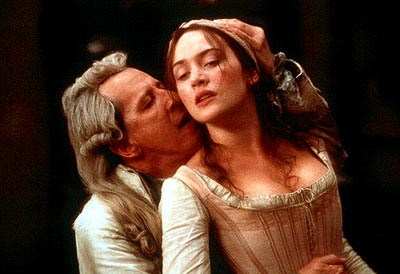 With the laundress of Madeleine ( Kate Winslet - apparently, the best role of the film, which will forever make the non -loving Kate after the “titanium” of critics to shut up), the opposite is true. She does not want to perceive everything that the Marquis writes about as given: she does not agree to become his heroine, she does not respond to his harassment, preserving the pure love of handsome and smart abbot in her soul. For her, the Marquis is a brilliant writer, and only; She admires the horrors invented by him, pity the writer enclosed in the dungeon, while remaining a smart and virtuous girl. However, her view of the world turns out to be false: at a certain moment, the creative force enclosed in the marquise’s head, without splashing out on paper, begins to bend the surrounding space, and in addition to the will of Madeline, it turns into the heroine of the last work of de Garden - the innocent virgin dying at the hands of crazy depraves. The same with the comrades of the Marquis in misfortune, crazy Sharenton: until a certain point, his friends and ministers, the actors of his theater, at the time of the release of the devilish energy of de Sad (no longer dependent on the author himself), they become a gathering of Boskhov demons with torches in their hands.
So the Marquis turns out to be stronger and smarter than its healers, but remains powerless before the destructive power of the word, which, not being spilled on paper, becomes a sign of real violence. Under the onslaught of this force, the Marquis himself also dies - he can do nothing with the words that are torn from the inside; He is ready to write on the walls, on sheets, on clothes, on his own body, from blood to shit. In fact, the correctness of the Abbot Kulmier is confirmed, who believed that "it is better to draw fire than to set fire to residential buildings." However, the abbot ( Joaquin Phoenix , a charismatic handsome man who became famous for the "gladiator" and clearly played the main role of his career in "feathers") falls into the network of his own delusions. He does not want to become the hero of the Marquis, refuting by every word and act the confidence of de Sad in the dark side of the nature of man, abandoning even the desired Madeline in the name of these vows. He does not want to read the books of the Marquis, he does not even know exactly what he writes about. He wants to relate to de Garden as a person, as his friend. However, the marquise cannot be just a person - he is a writer; Therefore, an unexpected and unenviable fate awaits the abbot ... After the catastrophe and the terrible death of de Sad Kulmier, he himself becomes de Garden. The abbot occupies his camera and begins to demand paper and a feather. After all, just as the reader and hero, the author is in the prison of his own books; Kulmier understands this too late.
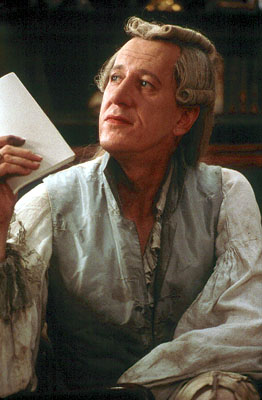 But what about the Marquis itself? The main reproaches of critics in connection with the “feathers” are addressed to two characters - the playing de Sad Jeffrey Rush and the director Kaufman himself. I will allow myself a few words in their protection. The garden, according to the plan of the authors of the picture, remains a mystery from the beginning to the end of the story. First of all, he is a mystery to himself. He wants to see himself as an adept of evil and debauchery, while in fact he is nothing more than an unhappy person who is imprisoned and hopelessly lonely (they feel and understand this and Kulmier and Madeline). He wants to be the ruler of words, but the words possess him, like demons, from which there is no salvation. De garden is changeable, he is the way that every specific character sees him; Rush plays precisely a chameleon, full of strong, but slurred feelings and emotions. Was there a real marquis - who cares? In the "feathers" before us is not a person, but a sign, a reference point of the local coordinate system.
And here's something else. Actually, the story of the doctor who came to treat the patient -writer, and then turned into this patient, is well known to our viewer - known for the "house, which was built by the Swift" Grigory Gorin and Mark Zakharov. Abbot Kulmier is an analogue of Dr. -Abdulov, Marquis is an analogue of Swift -YANKOVSKY. By the way, both contemporaries and researchers later compared Swift and de Sad as two brilliant artists, excessively violent satirists who are not understood by others. Sharenton in the film is the house that built the garden; The space completely defined by its perverted and attractive aesthetics. Here are all participants in the general drama that is going on outside the will of the author. In the place of Jeffrey Rush, any actor, conditionally called the Marquis de Sad. It is important not who is the marquise (for everyone he embodies something new, his own), it is important that he be. His camera should not be empty, so the abbot occupies it in the finale.
The director’s chair could not be empty, so Kaufman took him. Of course, the concept was invested in Dag Wright in both the script and the play, based on which the script was written, and Kaufman only took advantage of this concept (as Gorina Zakharov acted with plays). However, he did it at least skillfully. "Feathers" is a kind of encyclopedia of culture after de Garden. Including movie cultures. Impeccable costumes and scenery, and the presence of Jeffrey Rush, remind of the "Shakespeare in love." The American school cinema school is quite harmonious with European films - a text germinating through the screen that falls on any surface, the very visual appearance of the word makes us recall Greenaea. Finally, the psychiatric hospital selected as a place of action generates its cultural context; Here you can’t occupy authenticism, it is not without reason that real insane ones played next to the actors of the madmen. Where, if not in a crazy house, such a drama is possible? The times of the "flight over the cuckoo nest" have passed, freedom is no longer absolute; Therefore, "feathers" - a film temptation and questions, not answers. This is the attractiveness of the house built by de Garden. If you do not have your answers to the questions of the Marquis, then you have nothing to do in this house.