
Translated material
Alexander Ulanov. Prestigious (di) Zhitator
You think about how continuous life is:
Do not interrupt it, do not postpone it -
And still, we have to live on.
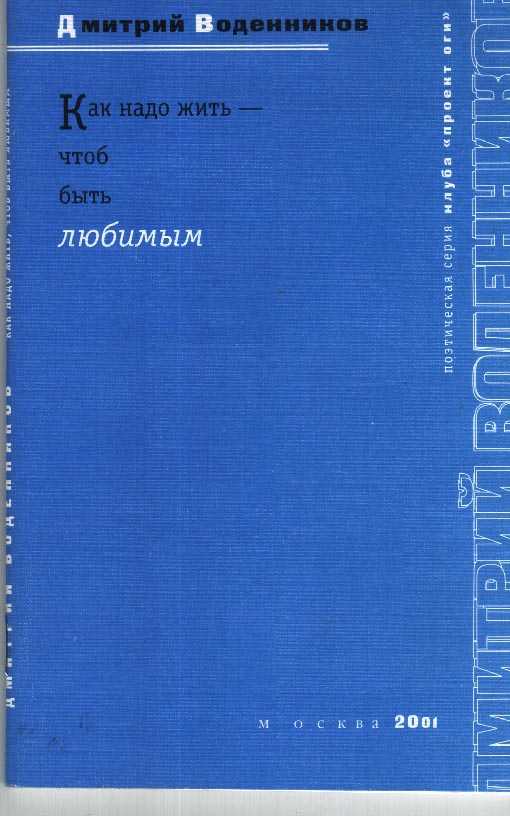 This is not Prigov - these are vodrennikov .
Conceptualism, apparently, was too cold for everyday use. You can sneak once, another, third, but it is difficult to live, constantly staggering on the void, to which the conceptual text displays. And to make personal efforts to fill this emptiness is also difficult. So Vodennikov was waiting, he had to appear. It is cold without sincerity, seriousness - and I want to see them at least for a second, albeit on stage. But no more than a second - if you have to look longer, what he saw can be too uncomfortable, not pocket, to introduce into doubts and confusion. And in general, watching is an effort.
The hero of Vodennikova pronounces what his listener is shy about to say. I want to be loved (and I want to be "more loved by you" ). I want to be happy. The listener understands that everyone wants it; And that the world owes nothing to anyone; But why not at least hear, if you are ashamed to say?
The more doubts about the existence of your own personality, the more hysterical it is to be insisted on this existence. It is stubbornly emphasized that this is all "mine": "But this is my poem, / my sin, / my shame, my ashes." All and all exist only to the extent that they belong to the hero. "Someone envies me, / Someone is afraid of me, / And many even respect me." The world is perceived only when it hit the head . "This world is configured against me." Of all the phenomena of the environment, only one is neighing - "the humiliation that I experience in a collision with life, daily and hourly." There is a certain hope that someone is still interesting to someone and will not be completely left by the Higher Forces. “So - walking along the cottage or on the way to the lake - I imagined, / that someone, who is more and better than me, wants to know my name ..." But there is a lot more fear than hopes.
"And I closed my eyes / and shake my head, / but still green is all with fear. / I, by the way, can die." Moreover, all these fears are again for itself. And quite standard. "The war began. Panic. Evacuation" ; "They beat me, with humiliation, through my fault ..." Actually, this is the infantile consciousness. A child either Soviet, or post -Soviet mass culture.
And relationships between people arise only to support each other, do not disappear "on the verge of buzzing emptiness or decay." A person loves - but nothing but erased words ( "please, beloved, dear, / only, mortal, living ..." ), he does not have. He knows that this is a cliche, but is not capable of an effort to individualize speech. Life is a tin, of course. "Well, they were in my life, there were, / these attacks of happiness ..."
Of course, Vodennikov takes into account the experience of Prigov. He understands that he speaks with other people's words, and understands what he speaks of . "I realized that this is vulgarity." But this is vulgarity, dear to the author (and the listener), and thereby for Vodennikov half justified. And something else, not vulgar, requires style (and not stylizing) impulses, is fraught with the danger of isolation. “So I am growing between vulgarity and shame,” Vodennikov announces. It is easier to express this, to declare vulgarity and shame with “two poles of national identity” - and leave everything as before. And the mask will even closely cling to the face.
It’s nice to be on the stage. It's nice to be in the spotlight. "A big bunch of people. I am on stage" ; "I am now standing / before girls and before men ..." ; "And I love when they clap me." Vodennikov rejoices from notes from enthusiastic girls: “You live like a dream, like a toy that no one / will give, and which must be stolen, steal certainly” (namely, steal; because at heart, the girl, the girl, is the most embarrassing to scratch all this). Rejoices when the listener addresses him with the words: "You all wrote about me." Sighs: "How hard it is to be a star."
For the sake of this, you can go to the demonstrative - professional - exposure of emotions. "But why is it so painful then?" (Vodennikov is a magician; an assistant seems to be cut, but she, of course, is alive). On a fashionable light attraction: "Why are you stared? After all, I am dressed, / A, really, / it seems / what will I undress right now?" ; "What should be in kind / Our usual life." From the author’s entry to the collection: “I am aware that everything below, perhaps, does not have great artistic value. But the conditions of my spiritual life are such that if I did not write all this, I would cease to respect ...” Unisex style, cocketing is now characteristic of men. "Well, I will die, well, you will die, / well, turn away from me - / What is the difference." Both the author and the listener feel falsity, but without it they cannot utter a word. So the definition of poetry in Vodennikov is not crowned by the sea, but by Mers. "Then, as in a Merce, you will float."
"So smoky here / and the light is unbearable, / that you can’t even distinguish your hands ..." - an accurate sketch of a pop concert with colored smoke. And the hero of the poems is a professional showman. Called in communication with the hall. "Ale, who wants to know how to live to be loved? / Well, what are we silent? No one wants to know?" (And a lot of losing outside of this communication: the book includes a “Excerpt from the play” - it is frankly bored because it is not lively with the personal charm of the star on the stage.)
The star lives for its listeners, voicing the emotions, on which they do not have enough energy and leisure. Vodennikov’s poems are sincere - in the sense in which they say: "We sincerely sat in a cafe on Friday." This is a poet of psychological comfort. Its audience, perhaps, is a little more reflective than, for example, in a bard song - and, accordingly, somewhat at the same time - but it earns more. Of the 48 pages of the collection, poems occupy 32, on the rest - the headings of the sections or nothing at all. And at the price of the book is comparable ... Well, let's say, with the 300-page collection of prose by Andrei Levkin. Actually, this is not a poet’s book - this is a concert ticket, a booklet for a concert.
So live to be
unnecessary and free,
no one, unnecessary, loose, like the earth -
And who can live like that?
Yes, anyone
And as you like - but not me, not me .