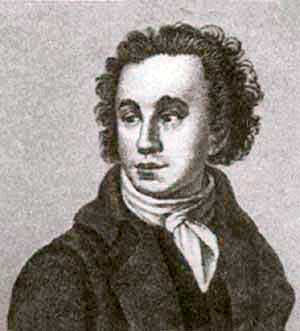
Translated material
Miroslav Nemirov. All about poetry 35
Barkov,
I don't remember the name. The most famous of the Russian authors of pornographic poems. More precisely, the only one, known to the public, is all that the vast majority of Russian people know about Barkov.
The same thing.
I mean, I know this, but more about Barkov - nothing.
There is no poem at the beginning, as usual. I had a little book by Barkov, A. Goflin gave it to me - yes I gave it to someone.
So - - -
* * *Many are sure that Barkov is the one who composed "Luca Mudishchev." This is not true. Luke Mudishchev - the essay in a clear way of the second half of the XIX century; Barkov is the author of the second half of the XVIII century, a contemporary of Derzhavin. Its poems are written by the most wild and barbaric, adopted syllable, to read them now - and even more so to remember - it is completely impossible.
And “Luki Mudishchev”, by the way, as I recently heard on the Radio “Freedom” from a special program dedicated to this transmission, ”they wrote, they claimed, A.K. Tolstoy.
* * *Pushkin wrote somewhere that as soon as the freedom of print comes, the first thing that will be printed is Barkov. Many people think that he thereby expressed the opinion that here, they say, which Barkov is wonderful, it is necessary to print it, but the censorship does not allow the bastard.
But it may well be vice versa.
It may well be, Pushkin wrote precisely in the approval of censorship: what if you remove it, they will immediately begin to print something, but Barkov and the like.
* * *December 12, 2000
Information about Barkov was got.
On the Internet, of course, like everything else, as much as you like, for example:
- Biography Barkova I.S. On the website of the St. Petersburg State University in the section "Petrovsky University in Persons" among the next outstanding releases of St. Petersburg State University: Dashkova Ekaterina Romanovna, Krasheninnikov Stepan Petrovich, Lomonosov Mikhail Vasilievich, Miller Gerard Friedrich, Ayler Leonard;
- A large selection of B. poems along with poems by Pushkin, Lermontov, Anacreona Klebnichkin, M. Zhuvalova, A. Pyrona in the section "Russian classic poems with the mats" On the site "Encyclopedia of the Russian Mata";
- A variety of poetic pornography attributed to Barkov ("King Bardak Fifth", "Luke Mudishchev", "Lullaby", "Father Paisius", etc.) plus B. biography from the BSE of 1926 (all in text mode without pictures);
- " Poet -Erotomaniac or a shameless holler? " - an article in the newspaper "Youth of Estonia" dated 06.06.98;
- " Barkov and Makov " - an article by Manfred Shruba about the influence of Barkovyana on Maykov in the comic poem "Elisha, or annoyed Wacch" ("UFO", 1996, # 14);
- An article about B. in the "Encyclopedia of Brockhaus and Efron";
- the consumer repertoire B. or a la B. on the site of jokes;
- "Fight" # 48 of November 30, 1998: Material about the 230th anniversary of the death of Barkov, in which an attempt is made to prove that "Luke Mudishchev" is the composition of Pushkin. In my opinion, unconvincing.
For those who are lazy to climb these addresses, here is information about B. from Brockhaus and Efron:
"Barkov (Ivan Semenovich or Stepanovich) - a translator and poet of the last century. The existing biographical information about him is scarce; even his middle name was not established with reliability. From academic papers relating to Lomonosov, it is clear that he was" Popov Son "and genus in 1732. When in 1748 Lomonosov and Brown examined the pupils of the Neva Seminary to choose from them from students For the Academic University, contrary to the will of his superiors, the pupil of B. appeared, who found the “Writing” and sufficient knowledge of the language on the exam. In 1751, he was excluded from the number of students and was determined by the “set-out business”. Translations by B. Prose and verses are distinguished by smoothness and simplicity of the tongue and undoubtedly that in poetic technique it was inferior only to Lomonosov, and Sumarokov. B.'s poetic translations dates back to the 60s of the last century: 1) "World of Heroes", the Italian composition of the city of Dr. Ludovik Lazaroni-Vennaanin; 2) "Quinta Horace-Flask, satires or conversations, with notes, from the lat. The language shifted by verses" (St. Petersburg, 1763); 3) "Fedra, Augustov Roted, moralizing fables from the Ezopov sample composed" (St. Petersburg, 1754 and 1787). All these transfers by an unknown publisher were collected in 1872 (St. Petersburg) in one book, under the title: "Works and translations of I.S. Barkov." Of the “Works” here there is only the “Life of Prince Antixa Dmitriev Kantemir”, which was attached to the Publishing of the Satire of the latter (St. Petersburg, 1762). In addition to the “Life” by B., he also wrote “ODU for the birthday of Emperor Peter III” (St. Petersburg, 1762) and published “Reducing the Universal History of Golberg” (St. Petersburg, 1766, 1779, 1805 and M., 1808) and together with Taubert I volume of the “Russian Historical Library” (St. Petersburg, 1767) containing a nestor in the Koenigsberg list. However, not these works brought the name Barkov the loud fame that he uses. He also acquired all -Russian glory to himself with poetic, but not printed "shameful works", as Mitr is expressed. Evgeny, in a huge number of lists who were dispersed among Ross. fans of piquant reading. This glory is so great that a special term was created - Barkovshchina and B., and there are all things that do not belong to it at all. A full list of non -printed works by B. is stored in imp. public library; His title is "a girlfriend or collected works of G. Barkov." The characteristic of the “shameful muses” by B. Dana S.A. Vengor in his “Critical-Biographical Dictionary of the Rus. Writers and Scientists” (issue 25, St. Petersburg, 1890) ” .
_____________
I personally know two versions about the death of B. - one by one, B., being in a state of binge, drowned in the needle; According to the second - as if he had committed suicide and at the same time in such a way that people entered in the Barkov’s office found him with their heads stuck in the stove in order to poison themselves with carbon monoxide, and there was a sticking ass without pants, but with a piece of paper stuck in it, on which it was written sinful, he died funny. (Option: "lived shame, died anyway.")
But something both options, and about drowning in the toilet and about suicide with naked ass, seem to me as small-standing. The first is too moral: he wrote an abomination, and he choked in it; The second - a too radical nihilist appears in it Barkov, somehow Ivan Karamazov, challenging the universe. Judging by the poems, Barkov was not at all, but there was just a funny cracker without any special undertakings.