
Translated material
Anton Dolin. Cinema-38: The smell of a woman
To the release of the film "The Man who Cried" and "Autumn in New York"
In the first distrust of films made by women, I woke up relatively recently - less than two years ago, when watching the Romance of Katrin Braya. Before that, I sacredly believed in the equality of sexes, including creative, and the ability of women to direct the cinema in my view was supported by the example of Kira Muratova - well, what is there to object, though the director of the highest class, which are few! And here is a “romance” ... It’s funny that the word is immediately associated with the Russian -speaking with something feminine, although in the original it is completely devoid of these meanings: a romance is just a novel, in one form or another, and the lyrical singing for the guitar about cruel passions has nothing to do with it. Having smashed the barely noticeable, but even more annoying, the spirit of sentimentality, which develops into vulgarity, and feminist notes, and a permanent bed with a completely excessive claim to philosophical generalizations ... I was forced to admit that this can be explained only in one way: the film was made by a woman. The point, of course, is not in feminism and not in the heroine of the woman; For example, the absolutely “male” and harsh film of the daughter of the best Iranian director Mokhsen Mahmalbaf, Samira, the “Black Board” , awarded the jury in Cannes, was something similar. There is a lot of pathos, little poetry, no suitable generalizations with a good figurative-painting series. However, finally, emotions and thoughts about the cinema made by women took shape after watching two women's films at once during a short period of time: “The man who cried“ Sally Potter and “Autumn in New York” Joan Jen. I’ll make a reservation right away: neither the first, nor even the second film can be called unsuccessful, although for some reason each of them causes an involuntary sense of irritation in a male viewer.
"The man who was crying" is a new job of his name by the adaptation of the aesthetic novel by Virginia Wulf "Orlando" Sally Potter. In that picture, Potter found winning intonation precisely thanks to the observance of a thin balance between male and female - as everyone remembers, the hero of the novel is hermaphrodite, but here the director completely surrendered to all creative instincts inherent in the beautiful sex. Before us is not only and not just the story of a woman stuffed with all the necessary attributes (love, betrayal, career, flight, search), but a whole concentric universe, rotating around the motionless nucleus - the main character. The female tendency to cleansing tears (the only possible reaction to the cataclysms of recent history) is transmitted to men here, but the meaning of the name is more worth interpreting expansion. A person who cries is not a specific character - this is a global image, a whole worldview in one phrase. For example, a crying person is a spectator, because if he does not move and does not cry, observing the heartbreaking history of the silent Suzi, then he will have to yawn from boredom - it is painfully predictable to the plot and dialogs are monotonous.
In the "man who cried" the majority of stamps inherent in the sentimental-epic genre in the cinema. The Jewish family broke up because of the pogroms that began, the father emigrated to America, and the daughter came to strangers to England. Then she grew up and decided to go to Paris - to sing and dance in a cabaret. There I met a local beauty and favorite, blonde Lola (the main character, of course, a brunette), then found a real work, met the love of my whole life, then the war began, I had to part and run to America to finally meet my father. In fact, retelling the plots is a crime, but not in this case, when the next move is guessed without labor, and without interest. It’s not a good and ideological system of the picture: the story of an outcast, which will certainly find a soul mate and gain happiness. The only plus of the film is the actors, but here the viewer is ambushed: almost each of them is catastrophically out of place. For some reason, Oleg Yankovsky plays the Jewish-Orthodox, and even the best singer of the whole village, and this can cause only laughter in our viewer. A touched giggling develops into frank irritation when Kate Blanchett appears, which is written to play the heroines Henry James or English aristocrats ... Here she is a ballerina from Kirovsky , it seems, the theater, who fled to Paris and became a lady of the hemilate there. Russian words pronounced to her and thoughtful discussions about cold and hungry Moscow evoke melancholy. Feelings interfere with each other and when the playing Jewish director of the opera house performed as a rule, as a rule, an autistic actor Lynch and Wenders, Harry Dean Stanton , who was designed to perform in the role of a wise and good uncle. But another surprise awaits the viewer: the favorite of the Cohen brothers, a nasty Jew or Spaniard John Tourroro , who has just shone in an extremely funny country-musical "Oh, where are you, brother?" Suddenly, about the scene in the make -up of approximately LoEngrin and, having waved his hand, sings something in the voice of an opera tenor. The audience laughs so much that the main tragic turn of the plot (the handsome man is a friend of the Nazis) passes by his ears and eyes.
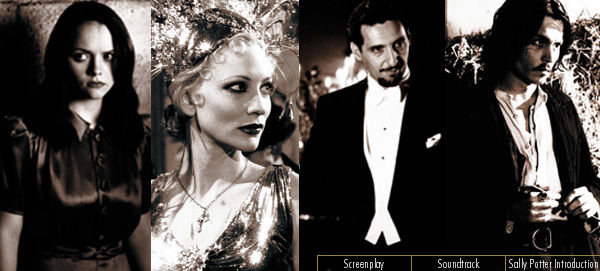
The absurdities in the film Sally Potter are full, but that is not the point. The fact is that her herself seems to be extremely little interested in the fate of European Jewry. "A man who cried" starred with another goal: to reduce two non -trivial actors with each other, compiling one of the best pairs of American cinema: Kristina Ricci and Johnny Depp. Alas, here Potter is notoriginal - Ricci and Depp are found for the third time, after “Fear and Hatred in Las Vegas” (director Terry Gilliam, man) and “Sleepy hollow” (Tim Barton, similarly). But is it important ... Ricci, the eternal star of the Adams family, an absurd child, shines with convex eyes and pushes puffy lips. The Depp finally turned into a gypsy Johnny seduces her, pursuing the night Paris on a white horse. Here, the unnaturalness of the situation is no longer embarrassing anyone. Because Ricci and Depp, that is, Suzi and Cesaru, good with each other, they look together - the upper class, and the viewer feels it. Why - why, and for happy love - even with the unfortunate end - women are susceptible. And this gives the rest of the curious film the right to life.
Joan Chen's painting "Autumn in New York" is the second directorial work of the famous heroine "Twin Picks" and the first in Hollywood. And this work is not an example more successful than in the case of a well -deserved Potter, primarily because what, as a result, Potter comes through the crucible of historical passions, Chen means from the very beginning. A harmonious pair of "Autumn" is an aging womanizer, a handsome restarator Richard Gir and a young designer, twenty -year -old Winona Ryder . Well, here it does not make sense to mention what the name of the heroes of Gira and Ryder in the film is called, since no one decisively remembers their fictional names. There is just he and she, and between them is a story, old as a world. He does not like to tie himself with any ties, she is ready to put up with this, because she is seriously ill and will die soon. He learns about it and understands that he fell in love seriously. It all ends as sad as in the "Love Story" , which remains the main plot prototype of "autumn", and just as the textbook melodrama should end: it is sad, but with a shade of something (the devil knows what) is bright.
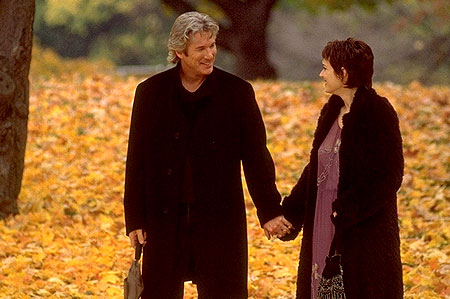 However - here is a strange thing - here Chen's purely feminine creative beginning has served a good service. Love was a plot of super -task - love was a success. There are not even attempts to build around the heroes the very value world full of secondary characters; They are, but each of them is only a reflection of what is happening in the center of history. Her grandmother is a reminder of his childless youth, his girlfriend is a living reproach of the past, his abandoned adult, and even a pregnant daughter - a look into the future. Both weight and rider are carriers of whole screen images that have developed over many previous films, and they seemed to have no need to love each other. And this is why their love looks natural: Joan Jong does not build a system of contrasts, nor unexpected similarities, but simply tells the story of feelings that cannot be explained rationally. And in this - irrational - women are stronger than men.
Therefore, under the rule of such successfully invented and shown love, the surrounding space changes that creates the very autumn in New York. The leaves fly off the trees, random reflections are visible in the deserted glasses of the windows, the streets are empty at night, forever occupied people with diplomats scurry past skyscrapers, water flows under the bridge slowly, a boat rustles oars. The space of love is a sensation and mood, that which was given by such titanic efforts Vong Kar -VAY in his last film is given to Chen (not by chance, as an Asian) without visible work. The task, of course, is simpler, and the genre, what to hide is banal to disgrace. But emotions - for which the large half of humanity goes to the cinema - is in perfect order.
And the remaining less than half remains only to breathe knowingly and try not to crunch in the darkness of the pop-root too loudly so as not to frighten off the sobbing neighbor. Still, a woman.