
Translated material
Elena Kalashnikova. Evgeny Vitkovsky: "Accuracy in translation is impossible"
Evgeny Vladimirovich Vitkovsky (born in 1950) - poet -translator, writer, literary critic, historian of art translation. In his translations, the works of John Kitsa, Oscar Wilde, Redyard Kipling, Rainer Maria Rilke, Gottfried Benn, Theodore Kramer, Artyur Rimba, the field of Valerie, Yosta Van Den Vonla and many others were published .
Elena Kalashnikova : How did you come to the translation?
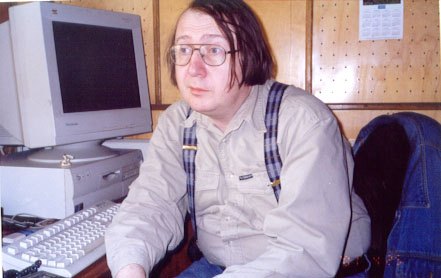 |
| Evgeny Vitkovsky. Photo by E. Kalashnikova |
E.K.: And who did you translate then?
E.V.: Although I am a Germanist and half a German by my father, I translated two later Coalridge ballads from English. Then I seriously became interested in Rilke and translated about a thousand of his lines, did not translate him anymore, but they reprinted this thousand lines many times.
As a translator, I quickly ripe, I was lucky with teachers. The first teacher was Arkady Akimovich Steinberg, then the St. Petersburg translator Sergei Vladimirovich Petrov - and not only as a translator, but primarily as a poet - and then Sergey Vasilievich Shervinsky, who taught me to read and hear poetry, put me a poetic voice.
Until 1990, that is, exactly 20 years, a poetic translation was my only legal occupation. I did not translate prose due to lack of time, the demand for my translations of poetry was always great. In those days, I chose from what they ordered, and the last ten I translate a little, but at my own free will. It is better - to translate the "imperishable", it is regularly reprinted.
E.K.: Who is your favorite translated author ?
E.V.: The answer to one line is Paul Valerie. I translated it a little, but the main verses. I fought for 15 years over the poem "Cemetery by the Sea", mainly because, like everyone else, I incorrectly translated the headline - the "sea cemetery", but in fact we are talking about the famous cemetery in the set, on which Valerie and Brassens are buried.
For me, the quality of this translation was that the deceased Samaria Israilevich Velikovsky, when in the late 80s he wrote a book about surrealists and Elyuar, from all the translations of Valerie used it was mine to replace French quotes, by the way, the translation was not even printed, wandered in Samizdat.
In general, the last work is the latter - this is the "song to David", written in London Bedlam, the poet of the 18th century by Christopher Smart. He was imprisoned for constantly praying, he could kneel and pray on the street. According to Dante Gabriel Rossetti, "Song of David" is the best English poem of the XVIII century. It is long and incredibly difficult, it is simultaneously classicism, mannerism and Oberus.
Arkady Akimovich Steinberg bequeathed to the translators to leave behind the "tract". Since he in the form of the “tract” left the “lost paradise” of Milton, I translated 3 plays by Yosta Van Den Vonla - on the basis of the first two, “Lost Paradise” - the trilogy “Lucififer,“ Adam in Exile ”,“ Noey ”was printed twice (1988 and 2000).
EK: Who, in your opinion, is one of the five best modern Russian translators?
E.V.: I can only talk about poets-translators and only about those who are actively translating. This is, of course, Gasparov, Mikushevich, Geleskul, Solonovich , Aleksandrovsky.
E.K.: These people translate from different languages ...
E.V.: Not a language for me is important, but a writer. In translators, I appreciate virtuosity. There is no Revich or my friend Viktor Toporov in this list - only because they are not translating anything now. Meanwhile, “God is sad” in Slovak in Revich’s translation or “let the storm with every hour of the evil” Rilke translated by Toporov - definitely masterpieces.
E.K.: Does the atmosphere of the translated work affect you? Revich, for example, said that during the time of work on the verses of Agrippa d'Obinier, his emphasizes became similar to the copyright, and he had not seen him before. Was there anything similar in your translation practice?
E.V.: When I translated the Catholic trilogy of Vonla, I realized why Chaliapin was fasting and prayed before playing the role of Mephistopheles. It was possible to translate a book about the devil only with prayer. I'm not sure that I was in this world. When you really grow together with the work, it affects very strongly.
When I translated the "Song of David", a gigantic psalm of more than 500 lines, written in one breath, then worked on it for 3-4 months, and finished on a passionate week. Smart is an amazing poet - he enjoys the name of things, such a poetic Adam, for him the process of calling things, pronouncing words is important to him. By the way, this is the main thing of the smart, but I will not translate it anymore. But others may well make his book - the foundation is laid.
E.K.: How important is it for you to translate the work first?
E.V.: Absolutely unimportant. This is not a theater where let there be a bad production, but the first.
The first full translation of the "drunk ship" of Rimbao made by Pobkov was printed in Paris in 1928. But what to do with the fact that 19 years before in Kiev printed an almost complete translation (V. Elsner), and 28 years before that they printed a prosaic translation (V. Gilyarov). Recently, in the archive of Sergei Bobrov, I found a full translation made back in 1910. The first Soviet translation made in 1929 David Brodsky. What is the first translation: which is previously printed - or the one that has been made before?!
When Vasily Betaki in 1972 printed the translation of "Raven" and introduced the refrain "not to return" instead of "Nevermore", it seemed a beautiful find. But this find belongs to the Ukrainian translator Grigory Kochura, and it was made 23 years earlier.
The first translation is often bad and important exclusively for the history of literature. For me, the "first" translation means "good".
I had cases when I did not know about the existence of someone else's translation and made my, for example, Kipling poems, and then I could shrug: "Why did I translate?" I am a translation historian, not a theorist. It is important for me to know that such a translation already exists. After the release of my book "Stanzes of the Century-2" I saw that in almost every new poetic collection there is a section of translations. Already, as it were, even excessive new translations of the already translated, for example, "Sonnet to Orpheus" Rilke. Already more than a dozen full translations! For what?..
My greatest contribution to Russian literature is the rehabilitation of translation as a genre. Poetic translation is now valued on a par with original creativity.
E.K.: In your opinion, a poetic translation is more complicated than prose?
E.V.: There is no difference. One wise poet said that poems must be translated as prose, only much better. Well, prose should be translated, like poems, only much worse? I do not agree. Good prose, like good verses, is equally difficult to translate. There is nothing easy in art.
E.K.: What languages do you translate from?
E.V.: I am translating from the interpreter only at the request of friends. In general, I translate from those languages that I can understand. For me, they merge into a single tongue. Before translating poems, I definitely write them down with prose - so as not to make excess mental effort.
I fluently read in German, English, Dutch, Afrikans (more often it is called Bursky), probably, at the same level, I know Portuguese. I know French worse and translate from it with a dictionary, I think that the difficulty is not in the language, but in the puzzling French poets themselves. Italian forgot; From the Ukrainian, once half -born, I translated almost nothing - the language here interferes with more, switching should occur in thoughts - but it is not.
E.K.: Which of the modern foreign literature is the most interesting to you?
E.V.: If we talk about poetry, for me modern is that a little “settled”, which was published this year, I am never interested in at all. If we talk about poetry, then, for example, the world -famous Latin American prose does not have a poetic analogue, Latin American poetry near it did not stand close.
But for me, probably, prose is still more important. Three years ago, I read Pavich, for me it was probably the main shock over many years. After the " autumn of the Patriarch " of Markes and the " Khazar dictionary " Pavich over the past 25 years, I have not experienced equal shocks. Even the very favorite novel " The name of the Rose " Umberto Eco - I did not act on me so much.
E.K.: Is there, in your opinion, interesting foreign translation schools?
E.V.: Of course there. If we talk about the second half of the 20th century, then the most interesting is German. Without transfers of the Geino Pionecket from John Kitsa, I probably could not translate Kitsa myself. I saw the author under a new angle and tried to find the same analogy in Russian. I like to read translations into German, this is a very flexible language and allows you to imitate everything, up to Russian sound. So Tselan managed to translate Mandelstam and Tsvetaeva. As for his translations from the block, I think he translated the wrong block ...
The Holland has a good translation school. Basically, they do not rhyme. Franz Joseph Van Akht, the former ambassador of Holland in the Soviet Union, so translated the "poem without a hero" Akhmatova that a separate work of art turned out - and he will just rhyme. Brilliant transfers from Gumilyov was made by Karel Van Hit Reva. The latest transfers of Pushkin are remarkable - especially two translations of the "Copper Horseman" . But "I remember a wonderful moment ..." In any translation, it will seem a parody.
The British, alas, moved in the mind - they rewrote the whole poetry with prose, especially for the Americans. By the way, Valerie said not in vain, quoting someone: " There is nothing but form ." Well, what is the substrate?
With the Italian translation school, the situation is also not very good. I advised the translation of Zabolotsky - no matter how translated, all ditties. Moreover, most likely, these are problems of the language.
Professionals say that the Poles are a good school of translation. Since the Ukrainian translation school is not bad, I think, in this regard, Slavic languages are all right.
E.K.: Do you think the translator of poetry should be an original poet?
E.V.: Here is the feedback. If he is a poet, then he can translate poetry. I do not believe that non-poet will remarkably translate the poem.
E.K.: Is it possible, not being a writer, to translate prose?
E.V.: This is a more difficult question. In order to write artistic, and not poetic prose, a person must have a fantasy, a property lying abroad of artistic talent itself. If it is not, a perfect translator is obtained from a person. If a person writes good prose, perhaps an interesting translator will make him.
I know another case - the person translated the four books of one author well, and then he himself began to write in Russian the book of almost the same author. This is Victor Pelevin , who translated Castaneda . Without Castaneda, Pelevin would not have arisen. And I consider this to be his dignity. It is also very difficult to adopt.
E.K.: And who, in your opinion, falls under this rule?
E.V.: Before my eyes, the same story happened to Andrei Sergeyev , but he died. Andrei Sergeyev was a brilliant translator. If you want to see a prose writer that has grown out of the translation, this is me. For example, they ask me how I know how the rocks look on those shores where I have never been. The translator studies a lot of material that remains in the head and which I want to somehow use. Only after finishing work on the anthology of the Stanzes of the Century-2, I realized how much I learned for 30 years of work in the field of poetic translation and what would not have been in this book, not this book.
E.K.: Where did you study?
E.V.: At the department of art history, Moscow State University. I studied there three and a half course and realized that I could not teach scientific communism as I could not fry ice in a pan. And since the literature was closer to me, I took up it by throwing the university. I began to study European literature on nodal moments.
I made a tremendous impression on the comments on Dante I.N. Golenishchev-Kutuzov and the exemplary work of M.L. Lozinsky. Lozinsky’s work is exactly the commentary on the original, you can make a new translation on it. This translation, coupled with the original, explained that before me the greatest, absolute poet. In the place where the fire turns into a person into hell, and the person into the fire, not without the hint of Golenishchev -Kutuzov, I realized that Dante was twistedomorphos. He won the competition with Ovid, humanity has nothing equal to Dante in any language.
E.K.: For some time you conducted a seminar of poetic translation. What is his fate now?
E.V.: As long as I had a seminar of young translators at the Union of Writers, I felt like a more necessary person than before and after. Now, when they don’t give me a living room for evening classes, but they offer me in the daytime, I study with seminarians at home. As a result, I have almost no new students; I am proud that at seminars I raised two generations of poets-translators. Sergei Alexandrovsky, whom I mentioned among the best modern translators, requires me to call him my student. He translated a lot - the “returned paradise” of Milton, two poems of Choser , Pessoa and many other authors. He lives abroad - in Kharkov.
E.K.: How did you come to the idea of your own seminar?
E.V.: There were several poetic seminars - Mikushevich, Ananiashvili, Revich, with me. My seminar arose after the death of Steinberg, when it became clear that a vacuum had formed. I accepted his seminar as mine. My seminar was aimed at professionalization, I took in publishers a book that, because of their difficulties, no normal publishing house, if I had not guaranteed quality, did not take plans.
At the seminar, we translated several books. The brightest is the "Lyra of the Seven Cities", the German poetry of Romania. We took Romania in a broad sense - 74 poets, including Tselan, Rosa Auslander, Rosencrantz. They worked on the second edition of 1989 Pessoa, on the book "Poetry of Luxembourg" - all this was well published. Now I have left the idea of collections - I try to ensure that each of my seminarians has a separate book of translations.
E.K.: In your opinion, we have many books ruined by translation?
E.V.: The question is unexpectedly interesting. There are more of them than we would like, but on the other hand, I'm not sure that a good translator would translate these books with dignity.
The miracle that the Russian translation did not ruin Ulysses . I know what part of Hinkis did, and which Khostli, and I think that only the deep theological education of Sergey Sergeyevich Khorozheoy saved the book. Sherman and Taras translated "Autumn of the Patriarch" so that the Spaniards who know the Russian language say that it is indifferent in what language to read this book.
I probably won’t name books ruined by translation. There are just bad translations, for example, a five -volume of Nabokov translated by Sergey Ilyin . Sergei Ilyin is a person, of course, gifted, but without any sense of proportion. In a stream of love for Nabokov in the novel "Hell", he translates the English "Inch" as a "top", instead of writing "inch" - in the end, literature plays a bad joke with him. Hell says to Van, who was washed in the bathroom: "I was worried about you, you could be left without your eight inches." “Seven and a half,” the honest van replies from the bathroom. Inch - 2.52 cm, and the top is 4.4 cm and the item that was about 20 cm in the original was about the 35th translation, and this is already a picture of a staunch in the spirit of Dali.
The translation was destroyed by Heller’s novel “The Ulovka 22”, but Andrei Kistyakovsky saved the book, translating it again, “Amendment 22” was published.
The situation with the translations of Georges Amadu is much worse, his books in Kalugin’s translations cannot be read. "Two husbands of Donna Flor" is better than others only because five editors were rewritten.
In Russian there is no normal translation of "Notes by Malta Lawurids Brigge" Rilke, there are three translations, but these are the pale shadows of the original.
E.K.: How much, in your opinion, is the role of the editor in translating? After all, many successful translations are the merit of the editor, and by no means a translator.
E.V.: I knew the editors who turned the works into something unrecognizable. I have several of my translations, printed in two versions - before the editing and after. As a rule, the fact that the editor has passed is scary to read myself.
E.K.: What publishers are you talking about?
E.V.: First of all, about "fiction".
EK: Are your comments relate to the Soviet editors of the magazine "Foreign Literature" ?
E.V.: Tatyana Vladimirovna Lanina, head of the poetry department, forced me to remake the poem five times. When I said: "I will no longer redo it!" She said: "That's it, it will go like that." Now I see that she was right, and I usually do not return to the original version of the text.
E.K.: Are you returning to your old translations?
E.V.: Reached the senseless. Rilke experts, pulling out my translations from different publications, found that they were completely different works. Sometimes the editors invited me to correct someone's translation. When I corrected something in an alien translation of the Lorelei Eichendorf, the editor told me: "Maybe you will correct another 2 lines?" When I corrected, it turned out that this is already my translation, I corrected all the lines . As a result, under the translation they put my name.
E.K.: Did you deliberately return to old work?
Е.В.: "Осенний день" Рильке я перевел два раза с разными ключами подхода. Каждый раз я пытаюсь сделать перевод как бы другой рукой. Когда берешься за поэта, его надо сначала выдумать по-русски, потом смешать в пробирке, скажем, 10% Бунина , 5% Ходасевича , 40% Клюева ... И заставить работать эту смесь как некоего синтетического поэта; если она синтезируется, а не останется аморфной водичкой, то этот поэт оживет под другим именем. Когда я переводил Рильке, для меня было откровением сходство раннего Рильке и раннего Клюева. Когда у Клюева читаешь:
Ты все келейнее и строже,
Непостижимее на взгляд.
Но кто же, милостивый Боже,
В твоей печали виноват? -
я не уверен, что Рильке не перепутал бы это с собственными стихами. Я обычно стараюсь найти аналогии в русской культуре. Когда аналогии нет - получаются 15 лет работы над Валери.
Точность в переводе невозможна. Знаменитый спор о том, что лучше - чтобы было по-русски лучше или точнее - аморален: если по-русски плохо, то и предмета для спора нет. Вначале по-русски должно быть хорошо...
На перевод плохо влияет ограничение по времени, поэтому я готов многое простить редактору, если только он понимает, что я к сроку работу не сделаю, и в связи с этим изменит свои планы.
Сейчас заканчиваю работу над антологией "Семь веков английской поэзии". 150 переводчиков, около 400 поэтов, более ста сорока тысяч переведенных строк... Бог его знает, что вышло. Но уж что-нибудь в таком томе да будет хорошо! Это меня и утешает.
Вообще - не бойтесь больших книг. Они приучают долго думать . Нам давно пора научиться этому занятию.