
Translated material
2 films of the week: January 3-9, 2002
"Experiment" . Germany. 2001. 120 minutes. Assessment - 6.5 (out of 10).
This film was very popular in Germany (it was watched in his homeland one and a half million spectators, which is a high indicator) and was awarded several cinematic prizes, and then got to the Montreal film festival, where he earned a prize for directing. At the very first show in Moscow, back in July 2001, as part of the Bavarian Cinema, actor Moritz whoretro ("reach for heaven", "Run, Lola, Run", "Moon Dad") and director Oliver Hirschbigel did not without amazement became eyewitnesses of the truly enthusiastic reception of our spectators after the end of the tape.
In fairness, it must be said that the action is spinning for quite some time and at first at first does not affect (after all, there are a number of similar paintings in the genre of psychodrama, where participants in psychological experiments are gradually moving from the proposed game to less controlled behavior, which sometimes leads to dangerous consequences). But the film sharply gains momentum in the last third, turning into an exciting and warning thriller about human violence, which breaks out with the same persistence and obsession, as well as striving to freedom from prison, even if they themselves previously wished to become temporary prisoners.
And most importantly - in the Bavarian version, this story about twelve volunteers and eight prisoners who took place in real life, who, for various reasons, agreed to take part in scientific experience on themselves, involuntarily causes historical associations from times of fascism, when an experiment on the release of animal instincts touched millions of suffering "to put an order." Perhaps this tape was so relevant in our country that so far the concept of power is tightly connected in the minds of many only with the strength and system of suppression.
And the fact that the German picture was released in the Russian film rent right now, although it was originally planned in October, even benefited it. Since now our viewers are better imagined by the television show “behind glass”, as people are really ready to be subjected to psychological impact in a closed space, not knowing how all this can end, and how they come around after some time, when a wave of public interest in them, and then the then famous people later discover that no one is needed anymore.
Cinema "35 mm"
"Others" . USA-Spanish-France. 2001. 101 minutes. Assessment - 6.5 (out of 10).
 This is a mystical thriller, or rather, a “Gothic Film of Horrors”, shot in the tradition of literary and cinematic works about ghosts that pursue the inhabitants of any old mansions. The innovation lies only in the fact that until the very end you can only guess who belongs to the world of the living, and who - to the world of the dead. And although the tape sometimes really scares, the finale makes us make sure that there is no slender logic in the picture, unlike, for example, from another mystical film with a surprise - “The sixth feeling” . The third work of the Spanish director Alejandro Amenabar (actually he is a native of Chile), who was invited to produce in the United States by actor Tom Kruz, who in this case acted as one of the producers, because also concerns the topic of contact with otherworldly reality, but still disappointed precisely when, it would seem, it reaches an absolutely original idea.
Without revealing the secrets of the plot, we can only say that Amenabar thought of an incredible assumption: not only alive are afraid of the dead, but also who have gone to the world, for various reasons, who have not found reassurance, may experience genuine fear of the “others”, whom they perceive just as messengers from alien limits. That is, the situation is located upside down - and we, spectators, also embrace the chilling horror when we see the living, but we empathize with the dead at that moment. However, the director himself seemed to be afraid to go too far and really telling the whole story from the point of view of ghosts caused by a spiritualistic session. Of course, it can be assumed that the dead are not always guessed that they have already left earthly being, out of habit, continuing to reckon themselves to the host of persons from flesh and blood. But they are unlikely to be exaggeratedly afraid of each other and behaving so different that one of them will seem quite alive, and someone will look quite dead.
Already on a bright debut , "Coursework" (1995) was not difficult to make sure that Alejandro Amenabar knows how to accelerate tension and penetrate into such frightening spheres of the human psyche, that only the thoughts and intentions of the heroes are much worse than the actual murders are actually murders. So in the "others" ignorance of all the circumstances and motives of what is happening, it is afraid until it is meticulously explained in the finale, which is why for some reason you feel deceived and substituted. And if, after watching the “sixth feeling”, many spectators had a desire to almost immediately rush to the cinema in order to re -see the above in a completely different light, then after the “others”, on the contrary, you regret the recognized. It would be better to remain in ignorance, like the heroine Nicole Kidman and her two children, living in 1945 on one of the Norman Islands.
Cinemas "Aurora", "Vityaz", "Horizon", "Kyrgyzstan", "Dream", "Prague", "Solntsevo", "Arrow", "Tbilisi", "Screen"
"Vidok" (Vidocq). France. 2001. 100 minutes. Assessment - 5 (out of 10).
 This is the first in the history of the game full -length film for wide rental, completely shot using digital cameras. However, technical innovation did not at all contribute to the manifestation of artistic originality in the mystical-detective history of the confrontation in 1830 of the Parisian private detective of Vidok and the mysterious alchemist in the mirror iron mask. One of the Internet users, who spoke out on the IMDB website, significantly defined this tape as “Homemade Amateur Video”, where large plans of the actors look especially unnatural. And in the most spectacular scenes of instant ignition of people or in episodes of fights between a vidok and an alchemist, the image seems to be too artificial, striking because of its almost demonstrative unnecessority, "digitization".
If a decade ago in the “dreams” of Akira Kurosawa one of the first local applications of digital cameras seemed to be a curious experiment, meaningfully emphasizing the ghost of what was happening, then, being expanded throughout the narrative, this technique exposes its own failure. The question is, why do we need such a distorted cinema in which the deformation of the usual image is not always excipiently justified?! In the same way, there is a bewilderment of a relatively not very successful imitation by the French cinema of that style of a fantasy-adventure action movie, in which only the Americans succeeded in any doubt. And after the weak imitation of the Mummy in the film "Belfegor, the ghost of the Louvre" appeared in France another example of such a "borrowed spectacle".
It is no coincidence that I did not enjoy the special success in his homeland, where the audience, despite their constant love of historical and adventure genre, especially a flavored share of mysticism and science fiction, prefer, for example, the “wolf pact” (in our box office - “the Brotherhood of the Wolf”), although there were moments imitating in relation to American cinema. special effects. Involuntarily, you will remember the good old French cinema of the adventurous plan - such as the "Secrets of Paris", where the tricks were still natural, and most importantly - the feelings and actions of heroes that were not at all like puppets, forced them to actually empathize with what was happening sincerely and as the truth.
Cinema Center
"From hell" (from hell). USA with the participation of the Czech Republic. 2001. 121 minutes. Assessment - 5.5 (out of 10).
 Another version of the mysterious events of the fall of 1888, when in London a certain type, nicknamed Jack for a Ripin, was sophisticated and bloodily killed. The action throughout the two-thirds of the film develops quite traditionally, except that the inspector of Scotland Yard performed by John Depp has strange visions under the influence of opium. But it would be better if the authors of the tape ( black brothers Allen and Albert Hughes ) abandoned attempts to interpret in the final third: it turns out that Masons and the royal family are involved in the course of what is happening. And the one who actually (we will not disclose who exactly!) Turned out to be Jack for the Ripper, began to intensively grate his eyes, depicting the infernal creature, which could only cause an unexpected comic effect. Then the entire political and ideological background of the accomplished is no longer perceived seriously.
The claimed claims of the creators of the tape that the myth of the bloody killer maniac was the first experience of manipulating the media, and Jack the Ripper she generated closely brought humanity closer to the terrible twentieth century, remain only unwatted by pre-learning reasoning. It is precisely by these that they seem unfounded assurances that an impressively depicted social background of the then life of the London bottom for the first time with sympathy and sympathy draws the unfortunate victims of murders. Perhaps the only person in relation to which the audience gratitude may arise is the hero Johnny Depp, which is tormented in this true hell.
If the authors of the picture were in addition to the idea of interpreting almost all events as the opium fantasies of the protagonist (as, for example, you can interpret the looped composition "Once in America"), then it would really be worth talking about the originality of the approach to mysterious circumstances more than centuries, many times described in books and displayed on the screen. Otherwise, some stylistic delights of the film disappear in a tuna, not supported at the semantic level. And they inevitably give the narrative elements of artificiality and far -fetched. That is why "from hell" is perceived in one bunch with a "vidok" - like the twin brothers, reflected in one distorting mirror.
Cinema "Zaryadye"
"Last Kiss" (L'Ultimo Bacio). Italy. 2001. 115 minutes. Assessment - 6 (out of 10).
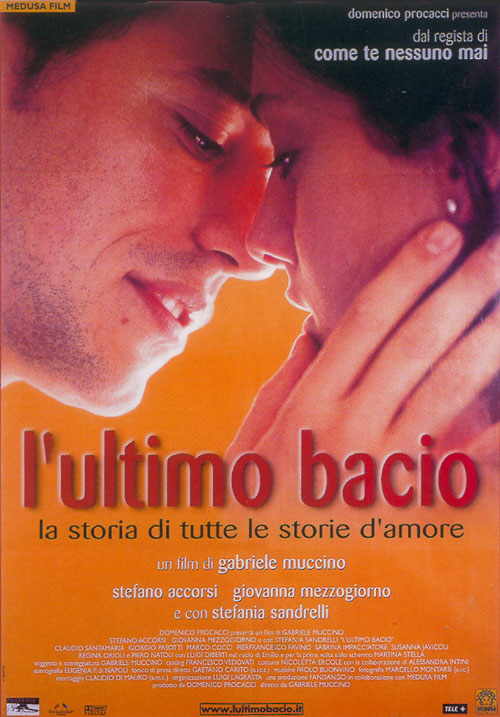 Having looked after the “son of the son” Nanni Moretti, awarded the David “David” Donatello Award for the best film, an even more commercially successful tape “The Last Kiss” by the young director Gabriela Muchchino, by the way, marked the same prize - for directing, you can give it a slight preference, because it looks more and more directly, moreover, more likely Cold and inhibited laureate Cannes-2001. Nevertheless, there is no special enthusiasm about the appearance of the long -awaited new talent. Because almost from the first frames (not because of the presence of a noticeably agitated Stefania Sandrelli?!), You recall with nostalgia about the same as the same genre, family-household tragicomedies Pietro Jermy, who somehow knew how to get knitted in love and matrimonial stories, pulling them out with a sarcastic look at all these temptations, wedding, marriages, marriages, marriages, marriages And divorces in Italian.
Muchchino, it seems, whimsically alternates several storylines, telling about the hopes and disappointments of four young guys, their girlfriends, parents and acquaintances. There is even a motive for escapism, more typical for the Italian "Cinema of Concitiation" at the turn of the 60-70s, when the youth at all costs sought to break with their petty-bourgeois existence and go to distant lands-to Africa or India, where only one can gain the desired meaning of being. However, in the end, it all comes down to a rather reconciling conclusion - and it’s not so bad here if you don’t look at strangers (or youths) in vain, not to torment yourself with doubts that your family life is worse than a hypothetical ideal, and in general to abandon eternal complaints about something better and unique. Tutto E Bene, and translated into Russian - everything is fine.
So by the end of the film "The Last Kiss" it is already difficult to get rid of the feeling that you are watching the next work of the Russian director Dmitry Astrakhan on the constant topic "Everything will be fine." The principle also coincides, according to which sad and ridiculous moments alternate, sometimes hysterical clarifications of relationships and sudden tenderness descending on the quarreling. In a word - a tragicomedy, always with a comforting outcome, which is perceived as a long -awaited exit from a complicated maze called life. As if there will be no problems further and the earthly paradise will immediately come.
Cinema "Five Stars"
"Jay and the silent Bob are responding to" Jay and Silent Bob Strike Back). USA. 2001. 104 minutes. Assessment - 5.5 (out of 10).
 It seems to be happy that the fiery heroes of Jay and the silent Bob performed by Jason Muez and Kevin Smith have finally deserved a separate film that have become cult heroes. They appeared for the first time in 1994 in Smith's debut tape "Sellers", and then necessarily appeared in his each subsequent picture - "party -madeers from the supermarket", "in pursuit of Amy", "Dogma". And according to the emerging peculiar tradition in Kevin Smith's work (his directorial works with odd numbers were much more interesting and artistically significant than opuses with even numbers) seemed that the film “Jay and the silent Bob would make a reciprocal blow” would be a new success.
Moreover, the plan was quite original-never matured characters, still hanging out near the shops, pushing the “grass”, learn that the comic characters Pykhar and Chronicle were honored to be transferred to the cinema (according to the common Hollywood fashion on the adaptation of comics), so they are departed from New Jersey to intervene to intervene in order In what is happening. However, on the way, they, like the plot itself, are constantly distracted in different directions, as if forgetting about the ultimate goal of the route. And in general, it turns out that the episodic funny heroes, who were pushing to the presence of a close -up, cannot withstand the whole narrative, which also falls apart before our eyes.
Although at times it’s really funny - for example, scenes in Hollywood, where they appear as themselves (but in a parody refraction) directors GAS Van Sant and Wes Craven, actors Ben Affleck and Matt Damon, and a number of enormous moments located on the verge of frank focus. Nevertheless, Kevin Smith’s “low-haired humor” as a screenwriter and director has a predominantly verbal nature (which in itself is anxdotically, since he prefers to speak with gestures as a silent Bob on the screen). And for cinema eXocentric, not only external comedian is required, but also the dynamism of adventurous situations, preferably with tricks and gags.
Feeling the shatter of the position of their internally static, not at all developing heroes, reminiscent of some iconic figures, Smith is no coincidence to diversify the action, including episodes in the spirit of "Charlie Angels" with the participation of a female gang of desperate robbers. But still, an amorphous sight is obtained, which is sometimes more entertaining to listen than to watch. By the way, he tried to give the equivalent to all the jargon words and punish statements in the film Russian translator Pavel Sanaev, deservedly mentioned in the ordered text in the final (which is actually a rarity in the world of cinema - unlike literature).
Cinemas "Angara", "Komsomolets", "Youth"
"Shrek" (Shrek). USA. 2001. 90 minutes. Assessment - 7.5 (out of 10).
 The American tape "Shrek" directors of Andrew Edamson and Vicky Jenson is recognized as a new word in animation in general and in computer graphics in particular. Although outwardly it looks like good old puppet films - unless all kinds of three -dimensional creatures move much more natural, and most importantly - people look more natural. In fact, the considerable dignity of the “shrek”, with such an enthusiasm for adopted at the festival in Cannes (there this film was even in the main competition!), And spectators around the world, is by no means in technical innovations, which also have the ability to quickly obsolete.
Perhaps, after Aladdin (1994), the same popular animated picture appeared for the first time, which famously, ridiculously and successfully rethinks the durable canons of fairy tales. By the way, two of the scriptwriters of the “Schrek” - Ted Elliot and Terry Rossio - just took part in the creation of “Aladdin”, therefore they know a way of virtuoso reanimation (literally revitalization) by heart of plots familiar to everyone since childhood. Let the term “postmodern cinema” have practically stopped using the term, like “Aladdin”, it is precisely a postmodern view of the long -standing fairy tales, which seem to be turned inside out, mixed one with another, are obviously modernized, and in addition they are supplied with parody allusions that allow you to perceive everything that is happening within the framework of ironic cinema.
Moreover, if another superkhit of the season, “grinch, Christmas kidnapper” (also, by the way, about the monster, which everyone considers terribly angry, and it, on the contrary, is ready to answer friendliness to friendliness), it seems unnecessarily attached to the American children's cultural tradition, then the “shrek” is more international, open for various comparisons. The title character can be taken not only for the Scandinavian troll, but also for the Slavic water or goblin, but in the history of the enchanted princess, who should get rid of bad spells only after the kiss of the noble Savior, it is easy to drop in the roll call with the “princess-barrier”.
Even Asian martial arts, which, as it turns out, brilliantly owns Princess Fyon, are quite appropriate in the space of the “Shrek”. And since Cameron Diaz voiced it, which was parallel to the Angels Charlie in the adventure action movie, where she resorted to the help of eastern martial arts, this is already perceived as witty self -fraudy. In addition, the amazing popularity in America Taiwan’s “the stealing tiger, the hiding dragon” contributed to the additional (also unplanned) ironic perception of these unexpected talents of the beauty, turning into an ugly creature at night, almost to match the Shrek itself.
So - two ugly steam? After all, the typical Hollywood happy ending, which, in fact, was borrowed by the "dream factory" precisely from fairy tales, obliged to end only happily, put in the "Shrek" upside down. Both the Princess-Wonderland, and the monster from the swamp, despite the mutual love for each other, does not at all become beautiful, but remain forever outwardly the same ugly. And even the donkey-bun, which was relentlessly following Schrek in his adventures, also looks for himself a breathtaking friend in the face of a fire-breathing dragon, or rather, dragon.
It turns out that it doesn’t matter how they all look and who they eat for breakfast at all. The main thing is that they are reconciled with their own shortcomings and begin to do kindly - of course, with respect to those who really deserves this (here is the low villain Farcaad, of course, is not worthy of this). Such is the modern political correct morality of Hollywood, as if slightly corrected the famous saying about the "our bitch son."
Cinema "Baikonur", Big Hall of the Central House of Council, Cinema Center, "Youth"
"Evening visitors" (Les Visiteurs du Soir). France. 1942. 116 minutes. Assessment - 9.5 (out of 10)
In the French name there is hidden poetry, unlike a more defined English version of the “messengers of the devil”, although this seems to correspond to the plot message of the Medieval Legend of the Devil, who sent his own servants to sow discord and turmoil among people, bowing them to his side. But it so happened that Jacques, one of the messengers of the devil, fell in love with Helen’s earthly woman, who seemed to him an angel - and time as if stops: now only love rules the world. Marseille Carnet resorts to the help of the realized metaphor, the literal embodiment of the Faust's desire, “Stop, a moment! You are fine”, when all the couples dancing at the Baron UGA Ball are freezing - and the new lovers leave the hall, spend a happy and completely uniting counting time until they are returning back, and are not again resurrected by those who froze in the dance. The devil (in the colorful performance of Jules Berry, who, before, in the tape "day begins" the same carne, played a kind of "small demon") makes every effort to deal with a naughty servant and his lover, turning them into a stone. But they still remain together, being like a monument of immortal love.
One of the classical pictures of “poetic realism” representing the work of the poet Jacques Perer and director Marseille Carne was perceived at the time of entering the screen in France occupied by the Germans relevant, even topically. She looked like an allegory of Devil Hitler, who in vain tried to conquer a pure soul and sincere heart of France. Only in the 50s, future figures of the New Wave (even before they fiercely pounced on the who had gone over to the former glory and freshness of the cinematic imagery, only fifty-year-old carne) exalted a number of genuine masterpieces born in pre-war and occupied France. They rightly saw the depths of the poetic and philosophical understanding of reality in these ribbons and perceived the sprouts of the new cinematic style, which allows metaphorically transforming reality and even inflated over it.
It is also significant that as an assistant director on the set of "Evening visitors" was collaborated by the Italian Michelangelo Antonioni (he was only three years younger than the 33-year-old Marseurne, already recognized by the Master of 33). Antonioni not only creatively learned the lessons of "poetic realism", including as if the meditative in the in-line rhythm of "evening visitors", but also ended up in further own works, which innovatively changed the ideas about the cinema, as if the binding link between the cinema of the two eras-the frontier of the 30-40s and 50-60s. And in the 90s, the story repeated in many ways when the German Wim Wenders, who had already managed (by the way, with the assistance of the French) to create his own moviengels in the “sky over Berlin”, acted as a voluntary assistant to Michelangelo Antonioni (“behind the clouds”).
Cinema Museum, January 7
"Adventures of the corpse!"/Mortal transfer " (Mortel TransFert). France. 2000. 122 minutes. Evaluation - 6.5 (out of 10).
In principle, the good tape of Jean-Jacques Benks is still inferior to the best works of this master, who, after a nine-year break, has finally returned to a big movie. But the hand of the author of such exquisite drams of passions as Diva and 37.2 in the morning, of course, is felt in his new Mortal Transfert film. Our name was translated playfully - "adventures of the corpse", although it is about a psychiatrist on the verge between sleep and reality, which also committed the "deadly transfer" unacceptable in his profession.
In cinemas from January 24