
Translated material
Dmitry Apollonov. Book of reflections
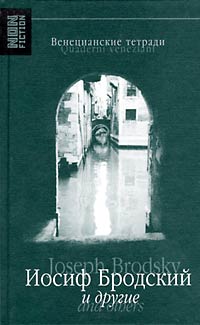 It would be affected that it could be more commonplace for a reading person than the theme of "Brodsky and Venice"? The poet’s poems dedicated to this city are known; It is known that the poet is buried in this city. It is also difficult not to recall the appreciated by Brodsky, Odin , as well as about what Peter Vile, who appreciated Brodsky, wrote and spoke on this topic.
However, the compiler (and, importantly, the artist) of the book Ekaterina Margolis was not afraid of all this beaten. And it turned out that even moving along the usual, seemingly path, it is easy enough to reach other levels that we did not immediately guess about. Yes, of course, here are Brodsky’s poems (eight poems, some of them are not directly devoted to Venice ). But here is his essay "Embankment inexhaustible", which begins the book and from which many threads lead not only to the mentioned poems, but also to the mass of other works - both Brodsky itself and other poets. And also - musical, architectural, etc. The first part of the book ("Reflection of Time"), given to Brodsky himself, goes into the second ("in the form of many waters"), where its predecessors are collected. And here we meet not only Wistan Oden and Eugenio Montale, but also Umberto Saba, not only Akhmatov , but also Pasternak , Mandelstam , Khodasevich . Their traces are clearly visible, if not in the Venetian verses of Brodsky, then at least in the essay. In the third part ("Post Scriptum"), the theme of Brodsky is picked up by three poets in three languages - Derek Walcott, Leo Losev and Thomas Ventzlova. The book ends with the afterword of the already mentioned Peter Vile.
Thus, we see the poet in the context of not only his own work, not only in the context of the work of his predecessors, but also his followers. Both the poet and the city continue to live. True, you regret that in this book there are no excerpts from the novels of Henri de Rainier, thanks to which Brodsky, in his own words, first recognized and felt Venice, nor those old photographs of the city that were at the disposal of the poet. You won’t switch in all, and thank God that after the book there will be an opportunity for independent searches. Some marks are given to us in unexpectedly detailed comments on the Brodsky essay (it seems that now this is almost rare). Here, for example, is a note to the word Vaporetto: "From Vapore - 'steam' ( Perhaps the third of this note would be enough to understand what is at stake, but the compiler offers us almost an excerpt from the encyclopedia. According to the number of links and traces of various cultural ties, this book is an example of the limit of the hypertext that paper can give us.
All translated into Russian texts are given in the book and in the original. One could complain that the Russian poems "for some reason" are translated into English. Partly. However, this is due to the fact that part of his own poems Brodsky translated himself (or co -authored). But the main task that the compiler set for himself was to try and in the verbal system of the book to preserve the most important topic for the city on the water.
In the book we hear the sounds of the city (and even the music sounding in it) through the words of poets. We see the city itself - through the excellent works of Catherine Margolis, through the game by various shades of white and gray paper (as if plunging into the notorious "Benier" fog). The compiler writes in the preface: "Dashes and strokes on paper are collected in letters, words, boats, houses and windows. Reflection is collected from the rowan on the water. Translation is the same reflection: one language is in another. This is the idea of this book." It remains to catch one more thing: the special smell of Venice, from which the essay "Embankment inexhaustible" begins. But for this it is already necessary to visit the great city of the great poet.