
Translated material
Ekaterina Margolis. "Other"
E Katerina Margolis , the plan and artistic taste of which we owe this book, tells Rebeke Frumkina about how the book arose. According to the compiler, “others” are poets directly or indirectly mentioned by Brodsky in his “Venetian“ essay ”embankment inexhaustible and in verses about Venice. But "others" are also ourselves. At least those of us for whom the verses and prose of Brodsky respond to those inexpressible, for which we find words in his poetry; The wrong thing that is connected with his early care and the bitter wisdom, which he left us in the inheritance.
Rebekah Frumkin: Tell us how the plan to collect the book appeared around Venice Brodsky. Have you walked, relatively speaking, "from Venice " or "from Brodsky "? You painted Venice a lot - how did it happen?
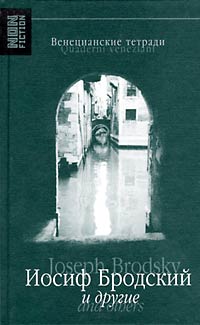 Ekaterina Margolis: First of all, it would be necessary to say "to Brodsky and to Venice", but not "from". Brodsky became my poet when I was fourteen. Therefore, his Nobel Prize , for example, was already perceived as an event, and for me - purely personal.
For the first time, I got to Venice sooner. Now it’s interesting to remember how, having received the opportunity to go to Italy, I decided that I certainly won’t go to Venice. Such a stupid youthful snobbery: since everyone wants to get there, then I have nothing to do there. Such a common place on the map.
R.F.: I know this-because of such an aversion to "common places" I have not seen something.
EM: Moreover, before my first trip, my friend gave me (in a printout), it seems, the not yet published translation of Brodsky’s essay “Inexhaustible Embankment”, just made by Grigory Dashevsky . And I deliberately left him at home unreasonable ... In Italy, I lived with friends in Padua, from where half an hour on the train to Venice. And I went.
The next five days in Padua I only spent the night, and lived - in the most complete sense of the word - in Venice and Venice. And to draw again (after a large break) became there.
R.F.: In what technique did you draw there?
EM: A pen or a capillary pen (this is, as it were, an extremely thin felt -tip pen) on tinted paper, so rough, granular. And on my second visit, in 1994, when I already read Fondament, a very significant meeting for me happened. Oddly enough, I met this person on the street - I drew, and he watched me and made some very accurate remark about what appeared on the sheet at that moment. We talked. He was forty -five, he was a native of Venice, and I thought - most likely he teaches at the University of CA 'Foscari . However, he had strained hands. He mentioned that he was a gondolier in his youth - I decided that this was so, pranks. To my question, what he is busy now, he replied that now he is just a fisherman .
And together with Francesco, we began to look for fondamenta, that is, the part of the embankment where this very hospital for inexhaustible went ... It turned out that there was no such embankment ...
RF: In the sense that there is no tablet with a similar name?
EM: Well, yes. In general, if not for Francesco, I would not see genuine Venice. He himself lived on the island of Burano and spoke almost in the dialect - I did not really learn the Italian then and did not understand this right away. He heard about Brodsky that there is one Russian poet who often comes to Venice. And this did not surprise him - because for his forty -five years he did not leave Venice anywhere, because, according to him, it was in Venice that he needed everything in this world. Francesco now and then threw phrases, which convinced that it was: “Here, I remember, Visconti took off his “ death in Venice ” , he had a limited budget, and therefore he recruited a mass of local orchestra - so smuggled, Francesco’s father, had to appear in the frame as a porter and take the Hero of a coat ... but when they buried Stravinsky, a gondola with a gondola with a gondola. His coffin sailed under this bridge, on which we are now standing, towards San Mikele. "
Then, a year later, I saw Yakovich’s film “Walks with Brodsky” : in one of the episodes, Brodsky stands on the very bridge near the hospital of San Giovanni E Paolo and says: “Here is the channel where the Stravinsky drowned” ...
So everything began to reflect and rhyme. Venice really turned out to be a "common place", but in another sense: this is a meeting point.
I led Francesco to the bookstore, and we bought there the translation of the "Embankment inexhaustible" to Italian (it was made by Gilberto Forti from the most complete English text - and now Grigory Dashevsky first translated this final and most complete version of the essay into Russian).
I so wanted my Italian acquaintance to be imbued with the spirit of this text that she asked: "Here, for example, what time is - Brodsky writes wonderful about this, right?" “Well,” he answered, “ time is water , for the Venetian it is obvious” ...
R.F.: Then everything started - " So timid is the first interest "? ..
EM: I think yes. Later, I was in Australia with my one -year -old daughter, I had a scholarship at the University of Melbourne to write a dissertation in the languages of Aborigines. I was so yearning for so much that everyone went to the ocean and thought that these waves would roll to me from those very mossy Venetian steps, and then back ... It somehow comforted. Finally, in Kanberra, I met Anna Vezhbitskaya , a great linguist. My beloved. I have long dreamed about this (you have long been friendly, right?) And with her eldest daughter Marysey (which you also know). Maryya wrote a dissertation on the vicious experience of various writers, which was conditionally called "Lost in Translation" (this is the name of the book of a wonderful Polish American writer Eva Hoffman, where she talks about her own experience in a new language, about awareness of herself in a new language after emigration).
Once we were talking about Venice, about Brodsky, and then Maryya dragged a tenderloin from the New York Review of Books with Walkott's poems in Brodsky’s memory (these are “Italian constedics”). Marysya saw my drawings, and, in fact, the idea to combine drawings with Brodsky texts and Brodsky arose with her. I did not consider these drawings at all "illustrations for ...", and Marysa saw them immediately as part of the future book. For me it was like gaining a new breath.
RF: Did you have to return to Melbourne?
EM: Yes, and there, with the help of a colored photocopy, I began to collect something like a book-I wanted the pages to be tinted, the colors of a gray-green Venetian water. And what I did was intended as a gift to mom for Christmas 1996. It turned out a book of Brodsky’s memory - it exists in our family in a single copy called “Venetian notebooks”.
RF: Did you then think that one fine day something like this will leave the printing house in the form of a real book with your illustrations?
EM: No, of course, - I recognized myself as a student, it was something completely personal.
R.F.: Probably, this is like a student to dream of creating an academic dictionary.
EM: something that could not be kept without expressing without expressing: in the drawings, perhaps.
RF: Such fullness with verses, the city - I experienced this, for the first time in Paris - then I went little, and I was all tormented by the fact that with these impressions I had to do something in order to survive them ... and at the same time, preserved in yourself. By the way, almost all your drawings have an image of a bridge, stairs and water. Why are the bridges?
EM: A bridge is such a capacious metaphor - connection, transition, reflection, connection ...
RF: I am captured in your drawings that in front of me is the space of the sheet, where I can go in, inside. I strongly prefer “mimetical” art: this does not mean that I “do not accept”, for example, Pavel Kuznetsov - you can also enter - for example, in a dream ... I need the space of imagination and empathy - this is what I mean, saying that I want to get up with you along these slippery steps.
EM: There, the city tells all itself - the fragility of the pattern, dilapidation, thin, as if half -dead paper. Water in Aqua Relia, describing herself ...
R.F.: Why is Brodsky and English -speaking poets Dan in two languages - this is understandable, but for what purpose the translations of Pasternak and Akhmatova are given to English? The Russian reader opens the book and - ..?
EM: Why and only Russian? It is no coincidence that the book also has the English title Joseph Brodsky and Others. Brodsky , Milos and many people close to him in life and literature lived in several languages and cultures. I wanted to convey this. So the book is addressed not only to the Russian reader, but to everyone who "experiences longing for world culture." After all, Brodsky continues in two languages. And in the verses addressed to the daughter in the collection "So Forth" (in Russian the book is called "Landscap with Flooding"), he talks about "These Somewhat Wooden Lines in Our Common Language" as it will remain for it when it will no longer be.
***
In conclusion - a few words are no longer about the author’s plan, but about the embodiment, as it is seen by my (R.F.) A preferential look.
There are books that, turning into an undoubted Object d'Art, lose their content: they want to not read them, but intently consider these, for example, publications of Russian fairy tales in the design of bilibin. Since childhood, I was used to enjoying this knitting details. I remember how, having returned to Moscow from the evacuation, I was happy that my favorite books survived - it was that I found that I read the texts for the first time.
"Venetian notebooks", which I find exemplary and, moreover, modern, not imitating from the point of view of the layout, first of all I want to read . The first full Russian text of the "embankment of inexhaustible" is a generous gift made to us by G. Dashevsky. E. Margolis we owe the opportunity to read the English original at the same time: it opens up a collection. Everywhere on white pages - texts in Russian, in tinted - in other languages. In the layout - nothing accidental, from the color of the binding to the headset and letters. Everything is stingy, thoughtful, harmonious. The comments are made carefully and designed (importantly) for a wide reader, but at the same time the sophisticated fan of poetry will be by the way.
Venetian sketches E. Margolis (graphics and watercolors reproduced here in the Sepia) are good as a quiet accompaniment. For my taste, the general spirit of the book is most accurately expressed by a landscape with a narrow boat, preceding Mandelstam's poems "Benesan life of gloomy and barren ...". This is a drawing of an unusual format, in the entire strip, but a third width of it, as if containing all Venice in itself at once, as we used to imagine it: the channel is so narrow that it barely contains the boat; Almost in contact, dialing, but still stone walls going into the sky; The incredibly short bridge connecting them, like a branch of one tree, miraculously grown into the neighboring one.
You can argue about the project, about the plan of "Venetian notebooks", but the book was indisputably successful.