
Translated material
Elena Stafieva. Bow the shadows
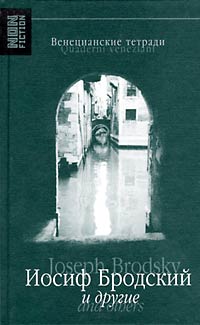 With a person who leaves the poetic book, if he is engaged in a recently deceased poet, has a choice: to publish an unknown or shuffle the old. By the very nature of their craft, the compilers usually prefer the first (which gives them a chance to turn into publishers). Often they honestly make the second against their own will. But it is also possible the third - to create something conceptual.
It was this third way that the compiler and artist of the tasty collection "Venetian notebooks. Joseph Brodsky and other" Ekaterina Margolis. The book has, as it were, two thematic rods: firstly, this is the Venetian theme (the first and second parts); Secondly, this is the theme in Memoriam (the third part). The fact that Brodsky is buried in Venice contributes to the fastening and interpenetration of these parts, turning the book into a kind of symbolic visit to the poet’s grave. And, of course, the name of all three parts is “Reflection of Time” (Essay and Poems of Brodsky), “In the appearance of many waters” (verses of Saba, Montale, Oden, Akhmatova, Pasternak, Mandelstam, Khodasevich), “Post Scriptum” (Venetian poems by Walcotta, Losev’s Ventslovs) - these Brodsky (however, his 1967 poem "What a pity that what the" postscriptum "was called for me, in one word).
The book is not only informative, but also formally: the essay "Embankment of inexhaustible" and all the shmetstitules are printed on lilac-pink paper, essay "Watermark"-on gray-lilac, and poems on two-tone, so that on the right is the lilac-pink page, and on the left-gray-siren. Such a whimsical color scheme, apparently, is called to serve as an illustration of Brodsky from the essay “Guide to the City Renament City” (“A Guide to a Renamed City”, for some reason called the book “Guide to the Bezny city” (p. 181): “Transparent pink tint of the sky so bright that the blue The watercolor of the river is almost not able to reflect it " 1 . However, in Brodsky this applied to another Venice - North.
Genre In Memoriam - an insidious genre. The costs of "this, ultimately, of self -plating, sometimes bordering the self -exile" 2 , the master warned: "┘ The most interesting feature of this genre is the unconscious attempt of self -portrait, which almost all the poems" in memoriam "are full of - or tarnished" 3 variegated by them "wreaths dead" Poem or book. All compilers of such collections should be remembered. So what was the self -portrait?
The book, as expected, was suggested by the introductory article “From the Compiler and Artist”, which sets out not only the poetic concept of the book, but also its (compiler and artist) Credo. Venice appears before E. Margolis a manual on the history of elegant literature in the open air: here the lines constantly "emerge" and "the shadows roam". "Brodsky ┘ following Khodasevich, he makes the path from the Venice station to the Square Square in his essay, where the Oden line suddenly emerges from the fog"; "Montalet, starting with the poem" Line "accompanies Brodsky from the shores of the Baltic through the Atlantic to the Adriatic"; "In the silence of the last Venetian island, one pet of the Baltic (Thomas Ventzlova - E. ) Lists into the silent voice of another" (p. 6). It turns out something similar to literary Petersburg - in the image of Marshak :
Neva has long been using verses:
Gogol's page is Nevsky,
The islands are remembered about the block
And Dostoevsky wanders around the road.
This poetic excursion in Venice is accompanied by thoughts about the meaning and purpose of art: "The connections of forms inevitably conceal countless strings of meaning" (p. 6); "Image back to the tongue, this is a way of liberation" (p. 7); "Bridge, three mossy steps and their reflection form a new whole essence" (p. 7) ...
The goal to which the author’s energy is directed is clear and transparent, like the waters of Adriatic, to achieve a complete stylistic merger with his beloved poet. The periods of Brodsky fascinate E. Margolis, like the rings of the CAA body. She brings to the point of absurdity characteristic stylistic features of the sample, once again confirming the obvious: you can not write about Brodsky to match Brodsky . The result is predictable. In Brodsky, the significance and importance of tone, Margolis has pomp. In Brodsky, the intonation is bewitching, and Margolis has obsessively monotonous. The compiler is trying to shift the prose of the famous verses: “The gondola hits rotten piles” (“Laguna”, p.141), and gets only a worn stamped picture: “Close your eyes anywhere in the world, on the edge of the world. And hear the splashing of the waves, tapping the gondolas about the rotten piles, the creak of the oars and the cries of the gulls at the lagoon. (S.7). To the final of the entry, the meaning from the text completely evaporates: “In the ordinary consciousness, the poet is just a self -centered, who does not perceive anything outside himself, and even more so, beloved. (As God give you to your beloved)” (P.7). Badness, on the contrary, reaches the apotheosis: "From a sweet-salted moment of recognition, it takes a breath. Harons, catchers of people, or just fish, the water merges with the sky. Post scriptum." (S.7).
But all this E. Margolis could be forgiven if she had impeccably played the main role - the compiler, commentator and the artist. However, here she is not able to avoid those genre dangers in Memoriam, about which Brodsky warned - "emotional optionality in such cases gave rise to didactic vague." 4 It is not even clear what kind of book before us: a gift folio or commented publication. For a gift book, she clearly lacks stylistic design: either luxury or conceptualness in the design. Otherwise, the gloomy-green cover will be more likely to remind of mosses and lichens of the undergrowth than the aquamarine of the lagoon, and the black rectangle with the spider-like inscription "non fiction" looks like a clumsy patch on a new suit.
For a commented ("solid") publication a commentary is too inconsistent and lightweight. Poisoning reigns literally on every page - it is enough at random to reveal the book. It is completely incomprehensible by what principle the realities were selected for commentary. Why, for example, the lines from San Pietro - “and the third week, drying sighs / are so used to the daylight / and to their rope” - need an introductory explanation: “A area where tourists are not often wandered. A lot of linen on the ropes.” (P.146).
And another mystery. Each text has been suggested by a small introduction of the compiler, usually containing some quote that explains its general meaning or circumstances of the creation. The text where such a quote comes from is not indicated in any way and no links to the cited publication are made. Of course, someone is able to guess that, apparently, Brodsky’s comments were taken from his interview, and N. Berberova’s memoirs about the Venetian journey with Khodasevich - from the memoirs “Mine”. But still, references to the sources would not have prevented. Or before us is an esoteric text, designed exclusively on the initiates?
The map of the literary world seems to E. Margolis like the Ptolemyeva universe: in the center of it, the frozen figure of Brodsky, various poets and writers rotate around which. Only this kind of cosmological ideas can explain the originality of the characteristics given in the commentary. Roberto Kalasso is “a famous writer, author of peculiar narratives based on ancient myths; Brodsky enthusiastically spoke about his book“ The Marriage of Kadm and Harmony ”(p. 173; it would be interesting to find out what is meant by“ a kind of narrative ”). Suzan Umbrella - “one of the“ rulers of the thoughts ”of his generation (“ cult figure ”of the American intelligentsia), a friend of Brodsky” (p.157; “cult figure”, apparently, is a translation into the “modern” language of the old -fashioned ruler of the thoughts). Wrist Hugh Oden - "The eldest friend and teacher of Brodsky."
Historical and literary comments are impressive no less than biographical characteristics. Thus, the poem of the Oden “The Fall of Rome” (“The Fall of Rome”) is accompanied by the following considerations: “Drawing a parallel between Rome and the British Empire, Oden follows the English literary tradition (Kipling, etc.)” (p. 229). What tradition are we talking about? Who are these most mysterious "others"? Dradyden, Jung, South, tennyson? Apparently, E. Margolis simply has nothing more to add to the name of Kipling, hence these mysterious "others" arise.
Does all the above means that we blame the compiler and artist of all possible sins? Not at all. Of course, E. Margolis's touching concern about external honorary, which adheres to such a classic as Brodsky, causes sympathy. The compiler is clearly confused by the poet’s habit of boldly using obscene vocabulary. Therefore, in the poem "From nature", one bean in a famous word was replaced by bashful points:
And pigeons on the pediment of the Palace Minelli
e . go in the last rays of sunset,
Fortunately, the poem fell precisely on the lilac-pink (the color of love notes from French novels), and not on the gray-lilac page.
Such happy coincidences, however, are inappropriate - in this book it seems as if everything is not in its place, and this impression is still intensifying with typos. For example, on p. 171 in a commentary on the "Venetian stanzas (II)":
... naked, cold marble
the hips of the New Susanna are accompanied by
diving under water cameling movie cameras
new elders -
We read "See note., p. 199". However, on the 199th page, instead of Susanna and Elders, we find a lampore and eel from E. Montale's poem "L'Anguilla". And the desired characters are found on p. 99, where the corresponding biblical plot is commented.
However, in these muddy waters, among lamps, acne and other creatures, small but real pearls come across. For example, Leo Losev’s commentary on Brodsky’s poems from the long -expected volume in the Poet Library. Well, and for this you should be grateful.
Notes:
 1 Brodsky I. Less unit: selected essays / Per. from English. Ed. V. Golysheva - M.: Publishing House Independent Gazeta, 1999. P. 93.
2 Brodsky I. About one poem / less unit: selected essays. S. 192.
3 Brodsky I. worship the shadows. / Less unit: Selected Essays. S. 345.
4 Brodsky I. About one poem / less than one: selected essays. S. 193.