
Translated material
And life, and tears, and rubles
More than a year and a half has passed since the death of the Kursk atomic submarine. But only last Monday, the Main Military Prosecutor's Office announced its decision to recognize the close relatives of the dead sailors with victims in a criminal case, instituted on the fact of the death of an nuclear power plant. Now the wives, mothers and fathers of the dead submariners will receive the right to get acquainted with the case materials - in order to finally understand the reason why their relatives died, to evaluate whether everything was done to save them, whether the circumstances of the tragedy were quite fully investigated. And besides, as victims, they will be able to file claims for compensation by the state of non -pecuniary damage for the death of their loved ones. However, with regard to money, the state fulfilled its previous promises: the apartments were provided, compensation was paid. True, both have already managed to become a reason for a squabble and strife. And the fault of this is not only stretched nerves of people who survived the tragedy, but also the seemingly unfair system of payment of compensation from numerous funds.
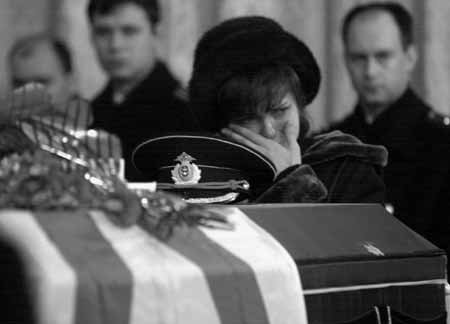
No matter how blasphemously sounds, but the relatives of the sailors from Kursk were in a kind of privileged position. This is the fifth dead Russian atomic submarine. But before, the state did not provide material assistance to a single family of the deceased submariner! The situation with the Komsomolsky developed a little differently, although the state had nothing to do with it. The designers and builders of the submarine allocated a large bonus, which they refused in favor of the families of the dead. So the relatives of the sailors from Kursk were the first to receive material compensation in Russian history.
The state provided the families of 118 dead submariners of the apartment and compensation: 720 thousand rubles plus military insurance (from 40 to 70 thousand, depending on the military rank). In addition, numerous public organizations and funds transfer money to relatives: Vidyevsky, Nakhimovsky ...
The first misunderstandings arose due to the distribution of apartments. This was most obvious in St. Petersburg: the largest stream of relatives of the dead sailors poured here. First, 8, then 12, then 18 apartments were allocated for them. To date, there are already 39 of them in St. Petersburg (for comparison, in Moscow and Moscow Region, only a few families have been provided with housing.)
It is no secret that some families received not even one, but several apartments: first of all a widow, then a mother, and if she is divorced with her husband, then her father. According to relatives, some fathers of the dead submariners were surprised by unexpectedly awakened father's feelings, after they lived far from their families for many years and did not see their sons almost from infancy.
The problem was with civil marriages. Many, for obvious everyday reasons, were not registered. For example, someone had to go to Vladivostok to dissolve their previous marriage there. Yes, no one thought that tomorrow could happen. Not a war, after all.
True, Deputy Prime Minister Valentina Matvienko at one time promised to register all civil marriages retroactively, but then she hurried. According to civil law, this is impossible. Therefore, civil wives could not fully receive official manuals and financial assistance.
By the way, in many families where they could get this money, they became a reason for serious expanses. After all, they were divided between 118 families equally - 720 thousand each. They gave the money into the hands of the widow, and if it is not, then parents. Valentina Matvienko said: "We do not concern us how they will share this money."
One of the public organizations that provided material assistance to the relatives of the victims was the St. Petersburg Club of Silent Supervisor. They distributed the money received in a special fund marked “to the aid of the relatives of the dead” - 376 thousand rubles. To understand how to better share them, they collected the relatives themselves and asked to anonymously offer their options. There were few suggestions - only three. “All of them were rational, thoughtful and to some extent fair, but here the human nature made itself felt: each pulled the blanket over himself,” said Igor Kurdin, chairman of the club of submariners, submariners.
In the end, the priority was given to the children from the first marriages, since when determining the size of state assistance, they turned out to be the most unprotected. Neither from military insurance, nor from the money of the National Military Fund, they did not get anything. For the second place, for the same reason, civil wives were put. It was proposed to be included in the share of minor brothers and sisters. But according to our law, they are not the closest relatives, and, allocating them funds, the fund risked to get into an unpleasant situation with the tax inspectorate. The money was distributed as follows to all other relatives: 7 shares, 3 - widow and 14 shares - each of the parents.
Such a kind of alignment caused a lot of disputes and discontent. For example, as the widow of one of the submariners Valentin Milyutin said, in her opinion, the money had to be divided equally, as was done in other funds: “Why did I, the wife of a dead sailor, and my child received 10 thousand in total, and my parents - 28? I understand that the fund could manage money at its discretion, but no one understands such a chaotic distribution. And in general it is simply dishonest. ”
Until now, nothing is clear with the Nakhimov Foundation: “We are regularly collected to inform you that there is money. But each time they call a new amount. Moreover, it all decreases every time. When the new commander of the Northern Fleet Gennady Sechkov was collected in the Nakhimov school, the amount of 34 million rubles was called. But so far none of us have received a dime. They say that as soon as it all ends with the investigation of the causes of the death of Kursk, as soon as everyone is buried, everything will receive everything at once. But will this epic ever end? And why do we constantly promise us some money if they are not given it anyway? " - relatives are indignant.
Alexandra Medvedev