
Translated material
. Like in a quagmire
Gardez
Afghanistan is a complex country. This is a banality, and yet, any story about Afghanistan can begin with this phrase: everything is very difficult. The battered truth that does not need to be ashamed.
Here were, say, the fighting in Gardza, the operation "Anaconda". There were a lot of messages, comments and analytical performances, but no one saw what really happened there. They conveyed about the successes of the Americans and the resistance of the Taliban, but everyone who came to Gardez saw the battlefield only to binoculars. Shots, breaks, smoke - all this could be seen, but there were no genuine, reliable messages from the scene. All that could be obtained from official sources cannot be considered nothing other than propaganda, however, propaganda is extremely contradictory.
The Americans reported their successes with all their might: about a thousand enemy fighters were destroyed during the Anaconda operation. But the Afghan allies of the Americans reported that there were very few corpses in the mountain caves. The Afghans are more likely to believe in this matter, in any case, a few days after the end of the operation, the Americans turned to the British with a request to send 1700 soldiers from elite units to Afghanistan. So the war is delayed, the victory is moving away, and all this looks rather strange.
In such a situation, it is quite appropriate to start with the simplest questions: who is fighting with whom? At first glance, everything is clear: the Americans and their allies with the Taliban and al-Qaeda. That is - the forces of good with the forces of evil.
So let's start with the strength of good. They are placed on the outskirts of Gardez, in an impromptu barracks, consisting of a clay hibara surrounded by a brick wall. In the courtyard of the heels of armored vehicles and two missile launchers.
Kami commander says: "We arrived to fight with al-Qaeda!" Around - its fighters. Everyone has joyful faces, they joke and laugh. They arrived from Kabul on the seventh day of battles in the mountains under the dressing room. The Americans need them. They clearly like it, although they understand that it can cost them life. Their total number of about one and a half thousand, and all of them are subordinate to Mohammed Fakhim, the Minister of Defense of the Kabul government. Mohammed Fakhim is one of the best in the ranks of the forces of good. Without him, the Americans would not have coped with the Taliban. His troops came from the north and, after intense bombing of American aviation, defeated the Taliban and ousted them into the inaccessible areas of the country. Fahim’s soldiers are experienced, determined and disciplined. “We withstood five years of siege in the Pandsher Gorge, we opposed the Taliban alone, without any external support,” says the commander of Kami. “Why shouldn't we continue to participate in this in the first roles?” Why not show their strength here, in the southeast of Afghanistan, where the Taliban clearly dug. Why - you can raise the question so - do not give them their lives instead of American soldiers? This is a practical solution that does not violate the spiritual calm of the West.
The problem, however, is not so much military as political or, rather, ethnic. The soldiers of Fakhim are mostly Tajiks, and Gardez is the city of Pashtunov, the largest ethnic group of Afghanistan. Traditionally, there is enmity between these ethnic groups, although now, under pressure from the West, they are forced to cooperate in the transition government. Until now, Fahim’s troops have not moved more than a few kilometers south of Kabul. The land of Pashtuns, if not enemy for them, is hostile, causing suspicion and does not exclude danger.
So the forces of the good Fahim in these places are not considered good. After all, if they fight on the side of the Americans with the Taliban, then they are fighting against Pashtuns like Tajiks. The confrontation between Tajiks and Pashtunov in Afghanistan is the matter that can give rise to a civil war. But for orientation in the Afghan maze of ethnic criteria alone, it is not enough. This is too rude approach. Whoever wants to understand what is happening in the city should get to the adobe hut on the other side of the city. Haji Saifulla, who heads the city council of Gardez, is taking the reception.
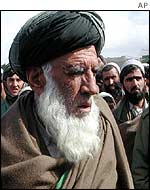 Haji Saifulla looks exactly as they imagine an Afghan elder: with a long beard, covered with wrinkles, a steppe. He sits in the half -gathering of the hut and briefly answers the questions of journalists, in the corner a pair of machine guns gleam. There is no doubt that he knows a lot about the course of the war. However, he does not give out the information that he has, and evasively answers with meaningless phrases: "I hope that the Taliban will stop resistance," or: "Of course, a peaceful decision would be better." In general, Haji Saifulla is careful - and is careful because he has to combine several roles at once. He is Pashtun, he is the head of the clan, he is the head of the council and ally of the United States, approved by Prime Minister Karzai. The decisive question for him, and therefore for anyone who is going to turn to him: how to combine these roles? At first glance, everything seems to be simple. First of all, he is an ally of the United States, omnipotent superpower. Everything else is determined by this. However, what will happen if any other ally of the United States, besides Pashtun, will take up arms against him, begin to oppose him? Haji Sayfulle had to deal with this. Behind the pass, in the provinces of the host, it is ruled by the unlimited ruler of Paja Khan, also a clan leader, also supported by the Americans. When a few weeks ago the question arose of who will become the ruler of Gardez, he declared his claims to this post. Haji Saifulla and his people resisted as best they could. In the end, 64 people gave their lives, fighting on the side of the union forces, and Saifulla managed to defend their positions.
However, Paja Khan is a cunning and adamant enemy. In December, the Americans bombed the motorcade on the road between the host and Gardez. According to them, in the column there were people al-Qaeda. In fact, these were the elders who went to Kabul to the ceremony of bringing the government of Hamid Karzai to the oath. Eyewitnesses report that then 50-60 people died. Deadly misinformation was thrown by Paja Khan. True, he denies this, but rumors go - and therefore, anger ripens. “Of course, there are problems in our province, problems with our people,” says Haji Saifullah, and if any emotions are reflected on his face, then right now, when he says: “Paja khan stroces obstacles. He blocks passes to the host. It is not good.”
Paja Khan and Haji Saifulla - which of them represents the forces of good? Which of them can the US Supreme Power rely on? There is no answer to this question. Each leads his micro -general - and the picture of the forces of good breaks up into many obscure gray spots. There is no clear "Who is who" in this war.
Maybe it’s easier to deal with those who are attributed to the forces of evil, with these villains - Taliban and al -Qaeda? As in any other war, they do not spare black paint on the enemy, so that everyone is clear with whom the struggle is going on and why it should be done. Evidence, clarity is absolutely necessary. Therefore, the victorious relations during the Anaconda operation were so broadcasting: it was about the final victory, the front line, the decisive battle - a clear picture was needed for home. But where was this front? How are things with the forces of evil? And these questions can be obtained in Gardza some answers if you move down the apparent endless staircase of the tribal leaders, the leaders of the clans, the heads of the families, until you get to the house of the commander of Amin, who does not give out his real name because he fears for his life.
During the Soviet occupation, Amin was a commander in his native province. He knows what a partisan war is, familiar with the strategy and tactics of Afghan warriors. But he was tired of the war, he would like it to end and that peaceful life began. However, the end of the war is not visible: "I'm afraid that this is for a long time. The operation" Anaconda "was not a decisive battle." Explaining why, Amin calls two names: Hekasyar and Hakkani. Hekyyar is one of the old warrior of the Afghan drama, an Islamic extremist who, to multiply his personal power during the civil war of 1992-96, did not stop before turning entire Kabul areas into steaming ruins. During the Soviet occupation, he received Western support, later, during the Civil War, the support of neighboring countries, Pakistan and Iran. Despite the defeat and prolonged expulsion of Hekasyar, he remained an influential figure on the Afghan chessboard, his shadow always hung over the country. “And now Hekstyar has returned to Afghanistan,” says Amin, “I don’t know where he is, but he is somewhere here!” He says this as if we are talking about the return of the devil. "Hekasyar has a lot of money, he has a weapon, this is a real leader, and he wants one thing now: war."
And to achieve this, he needs people like Hakkani, one of the leaders of the Taliban. He was also among those who earned their reputation during a ten -year struggle against Soviet troops. The last post of Hakkani was the post of Minister of Defense in the Taliban government. The Americans before the invasion of the Moderate, hoped for his "desertion" from the ranks of the Taliban, and when it turned out to be an illusion, several times tried to destroy it during air raids. So far unsuccessfully. Hakkani disappeared without a trace. Hekasyar and Hakkani, according to the former partisan commander Amin, are those people who can continue the war to infinity. "They know how to do it!" How to achieve this is clear: there will no longer be “battles”, there will be no battles, as was organized by the Americans and their special forces in the last operation. The front lines disappear, the war goes underground. "I know from reliable sources that Hakkani received from Omar, the leader of the Taliban, the task of giving 15 people from al-caeda." Fifteen lives as an entrance fee in the world of forces of good, fifteen lives as a bail to agree with the new government. Is it true that Amin says is not so important. More importantly, such thoughts go among people that such ideas arise and are realized in the country where war has been going on for thirty years; It is important that this does not seem incredible.
Of course, Hakkani is a strong and influential figure. Finally, he was not recorded into the enemies. Why not remember old ideas, if you need to get as many friends in this country as possible so that it is one? But when the border between the enemy and a friend is erased, then a long war begins. “The mission determines the composition of the coalition,” this remarkable slogan of the American Minister of Defense of Ramsfeld in Afghanistan will not surprise anyone. What is Hakkani American high-precision weapons if, after the issuance of 15 al-caeda militants, he will be located in a democratically updated house and receive his piece of thick pie to restore the country?
The commander of Amin also claims that the people of Hekasyar - “there are a lot of them” - are already sitting in the Kabul government, undermining him from the inside. It is impossible to check this, because people Hoekyar have no certificates by which they could be identified. And Amin probably has his own interests. What there is no doubt is that Hekasyar still has many supporters. As in the fact that he is able to convincingly promote the sacred war, this time not against the Russians, but against the Americans. And this will be a war that goes not on the battlefields, but carried out by terrorist methods. "According to my information, Hakkani has 280 Beviks from al-caeda who are ready to become suicide bombers." They have to sow fear and horror, not to give rest to the Western troops and shake compatriots with a martyrdom. And the longer the American troops remain in the country, the more chances the demagogues like Hekasyar. “So this is not visible to this,” says Amin.
This is what all this looks like in Gardza, in this small, dirty, nondescript city in the southeast of Afghanistan. You come with ready -made schemes: here is the enemy, here is a defeat, there is victory; There is the past, but here is the future. You leave, but everything is mixed up in your head, and you don’t know where the enemy is, where is a friend, where is the defeat. And most importantly: where is the victory?
Die Zeit , 2002, N 14.