
Translated material
Vadim Mikhailin. "Only a critic of a professional makes sense ..."
For a year now , an interview with translators of fiction has existed on the virtual pages of the Russian magazine. For me, this page (in the sense of a segment of life) is not virtual at all, but, on the contrary, tangibly real. Sooner or later (namely, soon) it will turn over, and it will end with a small, but extremely interesting, I hope, not only for me, a project. I am a little afraid of this ... Thanks to everyone who supported and continues to support me on this path. Thanks for all the reviews and letters. Lena Kalashnikova.
Russian magazine: How do you understand: this translation was a success, but that - no?
Vadim Mikhailin: The only criterion is the language. Intonation, the melody of the original text should be adequately transmitted in Russian, not necessarily the same melodic, always the same mood. And the translation of ideas, situations, something else is a technical matter.
RG: Which translation was the most difficult?
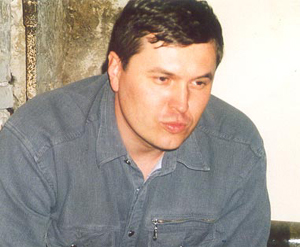 |
| Vadim Mikhailin. Photo by Elena Kalashnikova |
RG: And the most interesting?
V.M.: Probably, he. This book, my youthful love, was the first serious work to stretch for a long time. Then there were other intonations: after giving rise to romanticism and baroque, I took even thicker, broken romanticism - the early prose of Yates, and then a completely different tradition - Gertruda Stein .
RSH: Do you make a substrate or do you immediately work carefully on each phrase?
VM: I never do the substrate - first I read the whole text, and several times to knock down the soreness of the first perception, when you mainly look at the plot, the dynamics of the characters - to get to the tongue. Sometimes you translate fragments from different places.
RG: Are you looking for linguistic, stylistic, intonational analogues in Russian or world literature?
VM: The question is not easy. In the "water station", the roll call in intonation, motives, plots with Grasses is so obvious ... Swift does not even hide it, but it was interested in me last. Swift roll calls are very characteristic - either with a folkner , then with a grass . But from this his texts do not become worse, there is no taste of secondaryness, he manages to make them very English.
But there is no roll call with Russian literature, I mainly translate the authors with us unknown, or those who have not been translated enough. On the other hand, Dostoevsky , Chekhov can be found in Darrel and Swift, and in the work of Stain and Chekhov - Flaubert .
RG: Is this your installation: translate authors deprived of attention, or is it just that it happens? But what about the "Autobiography of Gertrude Stein", translated to you by Irina Ninova?
VM: The second translation is a claim to criticism of the first, as for the “Autobiography ...” is an exception.
RG: What would you note from interesting translations of recent times? What literature is close to you?
V.M.: Recently, the sphere of my interests has sharply shifted from literary criticism towards cultural anthropology, ethnography. I head the department of foreign literature and classical philology at the University of Saratov , and basically read texts written 2000 years ago.
RG: In the original?
VM: It’s a pity that I did not teach ancient languages poorly at the university ... Of course, you can now take up Sanskrit, Gothic, Old Norwegian, but it will take 3-4 years, so I read translations and communicate with those who know these languages. And from the translations of recent times, I would celebrate the Rigved.
According to V.L. Toporov , the modern advanced youth has an installation on a bad translation: “ Through a clumsy translation, she wants to see the original author’s solution, to speculate, turn the book into an interactive reading. This audience is uninteresting to receive a ready -made translation version through which the poor translators do not make this task involuntarily, and good ones are struggling with it .” What do you think about this?
VM: In my opinion, there is no such installation, in any case, Saratov students prefer good translations.
As for Toporov , each translator with experience begins to theorize and look for unexpected intercultural moves. It is like Gasparov experiments with a literal translation, like squeezes from Kawaphs, when a poem of 14 lines is reduced to the 4th. Such an experiment is interesting, but does not cancel the translation if you read these 4 lines without knowing the original ... Well, this is not a Cavafis .
RG: Or there should be a more classic translation nearby ... Would you like to put your translations in a book with a parallel original?
VM: Why not?
RG: Many do not want to let them into their workshop. According to A.Ya. Livergant , " ... when you publish parallel texts, you must select the translation accordingly. Translations should be more or less close to the text. Such things are in the nature of educational literature so that the reader can compare the translation and original ."
VM: There will always be comparisons. For a senior, the discovery when he sees that the phrase of the original is translated differently. Only criticism of professionals makes sense, they know how this work is being done.
RG: Does the attitude to the text change after the first reading? Maybe there is disappointment or, conversely, you see a new one in it, which you have not seen before?
V.M.: Usually not. Either the text immediately takes, or ...
RG: And so that the text is tired by the middle ... and it needs to be translated, or annoyed?
V.M.: The only time - this was the first work for money, the prose of John Lennon , then it was published, but in another translation. Lennon watched advertisements, cartoons, series, he had an associative series ... But this is not literature, although at times witty, you quickly get tired of verification with words. By the beginning of the second third, the collection is so tired of it ... I did not take on what could cause rejection.
RG: Reading the translations of others, not necessarily the last time, do you feel the feeling of envy: "How well is translated! .. ", or this does not happen?
VM: Viktor Lapitsky has wonderful, delicious finds, although some of what he does is not in my taste; In Vladimir Babkov, intonation is interesting how the text works from the inside.
Recently I was struck by accuracy - up to the order of words, the number of words in the line - the translation of the "Iliad" Gnedich , despite the fact that the accuracy here is not at all to the detriment of literature.
RG: Do you have large breaks between translations?
VM: It happens, and sometimes two or three translations are going on at the same time.
RJ: different genres?
VM: Most often I translate prose, extremely rarely poetry, if it is part of the prose, sometimes drama. I am not a poet and is not entitled to engage in poetic translation.
It is useful to switch the brains, and drink wine on tasting with water so that the taste does not bore - when scientific work is bored, translate a couple of pages, the soul flows easily and smoothly. And it happens - for several days you can’t put yourself at the table, the text is not lay down on your ears.
RG: In plays, among other things, the text should be easily pronounced. Do you think about it or does awareness come later, during the editing?
V.M.: The most interesting experience in this area is Edward Bond "Lear". I translated it primarily for reading - from the point of view of the actors and the props, it is so large that it is unlikely that we will put it with us for the next ten years, and it is quite possible to read it.
RG: Are you returning to your old translations?
VM: Sometimes, moreover.
RG: In the case of reprints?
VM: Not only. Once at the conference, far from the house, I wanted to give A.Ya. Lievergant a book in my translation. He began to flip out, and on the third page it became so ashamed ... in the end, I gave it, but promised that I would not be like that anymore.
Agreeing with the Publishing House "Symposium" about the reprint of the Darrel, I set the condition that I would process all four of its texts from above to bottom. During work on the large text, the eyes are blurred, besides, the novel has practically no editors, he went directly from the wheels.
But still, a return to old work is rather an exception.
RG: Do you read passages to anyone? Do you listen to the opinion of colleagues, acquaintances? Someone's opinion can affect a change in the phrase, fragment?
V.M.: Of course, I read to others, in general, it depends on a person - the opinion of some works a plus, others into a minus.
RG: What translations do you think successful? Or at different times I like different things?
VM: Of course, the tastes are changing. I have a difficult attitude to Darrelovsky translation - not everything is done there ... Maybe I will return to it in five years.
RG: Why not everything is done? Was it not enough time?
V.M.: In part due to time: I finished the translation of the last two novels in a hurry, moreover, it is more difficult to edit such a large text than to translate it in a row.
As for the successful ... I like the translation of the little story of Gertrude Styin "Quiet Lena", it was published in "Foreign Literature"; In the "water" Swift turned out to be intonation ...
RG: Knowing that the deadline for passing the transfer is coming soon, do you mobilize or a panic appears?
VM: Panic does not appear, this is not my type of personality. Translated by the Abraly is rare, the normal publisher understands that two months can save the soul of a fallen sinner, while the author of the scientific journal will not wait - the materials should be by the time.
RG: For the translation of which authors or genres (except for the poetic) you would never have taken up?
VM: Yes, it is not easy with poetry, I would not have taken up the poetic collection or poem ... As for prose, there are no restrictions, only in terms of quality and form of material.
RG: And in the field of drama? After all, few translate it.
VM: Perhaps there are also no restrictions. I have a theatrical experience: for three or four years, I was supplied in one of the Saratov theaters, so I know the profession and space from the inside.