
Translated material
Evgeny Primakov: "The war with Islam can split Russia"
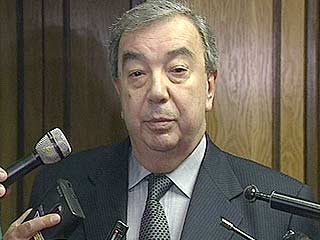
The course of the development of events in the 21st century largely depends on whether it will be possible to prevent a new section of the world
This thesis is contained in an article by a professional Arabist, academician Evgeny Primakov in today's issue of Izvestia , ITAR-TASS reports.
The article by Primakov, the newspaper continues a series of publications dedicated to the "Islamic threat", begun after the attacks of September 11, 2001 in the United States.
“As for Russia,” the author writes, “on its territory, Islam has a centuries -old history, during which regions with a compact Muslim population either joined or have been connected. Now about twenty million Muslims are living in a single Russian state. It is completely clear that the division of the world on a civilizational and religious principle would cause a serious blow to Russian federal federal federal federal federation.” As Primakov emphasizes, "the very prospect of such a section, the movement in this direction will create favorable conditions for the growth of separatism - one of the most dangerous diseases of our time."
The creation of new states in modern conditions, the author notes, is possible only when the “bilateral consent to this is reached - both the part of the population that is distinguished and remaining within the framework of this state. If such consent is not reached, the only way to resolve the national issue is autonomy within the framework of the state that retains its unity. Such autonomy should give the self -determining national or ethnic group the widest rights in the economic, political, cultural areas.”
The section of the world on the religious and civilizational principle will have an extremely negative impact on the stability of interstate and domestic relations, the author states. At the same time, “the formation and development of world civilization can be difficult, capable of absorbing all the best features of various civilizations of today's world,” says Evgeny Primakov.
Evgeny Primakov categorically disagrees with the assertion that the roots of Islamic extremism are laid in the Qur'an
Interfax, citing the further theses of the article by Evgeny Primakov, notes that the author categorically does not agree with the opinion that the roots of Islamic extremism are laid in the Qur'an .
"Extremism was born in the bosom of Islam not as a result of its natural development, but during the emergence and activities of a number of Islamic sects. Some of them protect values far from traditional Islam, and their adherents, eagerly emphasizing their affiliation, do not know about it," writes E. Primakov.
As an example, he cites Wahhabism , the adherents of which, based only on the Qur'an and the Sunnah , even deny the cult of the prophet, and on this basis in the 18th century they defiled the grave of Muhammad . "Do his homegrown followers know the history and essence of Wahhabism in Chechnya and Dagestan?" - in this regard, E. Primakov asks.
He explained that Islamic extremists often resort to a one -sided perception of the Qur'an, although individual phrases, picked up from it, "are unlikely to serve as a characteristic of the entire religious direction." "Moreover, in the Qur'an, along with sayings that can be interpreted as calls for violence, abundance contains calls for peace, patience," added E. Primakov.
In this regard, he cited two provisions that are found in the context of the Koran and in the decisions of Muhammadan law compiled by the famous Muslim theologian of Kuduri regarding the war with the infidels. "
The first is the call in the case of force against enemies of Islam not to harm the civilian population - women, children, helpless old people. "It is indecent to violate the oath, use a trick, disfigure people, kill women, old decrepit, children, blind, lame, if none of them will participate in the war with their advice or if a woman is not a queen," the decrees said.
The second position in the context of the Koran, writes E. Primakov, denies the right of Muslims to suicide.
The ex-Prime Minister also pointed out the difference between Islamic fundamentalism and Islamic extremism. "The first, like any other religious fundamentalism, advocates traditional education, observance of religious traditions in everyday life. The second sets its goal to spread - force, including other countries - the Islamic model of the state, Islamic rules of behavior in society and in the family," said E. Primakov.