
Translated material
Aviators are striking in Germany
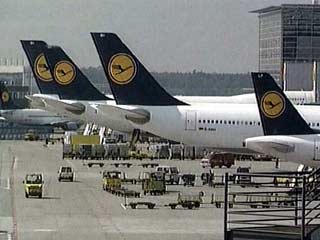
In Germany, on Tuesday, after urban transport workers, civil aviation begins to strike. And on Monday, the strike of buses of buses and trams in dozens of cities of Germany, and the current strike of the workers of several German airports organized the trade union of the Verdi service sector. It represents the interests of more than 3 million workers - from police officers and drivers of buses to school teachers and government officials - and is now conducting hard negotiations with employers to increase salaries by 3.5%. Another requirement is to equalize the amount of wages in the east of Germany with salaries in the western part of the country.
Of course, employers refer to an unfavorable economic situation and insist on freezing salaries for next year. They are supported by the government. The Minister of Internal Affairs of Germany Otto sewed the day before condemned the actions of the trade union, claiming that the increase in the salaries that he would achieve will "lead only to a reduction in jobs." And the Minister of Finance of the Earth Bavaria Kurt Faltlhauser said that "the trade union lost any sense of proportion."
In the meantime, no compromise was found, the strikes continue. Employees of fire services of airports and technical personnel serving conveyors for loading and unloading baggage refused to go to work in the morning shift. In the morning of Tuesday, at the largest international airport-in Frankfurt-on-Main-160 flights were canceled, and the Munich Airport named after Franz Joseph Strauss accepts only the aircraft arriving from abroad. A significant number of flights at the airports of Stuttgart, Dusseldorf, Hamburg and Hanover were canceled or detained, as well as at the Tegel Berlin airport.
According to RIA Novosti , according to the representative of the largest in the Federal Republic of Internal Affairs of the International Airport in Frankfurt, on the eve of this strike on Monday, the largest German airline Lufthansa canceled more than a dozen internal and international flights here, explaining that "the aircraft may be needed during the offensive, if there are problems suddenly". The airline’s leadership promises to catch up in the evening. In the meantime, according to Interfax, due to the strike of airport employees, she was forced to cancel one of her five regular flights from Frankfurt to Moscow and back. The LH 3244 Frankfurt Moskva and LH 3223 Moscow-Frankfurt were canceled. In total, Lufthansa was forced to postpone 252 starts.
On Monday, the strike of tens of thousands of transporters affected Berlin and Hamburg, as well as the city of Bavaria, Hesse, Baden -Württemberg, North Rhine - Westphalia and Brandenburg. In Munich, all subway drivers and most bus drivers take part in the strike. And on Tuesday, the strike in many regions continues. In the morning, the buses, trams did not go to the line, the suburban trains in Bochum, Bonn, Dortmund, Duysburg, Essen, Cologne, Karlsruhe, Stottgart and other cities of Germany remained in the depot.
In Hamburg and Bremen, as well as in the lands of Nizhny Saxony, Reinland-Palatz, North Rhine-Westphalia, Bavaria and Saxony, representatives of other professions of the municipal sphere joined the strikes of transporters: orderlies, city officials and garbage students.
The next round of negotiations on future salaries will take place on Wednesday, in the city of Kassel. The leader of the trade union Frank Bzirsk said on Tuesday during a rally at Düsseldorf Airport, that if the next round of negotiations with employers, appointed on Wednesday in the city of Kassel, will endlessly end, then the organizers will move from warning, “short”, strikes to long strikes across the country.