
Translated material
From the beginning of the year, the Russians have lost 375 million on the dollar.
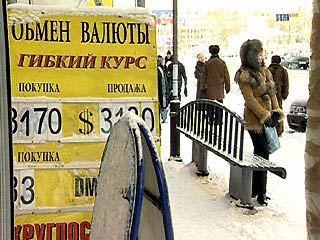
From the beginning of the year, the Russians have lost 375 million on the dollar. The mechanism of loss is this. Since the beginning of 2003, there has been a noticeable strengthening of the nominal course of the ruble in relation to the American currency. From a record of 31.88 rubles per dollar, the quotes of the Russian currency rose to 31.64 rubles. For the dollar. The same course was declared the Central Bank for February 18. This means that in a month and a half of 2003, the ruble was strengthened by 0.75%. And the ruble equivalent of dollar savings of millions of Russians decreased just as decreased. According to conservative estimates on the hands of the population, there are about $ 50 billion, so the Russians, out of habit, saving in dollars, lost a total of 375 million dollars.
Experts diverge in their assessments of strengthening the ruble course and how it responds to this population. Denis Rodionov from Brunswick UBS Warburg believes that "Rooting the ruble is very good, primarily for Russia in general and for smart people who keep money not in dollars under the mattress, but in banks." He explained that the strengthening of the ruble "will be an incentive for investing this money in the economy, and not for storing it in cash." Georgy Trofimov, on the contrary, told the independent newspaper from the Institute of Financial Research that "nominal strengthening can ultimately cause a massive discharge by the population of dollars."
As for the possible decrease in prices for imported goods (which could be expected due to strengthening the ruble), it should not be expected, according to experts, it should not be expected. Consumer goods are imported mainly from Europe, and the European currency has also recently been strengthened relative to the dollar. So European price tags in a single currency have become more for Russians. In addition, other factors are affected by increasing prices, for example, gasoline prices and services of natural monopolies that will grow.