
Translated material
The DPRK is preparing for the war with the United States: the Earth-More class was launched in the Japanese Sea.
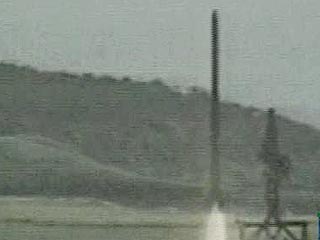
The DPRK released a missile "Earth-More" of a small radius of action in the Japanese Sea, in the area located between the Japanese islands and the Korean peninsula.
The launch of the rocket occurred on Tuesday night. Official Pyongyang has already stated that this is just a test of weapons, which is exclusively defensive.
Japan, the USA and South Korea require an explanation
At the moment, Japan, the USA and South Korea require an explanation. Until now, the DPRK has a moratorium on any missile trials, Interfax reports.
In Seoul, it is believed that the launch of the missiles over the DPRK over the Japanese sea increased tension on the Korean Peninsula.
The demonstration of North Korean military power was undertaken on the eve of the inauguration of the new president but Mu Hen, who proclaimed the "policy of peace and prosperity" in relation to Pyongyang.
At the same time, the experts of the Ministry of Defense of the Republic of Korea believe that the launch of the rocket was made as part of the annual exercises of the Armed Forces of the DPRK.
In addition, military exercises in the DPRK coincided with a visit to Seoul Prime Minister Japan, Juniitiro Koizumi and US Secretary of State Colin Powell, who were invited to the inauguration of the head of the New Seoul Administration, RIA Novosti reports.
Officials accompanying Colin Powell in South Korea said that at present, most likely, we are talking about a regular rocket with a small radius of action.
Due to the launch of the Korean missile in Japan, the national currency and quotation of the shares of companies has sharply decreased
The news of the launch of the rocket caused increased attention in Japan, where the national currency and quotation of the shares of companies immediately decreased.
As the Minister of Foreign Affairs Ioriko Kawaguti stated in Tokyo, the Japanese government checks the information about which rocket was launched in the DPRK. According to Kavaguti, if we are talking about the Earth-Corab rack, then its launch is not a violation of the North Korean Japanese Declaration signed by the leaders of North Korea and Japan on September 17, 2002 in Pyongyang.
Earlier, the DPRK introduced a unilateral moratorium on missile trials until 2003, which, according to the declaration, agreed to extend for an indefinite period. However, against the backdrop of exacerbation of relations between the DPRK with the United States and Japan, the North Korean leadership has repeatedly warned about the possibility of removing the moratorium.
In 1993, the DPRK experienced Nodon-1 ballistic missiles. In 1998, the Tepkhodon-1 missile was carried out, which demonstrated the ability to hit the target at a distance of up to 2500 km.