
Translated material
Sergey Kuznetsov. Slowly bulls
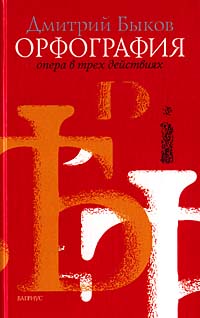
The novel by Dmitry Bykov “ Spelling ”, I always caught myself thinking that I would have given dearly to know anything about the Bykov-publicist, the author of the “ Quickly Bulls ” and the employee of the newspaper “ Conservative ”. Then I could calmly read this novel as a good book for intellectuals, an adventure novel of thought on the material of Russian history, literature and philology of the beginning of the century. The existence of Bykov-publicist forced me all the time to extrapolate what he wrote today. Moreover, the topics discussed in the novel are all the same as in Bykovo articles: archaists and innovators, revolutionaries and conservatives, liberals and guardians, literature and fate.
These attempts exhausted me at the end: the fact is that the “spelling” not only does not come down to Bykov’s journalistic ideas - it is perpendicular to them in some way. Not the opposite (where there was a plus, it became a minus), but perpendicular. Where Bykov-publicist confidently defends his point of view, as usual, most of his colleagues, freely or involuntarily distorting the position of the opponent, there the bullshocus represents the whole range of opinions-and they all look quite convincing. In other words, the bull-writer is not smarter or more honest than Bykov-publicist.
I ask the reader to understand me correctly: we are not talking about whether I like or do not like Bykov’s ideas - I just say that the intellectual landscape of the novel is much more saturated than the quikley landscape and other Bykov articles. And therefore, reading the novel, it is better to forget that Bykov-publicist says about the Russian Internet, Boris Berezovsky or Vladimir Putin: these thoughts will only distract. Do not give in to a temptation and try to find some allegory in the “spelling” (“conservative” against the Grani.ru , or traditionalists against postmodernists, or something else boring)-it is best to read it as a novel about 1918 , dedicated to the forever and uniform themes in Russia listed by a couple of paragraphs back.
In a nutshell - what is the novel about. In the alternative version of Russian history, in January 1918, the Bolsheviks cancel spelling and soon bring all philologists to the Elagin Palace: so that they would not die from hunger, and were under supervision. The radical part soon leaves the commune and moves to Krestovsky - and the polemic between these two camps occupies most of the seven -spent novel.
It is funny that whatever the views of Bykov, this novel is quite postmodern. Of course, I understand that the word "postmodernism" today means almost anything - but if you mean the old ones - the seventies - interpretations, then we will find a bouquet of postmodern techniques here: an alternative story, the theme of mutual proportion of literature and reality, games with literary characters and historical figures, deliberate anaches, polyphony and carnivalization, at the end The ends. Of course, to the interpretation of postmodernism as irresponsibility, which for some reason our publicists love so much, it has nothing to do.
I already wrote that by setting out the numerous ideas and ways of being their characters, the bulls do not distort and does not force, for example, supporters of the “liberal” position to crumble young people and knock on the Cheka, and conservatives to die like heroes. Nevertheless, as in any ideological novel, by the end of the reader - well, well, specifically, I have a desire to summarize. Not so on the forehead, to say who is right, who is to blame, but still, that there is some clarity.
The only result in Bykov’s novel is the idea of a fictional French thinker Lauson, which is stolen in the third part of the idea, which in the epilogue of Bykov summarizes in one phrase: thaws are needed only for frosts to look more legitimate.
A similar approach to post -revolutionary events is not new: Nadezhda Yakovlevna also wrote in memoirs that when the corpses are lying on the streets, the population agrees to any form of state terror. The widow of Mandelstam , however, did not believe that this fact relieves anyone from moral responsibility and could serve as a reason for the adoption of terror. She talks about this, as it were, between the matter - and in my opinion, the Lauson theory does not pull. Well, yes, winter comes in spring and, perhaps, winters are colder and colder every year. And what do you order me to do with this? Welcome winter? Serve firewood? Leave to warm countries? Bykov does not give any answer - moreover, having interrupted almost all the characters, he admits that there is no answer: no matter how live, they will come and cut it out anyway. Well, you can bite and run away - but this also does not pull to the moral position either.
The heroes of "spelling" have no excuse - no matter how live, nothing remains. I understand that a position is possible in which human life cannot be justified - but it is somehow not declared Bykov, and therefore the novel leaves a certain feeling of bewilderment.
Meanwhile, the people that Bykov writes about have a chance for justification - because they are people of culture, that is, those who do something that experiences them themselves. The perception of the story of the story changes depending on whether we consider Kazarin a good or bad poet, do we think that the ideas of the Ligs are firmly forgotten two years later or turned the philology of the twentieth century.
In other words, I am sorry that Bykov hid the heroes behind the pseudonyms. Of course, you can play guessing and calculate who Mayakovsky is here, who Khlebnikov is , and who is Nina Berberova - but these are the very postmodern games that have managed to submissive. They are not worth the fact that the novel lost, abandoning the real historical perspective: if each of the heroes became a corps of texts, “spelling” would become much better.
I do not consider myself the right to confidently talk about the motives of other writers, but I suspect that Bykov was not afraid of the wrath of philologists: after all, five years ago he was not afraid to write a corps of posthumous Gumilev poems for Roman Lazarchuk and Assumption “look into the eyes of the monsters”, in which Gumilyov does not die, but lives forever, as a savior of humanity and a wrestler with monsters. Probably, Bykov would not be frightened this time - he simply decided to be honest and not invent about real people. But when you write an alternative story - why is it already embarrassed?
Sorry, really. I would give a lot to Viktor Shklovsky in front of the hall of the sailors who came to the cinema. And then Lgovsky - who is Lig? What am I to him? Maybe he died five years later - and Viktor Borisovich panted his whole long life, afraid to stop, because he knew - they would tear off. But at the same time, he helped those who were in disgrace and wrote books - and therefore life is much more interesting than art, no matter what post-, sorry, modernists.