
Translated material
Sea warmth in a protected area
“Wild” tourists lit bonfires and barbecued here. All the benches here were broken and the lamp shades were broken. Here, all the urns are drowned in the lake, and stray dogs roam around the park... This is the State Oranienbaum Museum-Reserve.
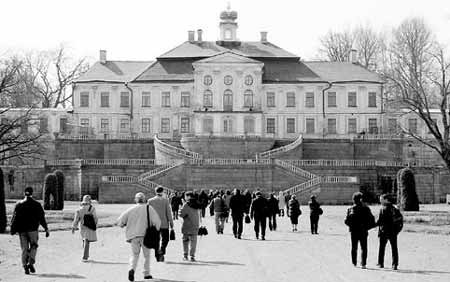 Grand Palace awaiting a miracle
Viktor Gribanov, appointed director of the reserve in 2002, invited journalists to talk about future exhibitions, and, it seems, he could not resist - he talked about everything related to the territory under his jurisdiction. When asked by Novaya Gazeta why the journalists came, Viktor Gribanov noted: “Few people know about our reserve, meanwhile, this is the only suburb that was not destroyed during the war, so everything that has been preserved here is authentic. And how you tell us about us, about what problems - that’s up to you.”
In 2011, the GMZ will turn 300 years old. This year also has round dates: 25 years ago it was announced the creation of museum-reserves in the suburbs, and 10 years ago the restoration of the entire Oranienbaum was supposed to be completed. Should have...
The most interesting story is connected with the Great (Menshikov) Palace. Until 1917 there was a hospital here, after which there was a technical school. Under Stalin - a military unit, then the city of Lomonosov was closed, and torpedoes began to be produced in the Menshikov Palace. Already in our time, another event occurred.
“Gosstroy” and the contractor “Georekonstruktsiya” somehow spent the money. In Oranienbaum. There was little time to master it, but there was no point wasting it. That is why they decided to strengthen the hill on which the Menshikov Palace and the terraces of the palace itself stand. (This hill once moved, but the movement has not been monitored for four years, and it is unknown whether the hill has moved recently). There was no time for design and estimate documentation, nor, indeed, for drainage. Without thinking twice, the builders hammered 500 piles in two rows. A dam formed under the palace, and the palace itself began to crack, but then it didn’t matter. Then, in December 2002, at 25 degrees below zero, workers poured concrete at night, in the light of spotlights and fires...
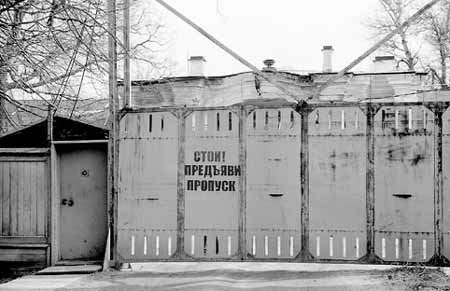 Secret protected area
Restoration is currently underway, and in the summer new exhibition halls open in the Menishkov Palace.
We approach a dull building. The windows are covered with rusted sheet iron, the walls are black. This is the Picture House, and from here another story begins. Back in the 18th century, there was an opera hall and a small cabinet of curiosities: a dried Chinese head, worms preserved in alcohol, and four dried crocodiles. During Soviet times, a school was located in the Picture House, but it burned down. Restoration began in 1976. First, the expensive oak floorboards disappeared, then the marble slabs. For three days, local residents removed and carried away the copper roof - the restoration was completed before it even began... By October, Viktor Gribanov promises to restore the facades and roof, and in a year - to open an art hall and restoration workshops.
Withered grass on an imperceptible path leads us to a huge iron gate, with barbed wire stretching along the fence. From this place begins another story related to the largest conflict in the history of the city of Lomonosov: between the management of GMZ Oranienbaum and the Morteplotekhnika Research Institute. We are talking about the Menshikov Palace: the research institute now occupies two-thirds of its territory and has no plans to leave the protected areas.
The history of the issue is as follows. In the past, when, by order of Stalin, a military unit was located in the Grand Palace and the city of Lomonosov became a closed city, torpedoes began to be invented in the Grand Palace. Then the institution was transformed into the Gidropribor Research Institute. In the early 90s, the Lomonosov administration provided the research institute with other premises. And the torpedo workshop seemed to have already moved, but at the last moment it returned back: they say, everything in this new building has already fallen into disrepair. One way or another, Gidropribor moved to St. Petersburg, where it now operates, but in 2001, in its place in the building of the Menshikov Palace, the Morteplotekhnika Research Institute arose, the charter of which states that the organization is the legal successor of Gidropribor. Now the new scientific institute is hidden behind a high fence, and the legal successors do not allow journalists to visit them. Meanwhile, “Morteplotekhnika” provides... only Stalin’s order as documents that give the organization the right to occupy premises. The research institute does not pay for rent, while renting a square meter of land in Oranienbaum costs $26 per year.
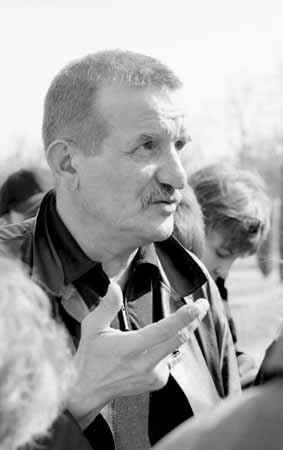 The director sees a bright future
All these stories could cause justifiable indignation and anger; only one thing confuses us. All these are stories from the director of the reserve, which, at least, are not documented. Viktor Gribanov’s argument looks strange, based on the fact that it was the Gidropribor that fired the torpedo that caused the death of the Kursk. The criminal case into the death of the Kursk was discontinued due to the lack of corpus delicti. And, according to Prosecutor General Ustinov, those responsible for the design, storage and operation of the torpedo could not foresee the possibility of its explosion and the death of the crew along with the ship. So telling journalists about terrible torpedo manufacturers, embellishing your monologue with such talk, is at least tactless. No one is going to argue that torpedoes cannot be designed on the territory of a priceless reserve: this is obvious. Another question is how to deal with the situation.
As for the rest of the museums and palaces, their desolation seems like a dubious landmark, and stories about the color of paint in which this or that building will be painted look... well, how can I put it mildly, premature. We, of course, are ready to look into a bright future with a smile, but somewhere in this country something similar has already happened...
Red deer and fallow deer walk along the paths. White swans float on the Lower Pond, and a black swan on the pond near the Chinese Palace. The Japanese pavilion and the Samurai exhibition, the Palace of Peter III and the Chinese Palace are cordially open to visitors. Rolling hill operating in winter. There are armed guards along the entire perimeter. Paid entry. This is the future of the Oranienbaum State Museum-Reserve according to Viktor Gribanov... We don’t know what it’s like with deer and fallow deer, but they promise to charge an entrance fee from June 1 of this year.
Alexey KOBYLKOV
Photo by Alexander GUTORKIN