
Translated material
St. Petersburg timelessness
According to a certain general, “yesterday we lived in the post-war period, and today we are already living in the pre-war period.” Something similar happened in St. Petersburg. After Vladimir Yakovlev announced his reluctance to run for a third term, the city immediately fell into a pre-election state.
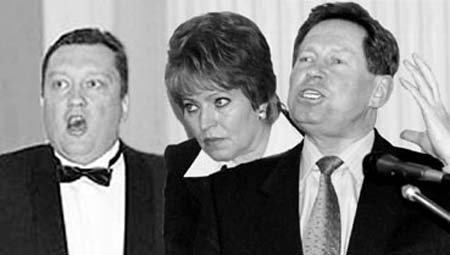
This fact in itself is neither good nor bad - it just so happens. It can also be said that after Yabloko leader Artemyev left his post, all features of collective responsibility for the fate of the city disappeared. Governor Yakovlev took the entire burden upon himself. It is not surprising that his team was formed in such a way that the leader was at the forefront of all problems, and he was responsible for every decision. In contrast to Moscow, where a whole group of relatively independent but loyal to the mayor leaders gathered around the charismatic Yuri Luzhkov - Valery Shantsev, Vladimir Resin, Vladimir Yevtushenko and others. And if in Moscow Luzhkov’s departure did not frighten anyone - Yuri Mikhailovich has more than enough strong and effective heirs, then in St. Petersburg there was some prostration: what will happen next, since the governor has no heirs known to the public?
As a result, the sudden transition to a pre-election state turned St. Petersburg into a zone of power vacuum. The current plenipotentiary, Valentina Matvienko, has to some extent tried to reconcile the executive and legislative powers. But the situation still remains unclear. Some confusion of the city administration is spurring the Zaks opposition to sudden movements that are absolutely unnecessary in the transition period. Supporters of Valentina Matvienko, it seems, even without her consent, are trying to conduct an election campaign, which further instills uncertainty in the current administration. And all this is done when there are no real preconditions for escalating tension: the governor is in place and acting, the city economy is functioning as usual, St. Petersburg is preparing for the anniversary... Moreover, the real political situation has actually softened - after the possibility of establishing an unusual multi-centre opened up (the current governor, the recovering Legislative Assembly, a new plenipotentiary representative capable of dialogue).
In principle, everyone is already beginning to understand the need for such a system. First of all, these are politicians who are also business executives. They begin to look for approaches to both the plenipotentiary representative and the Legislative Assembly deputies. Take the same statements by Andrei Likhachev. He seemed to talk about his gubernatorial ambitions, but later he supported both Valentina Matvienko and the governor. And even skeptical about the desire of the deputies to hold gubernatorial elections in December. And the governor demonstrates incredible loyalty in former times, declaring: if you want to “leave” me in December, please do so. If only someone will benefit from it. And Valentina Matvienko says about the same thing: they say, there is no need to hastily eliminate someone, let people work in peace.
Similar statements, though not always publicly, are made by other business executives. And all this suggests that the formation of a “political-economic coalition” is possible. And even before the elections. Therefore, the process of changing power can take place painlessly. Unless, of course, no one and nothing interferes with this...
Sergey KOROLEV