
Translated material
The American military in Iraq threaten the execution of marauders
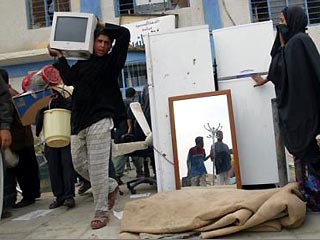
In the city of El-Kut in Eastern Iraq, rumors quickly spread that the American marine infantrymen intend to execute 40 looters who were operating in a local textile factory, put their heads on the poles and put up at the city gate.
“Do not tell them that this is not true,” said Lieutenant Colonel Eric Gorovski employees of the newly created television company TV KUT, who asked the new “owners” how to report these rumors in the evening issue of news.
"Our task here is to give out cuffs, people should not think that even the murder will get away with them, and let them know that the marine infantrymen are ready to lift anyone who will not keep themselves within," he said in an interview with Daily Telegraph (translation on the website inopressa.ru ).
Marine infantrymen help a team of 12 people create a television company in El-Kut, which will disseminate information about the post-war Iraq. Citizens, who were stuffed with propaganda for many years, were hungry for information.
But it turned out that the project is not easy. For the most part, employees of the company used to work in the Ministry of Information, and for them objective coverage of events is something completely new.
Although the Iraqis are very awaiting news, the American military intends to control the methods of presenting information.
It was convenient for the military that the TV KUT team was very busy installing a new computer in its office and did not notice the demonstrations organized by Shiite religious leaders, the participants of which demanded that the military leave the city.
For most local television companies, the demonstration would be the main topic of evening news releases, but Bob Zangas, Lieutenant Colonel of the Marine Corps, responsible for relations with the civilian population, said that it is better not to cover this event.
“The lighting of the demonstration does not fit into our concept,” he admitted. “Most likely, new problems will arise because of this.”
The 43-year-old lieutenant colonel Zangas, who studied journalism at the college, would prefer that his subordinates enjoy the acquired freedom to illuminate more simple and useful issues: amnesties for the delivery of weapons, edited version of the Qur'an, harvesting, destroying unexploded shells.
But, as one of the team members explained, confidence in the company was put on the end. “In the past, the local television company distributed the false promises of the regime,” he said. “They will take us seriously only if they see that we are telling the truth and can change something.”
Lieutenant Colonel Zangas decided to work on a plot about a textile factory. "We have a chance to show that the military is doing everything possible to stop the activities of attackers who seek to break peace, and you have a chance to understand how to collect information," he told the television company. A team of four arrived at a factory with a video camera, which is already 20 years old. But after half an hour of conversation with the participants of the events, TV Kut was closer to the truth than the marine infantry people would like.
The military broke into the factory, having received a message that the members of the Baas party and Feda Saddam use it as a warehouse of weapons and food.
The raid, during which they knocked out the doors and smashed the equipment, including phones and calculators, lasted four and a half hours. As a result, only a few Kalashnikov assault rifles belonging to the guards of the factory were found.
Journalists shot the plot, but the marine infantrymen did not tell them to put it on the air. They returned to the base and took up more pressing problems: breaking the Qur'an into digestible fragments and removing naked bodies from commercials and soap operas, since religious leaders require this.
Meanwhile, local residents gathered at the gates of the factory who wanted to look at the promised execution.
There is such a feeling, as if little has changed, concludes the publication.