
Translated material
The sky is removed from the earth
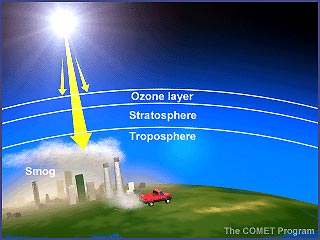
The sky does not fall to the earth, on the contrary, it rushes up. And people are to blame for this, Nature writes today (translation on the website inopressa.ru ).
Scientist Ben Santer, an employee of the Lorence Liver Laboratory and his colleagues believe that, starting in 1979, due to transport emissions and industrial enterprises, the upper part of the troposphere, this closest to the land of the atmosphere, has risen by several hundred meters.
In the height of the troposphere, as by a kind of barometer, one can even judge the scale of global climate change.
Scientists on the computer simulated five possible causes of shift, three of them are associated with human activities, and two are natural. They analyzed the changes: the amount of carbon dioxide, the level of reflection of sunlight with solid particles present in the atmosphere, the concentration of ozone, the amount of light and heat entering the Earth from the sun and the amount of dust, which is thrown into the atmosphere of the volcano.
All these factors affect the air temperature at various heights, thereby leading to expansion or, conversely, narrowing of different layers of the atmosphere. So, for example, the destruction of the ozone layer can lead to cooling and reducing the stratosphere, the layer that is located above the troposphere. Carbon dioxide, in turn, causes heating and increasing the troposphere. The impact of these forces leads to the expansion or narrowing of the tropopause - the transition layer between the troposphere and the stratosphere, which is at an altitude of 9-18 kilometers above the ground.
The Santers model gave an increase in the height of the tropopause in line with observations only when all the factors were taken into account. However, this model suggests that the responsibility for the amount of carbon and ozone dioxide and ozone that observed in the second half of the twentieth century.