
Translated material
Gel crystal of the eye will help get rid of vision problems
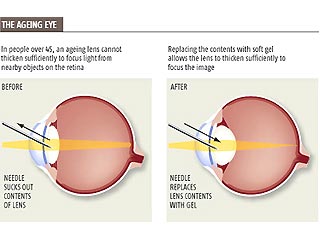
Soon, scientists will begin testing the new method of correcting worsening with age. The new method, which involves the replacement of the contents of the eye lens with a soft polymer gel, will allow millions of people to throw out glasses, reports New Scientist (translation on the website inopressa.ru ).
“At first, we believe, this technique will be used as an auxiliary remedy for surgical treatment of cataracts of the eye,” says Arthur Ho from the University of the New South Wales, one of the leading specialists of the Vision CoopeRach Center (Vision CRC) government organization, which is developing in this direction. “But as soon as its safety and efficiency is proved, it is proved, as soon It will be used to help young people who need reading glasses. "
In the human eye, the focus of the lens occurs due to a change in its shape. When the muscles of the eyes relax, the lens becomes flat and focuses on distant objects. When the muscles are reduced, the lens takes a more convex shape and captures close objects.
But with age, lenses become more stringent and hardly take a convex shape: the crystal of a 40-year-old man retain only a quarter of the opportunity to change the form or, expressed in a scientific language, "accommodate". After 45 years, most people need reading glasses or two -focus glasses.
Perfect polymer
In the late 1980s, Jean-Marie Parel from the University of Miami proved that replacing the contents of the eye of the eye of the aging macaques-ruseum with silicone oil can restore its ability to focus. However, over time, silicone oil begins to penetrate through the walls of the lens capsule.
Since then, scientists have worked on the creation of a polymer that would have the same refractive index as the human lens, and also possess suitable biomechanical qualities.
Having evaluated about 30 different polymers created at the Australian Research Institute of the Csiro Molecular Science in Melbourne, Ho believes that the right material was found. This substance based on Silovsan, which, after introducing it into the lens shell, is treated with ultraviolet rays or visible light to turn from liquid into gel.
As the tests conducted on rabbits and monkeys showed, this substance has an average of the same refractive index as a healthy lens, and can allow you to read, even if the eyes are at a distance of 10 cm from the text.
So far, only a few experiments have been conducted on human eyes, but the qualities of this polymer allow you to say with confidence that the operated patients will be able to read with ease.
Work for 15 minutes
Gel implantation will resemble the current cataract operation. However, after a small cut of the cornea, instead of cutting the lens, the doctor makes a microscopic hole in the shell of the lens and the contents sucks using special equipment.
After that, the gel is pumped into the lens, comparable to dense oil, and the new lens is treated with ultraviolet or visible light, which turns the material into gel. “It will be a quick, 15 -minute procedure,” Ho says.
She very successfully carried out such operations on rabbits by a group of scientists led by parliament in Miami. However, lenses of adults of rabbits do not accommodate the eyes of adults, so the next step is to master this technique on living macaques -rezus, the eyes of which are similar to the eye of a person. Work in this direction will begin at the end of 2003 and with the most favorable development, notes Ho, "we must start tests on a person by the end of 2004."
Hugh Taylor, the director of the Center for Eye Studies in Melbourne, is optimistic: "This technique is in huge potential. If everything goes well, it will completely change the ophthalmic surgery," he said.