
Translated material
Washington presents the Enola Gay bomber, dropping the first atomic bomb on Japan
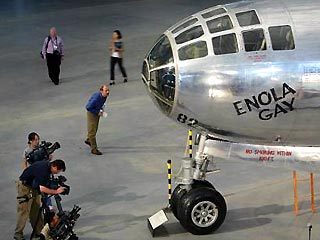
Smithsonovsky Institute exhibited the legendary bomber of the Second World War Enola Gay, for the first time since 1960 as a whole.
The "flying fortress" of the B-29 dropped in 1945 at Hiroshima an atomic bomb, which, according to estimates, killed 200 thousand Japanese. The aircraft will become one of the main exhibits of the new site of the National Museum of Aviation and Cosmonautics in North Virginia.
Enola Gay is restored, its huge wings are polished to silver shine, and the cabin, bomb compartment and propellers sparkle, thanks to work that took 300 thousand hours, Washington Post writes today (translation of the article on the website inopressa.ru ).
This is one of the 80 historical aircraft, which will be exhibited in December at Dulles International Airport.
Enola Gay remains a unique machine, but his difficult fate caused a wave of criticism when the Smithsonian institute decided to include it among the exhibits in the early 1990s.
“The initial plan was built around the bombing and its consequences, and not around the aircraft,” said General John Daily, director of the Aviation and Cosmonautics Museum. Initially, only the fuselage, a description of the aircraft and its crew were exhibited. For three years, the exhibit attracted almost 4 million visitors.
This time the plane will be shown along with other historical exhibits of the Second World War.
Daily expressed the hope that the debate around the aircraft and the museum are over. “We are proud of what we did,” he said. “We will demonstrate it in all its glory as a wonderful technical achievement.”
The plane was transferred to the Smithsonian institute in 1949 and for many years was demonstrated in the open air at different sites. In 1960, he was dismantled, and since then he was kept in a reserve.
Enola Gay, the length of which is 99 feet, a height of 28 feet, and the wingspan of 141 was too large for the aviation and astronautics museum. But on the new site, which has an hangar size with three football fields, it is quite in place.
Enola Gay will be suspended at an altitude of eight feet. Visitors will be able to go under the hatches of a bomb compartment, rising along the ramp, they will be able to look into the cabin. The exhibition will have such aircraft as the British Hawker Hurricane Mark IC, the German FW 190A-8, the Japanese Aichi M6A1 Seiran, the American P-38J Lightning and P-47D Thunderbolt.