
Translated material
Grigory Zaslavsky. Blessed
It ’s now, in a frame or on stage, sits or stands. You pay attention to how she looks standing or sitting in a half -brood grinder. Eyes, a little a bit, look intently and express some surprise. Whatever there may be, everything for her is a surprise. As if life itself is surprising, amazing, sometimes terrifying, but in her eyes surprise and horror are always mixed with acceptance, this is some kind of Christian humility, the willingness to accept fate as it is, readiness for deprivation and suffering.
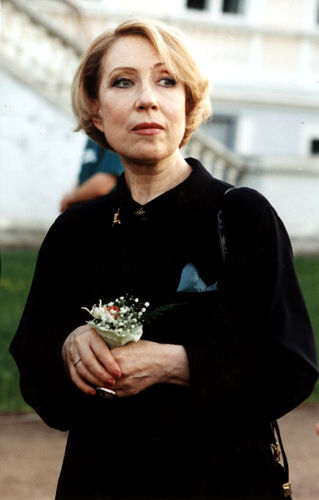 And in this humility she is winning.
Looking at people like her, or rather, at the heroines she played, they say - Blessed (sort of: “Do you dance?” - “Dance.” - “And I sing”). And on the other hand, in the Gospel it is written that the poor are blessed by spirit, for their kingdom of heaven is. And the crying, and the hinges are still blessed are blessed.
Mysterious words, perhaps, are the most mysterious of everything that is dark in the Scriptures. Powns in the spirit in this context - probably those who are modest, do not climb forward, are not a charismatic leader. But a beggar in spirit does not mean a weak spirit or poor. And if so, then everything converges, in the sense - such a definition is suitable for that modest and independent, that is, separately standing and at the same time unbending, strong women, who were beaten by Inna Churikova so much.
The quantity, however, is not a decisive quality. Rather: it plays a lot, but this set is calculated not by the number of roles played and played: in the native Lenkom - “just“ Glumova in the “wise” , Antonida Vasilievna in “Barbara and heretic” , Filumen in the “city of millionaires” , and also the nurse in the play by Alexander Galina (joint production of Lenkoma and the Russian theatrical theatrical " agencies). Here, probably, by the way, it will be said that all her nurses are poetesses. Churikova - a romantic actress, her heroines will not spoil even a frivolous past: her Philumen, - probably, as the author was conceived - was not too legible in a past life (not to believe what she says, because the Soviet poet once called "unnecessary connections and unnecessary friendship." But who will turn the tongue to blame her for this?! Even in frivolity, she is magnificent, like a queen.
The description of the actress Inna Churikova invariably begin with the description of her face. And this description, one way or another, appeals in our literary memory to how Tolstoy , more and more enthusiastic about and even falling in love, writes about Princess Bolkonskaya.
Like almost every great Russian actress, Churikova is smart. Paradoxes in the spirit of Shklovsky are expected from her, but she speaks smartly and simply, it seems, she understands everything to herself, but at the same time she is absolutely deprived of any arrogance for people or to life. And it also seems strange.
Her heroines are also habitually perceived, although they are the most traditional, if they measure their Russian literary or any other tradition.
Smart, all -understanding, lonely, often abandoned. She is alone. Even her husband, Gleb Panfilov , in his films, is one. He always chose her such heroines (in Russia it is customary to call them strong women - they have no one to rely on them). In the "beginning", in the "vassa", in "I ask for words." One is in meaning: settled from others. In “I ask the heroines” the heroine of Churikova, it seems, there is some kind of husband, but she still worries all the troubles and flour (and the non-nanfil “courier” begins with the fact that the heroine of Churikova is divorced with the now ex-husband).
If you write about the relationship of the heroines of Churikova with men, you will invariably “take it” into Tsvetaevskoye, famous: “Oh, the cry of women of all time:“ My dear that I did to you ”...
Churikova - of those actresses about whom we can say: "Her theme ...". Her topic is not retreating, not grazing before fate. On the contrary, boldly entering into battle with the very inevitability (and in this sense - of those who, I apologize for the beatenness of quotes, the horse to the gallop and in the burning hut ...). The heroines of Churikova fearlessly enter into a game that does not promise good luck, even if it is, like in Barbara and heretic, playing cards or roulette, although for such games her “wards” have always been too intelligent or too busy with their affairs or worries of the soul. Her game is a Russian rebellion, meaningless and merciless, but in a card -rouplet version.
By the way, in the "Barbara and the heretic" (according to the "player" of Dostoevsky ) Churikov boldly, without any drama, agreed to the age role of the grandmother, whom everyone is waiting for each other scares each other. And having played my grandmother, a year or two, on the same stage, Lenkom returned to “Big Love” - in the “city of millionaires” (based on the play by de Filumen Marturano). Both courage and unpredictability are signs of greatness, which with some caution is discussed when it comes to Churikova (talking about "adults" are devoid of the deadly freedom with which the titles are heard in the circle of beginner young).
Churikov can be called the Great. It is not just good, or wonderful, or very talented, which are many in different age categories. The great, as always, units, but they are. The Great is Tatyana Doronina . It is curious to compare them, finding a striking dissimilarity. To notice, for example, how different and different things are in the cinema and on the stage of love. Churikova has always longing for love, a view of love from the side, at a distance. Not because she does not let into herself a strong feeling, no, love is always in her, but she does not want to destroy a feeling of touching a real object, preferring personal contact - spiritual communication. Her heroines are suitable for a remark, said more recently about modern love literature: in Russian literature they still love through tears.
It also unites Churikov with other great ones - a small number of roles. With the greats, always this: the more talent, the less roles, the less often - new ones. Well, of course, the fewer roles, the more it is placed in each.
And although it is difficult for Churikov to attribute to some specific method or style, Stanislavsky’s science-like discussions about radiation and radiation perception on stage are surprisingly accurately approached by her game. Both K.S. He believed "invisible ways and means of mutual communication", "invisible communication through the understanding and radiation, which continuously moves over the word."