
Translated material
How many years should I be on the papal throne?
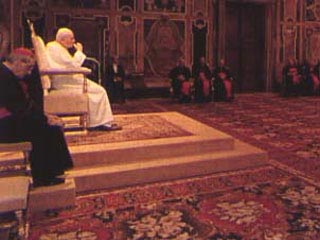
Twenty -five years on the Vatican throne - is this a long time? This question is asked the author of the article published today on the pages of the Swiss newspaper Le Temps (with the translation of the material introduces readers the site inopressa.ru )
A similar question, according to the Swiss observer, today no longer looks like a sacrilege. At the moment when John Paul II celebrates the anniversary of his election, many Catholics urge him to resign and demand the establishment of an age limit for papal ministry.
The achievements of medicine and the possibility of prolonging human life denote, according to the newspaper, a fairly alarming prospect for the hierarchs of the Roman Catholic Church .
This is what the journalist Le Temps sees the picture that this pessimistic scenario draws: - the elderly and sick dad, unable to lead the affairs of the church, but refusing to leave the throne of St. Peter; - The Roman Kuria, who admits all the power in the church and that reduces everything that once still a full strength of the Roman high priest patiently created with his bold initiatives; - A weak church, to which few people do not listen to the voice and which, with their moral rigorism, makes the believers move away from it, making a choice in favor of other, more tolerant religions - for example, Buddhism.
In the history of the church, examples of such a long pontificate are rare. Of the 261 pope, more than half has performed their functions for less than 6 years, 28 - less than a year and 12 - less than one month.
Meanwhile, according to the observation of the author, the story indicates that the frequent change of popes often contributed to the reform, while how long the stay on the papal throne strengthened in the church inert trends.
As an example, the article provides the board of Pius IX (1846-1878), which headed the church for thirty-two years. It is to him that Catholics owe the appearance of the dogmas about the infallibility of the pope and the primacy of his jurisdiction. He became famous for fierce attacks on modernism.
The absolutist character, which, according to the publication, acquired the papal power under John Paul II, apparently, ceased to respond to the realities of the modern world, in which most Catholics live in a democratic system. Currently, he believes, the papacy is a monarchy by divine law.
Is it possible to imagine that the stay on the throne of St. Peter will be limited? Such a reform would allow the church to avoid "ossification" and would make the role of the pope more modest. Is it not time to make papal power democracy by divine law, the author of the publication in Le Temps rhetorically asks.