
Translated material
A quarter of animal species can disappear from the face of the earth
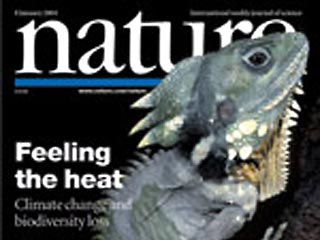
Climate changes can lead to the disappearance of a million biological species around the world by 2050, the results of the recently published scientific research of the organization of Conservation International .
In an article published in the authoritative journal Nature, scientists who studied the habitat in six regions of the world said that up to a quarter of animals and plants in the world can soon disappear forever.
In addition, the perspective of extinction threatens billions of people whose survival depends on the state of the natural environment. We are primarily about the inhabitants of the poorest countries of the world.
The study was conducted in six differing in a special biological variety of regions of the world, which occupy about 20% of the total area of land on the planet. The populations of 1103 species of plants, mammals, birds, reptiles, frogs, butterflies and how they will respond to temperature and other climatic changes were studied.
During the study, three scenarios were modeled: minimal, medium and maximum climatic changes. The base for scripts was studied by the intergovernmental commission on climatic changes, the Air Force reports.
The conclusions of scientists are disappointing: from 15 to 37% of animal species in the studied regions will disappear until 2050. “If these forecasts are extrapolate throughout the world and other groups of ground animals and plants, then, according to our analysis, more than a million species are threatened with extinction,” says the professor of the University of the British city of Lids Chris Thomas, who headed the study.
Many species will lose their suitable habitat, while others will not be able to migrate to distances sufficient to find a new house. If events go according to the scenario of minimal climatic changes, then losses will amount to 18% of the species. According to the "realistic" scenario, 24% of species will disappear, and 35% of the most pessimistic.
However, Thomas believes that his forecast is still quite optimistic, because many factors were not taken into account by them. "The most severe consequences for the environment will have combinations of various factors and threats, far from all of which we were able to take into account in our analysis, and not climatic changes in our own," the article in Nature says.
"The reduction to the minimum of greenhouse gas emissions and carbon accumulation will minimize the consequences of climatic changes and preserve a significant number of species," the authors of the study concluded. However, the disappearance of some types of flora and fauna is practically inevitable, as well as climatic changes.