
Translated material
Lukashenko gives up?!
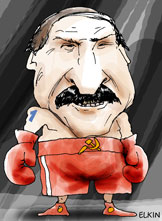
President of Belarus, Alexander Lukashenko, agreed to the supply of Russian gas on the basis of Moscow. He stated this at a meeting with the Belarusian government. “ I agree to conclude an agreement on Putin,” said the President of Belarus.
“We will collect the necessary 200 million dollars for gas, take them from children, the elderly,” Lukashenko said. Here the fact is that one of the president’s election promises was an increase in the average salary to the equivalent of $ 250 (now it is 128). The Belarusian budget, half of which was aimed at salaries to state employees, was a reversed at the rate of gas prices $ 30 per thousand cubic meters. However, Moscow made it clear that she no longer agrees to supply gas to Belarus at this price and insists at a market price - $ 50. In this case, you will have to forget about the increase in salaries. In addition, according to Lukashenko, "this action is aimed at the destruction of Belarusian enterprises that have just risen from the knees."
At the same time, Lukashenko instructed the government to “renewal” allied agreements in order to “put our claims on the table to the Russian leadership”. “We can no longer engage in charity,” ITAR-TASS reports Lukashenko's words. This statement is a little reminiscent of the thought of Vladimir Putin that Russia should not be a dairy cow.
"Today, Russia went on the destruction of all the agreements that have been reached lately," Lukashenko’s statement reports to RIA Novosti. Probably, you should soon wait for the arrival of the responsible officials of the Belarusian government to Moscow, who will again tell that the president got excited and was incorrectly informed. In the latter, they will be completely right, since it was the Belarusian side that violated the obligation by July 1 to create a joint venture with Beltransgaz, it was the Belarusian side that carried out an unauthorized fence of transit Russian gas. Russian companies provided exactly those deliveries that were agreed upon by concluded contracts.
No less interesting is the planned sources from which the leadership of the fraternal country is going to take money to pay for gas. Lukashenko’s speech does not lead about income from the sale of confiscate (one of the significant sources of income passing through the management of the President), not even about income from increasing the cost of pumping gas through the territory of Belarus (and these tariffs will be inevitably increased). Instead, the desire to take money from state employees and enterprises that allegedly recently got up from the knees is proclaimed. This is probably worth regarding either a well -thought -out antisocial policy, or as a very skillful social demagogy aimed at the country's population and designed to convince him that real troubles are not from the ruling regime, but from greedy Moscow.
The analysts responded to “Polit.ru” are difficult to give an accurate forecast of the further development of the situation - the Belarusian president is too unpredictable. Everyone converges that Belarus will give way to Russia, at least in terms of gas prices. Thus, perhaps at least today's promise Lukashenko will be realized.
Experts of investment companies are concerned that when the conflict enters into a protracted stage, not only the Belarusian side, but also Gazprom may suffer much. “Gazprom will have delivered deliveries to Europe. In addition to non -fulfillment of obligations to European consumers, Gazprom will lose a certain part of its cash flows: about 18-20% of the total exports are supplied through Belarus,” said the analyst at the Investment Company of Aton Lev Snykov . The analyst of the Troika-Dialogue Valery Nesterov believes that Gazprom will lose because a dangerous precedent for stopping gas supplies through a transit country has been created. ”True, Nesterov believes that the conflict will be exhausted in a maximum of two weeks, and most likely earlier.
Experts, however, believe that the issue of gas prices for Moscow is not so fundamental. “This is nothing more than a lever of political pressure on Lukashenko,” Vyacheslav Gamesunov said in an interview with Polit.ru. And the analyst atona Lev Snykov generally believes that the resolution of the current conflict will not affect the fundamental disagreements between Moscow and Minsk: “The situation will return to the pre -crisis level when negotiations on market relations and the sale of“ Beltransgaz ”were conducted.” The analyst believes that the situation with the privatization of Beltransgaz is absolutely political, and it is impossible to predict its development based on economic consideration. “Gazprom in the situation with Beltransgaz, economic considerations prevailed over political - he did not agree to buy the assets of the Belarusian company at an inflated price. However, only the political decision of the President of Belarus can finally resolve this situation.”
As for the more distant prospect of relations between Russia and Belarus, they are very vague. The director of the Institute of Humanitarian Political Research Vyacheslav Gamesov believes that Russia is behaving excessively tough. “Apparently, Moscow has lost the belief that in interaction with Minsk you can work with other methods. In the end, Lukashenko will twist their hands and make you agree to Moscow conditions.”
So far, however, in Moscow, they do not intend to drive Lukashenko completely in a corner - today there was information that the Belarusian gas company Beltransgaz has signed a contract with the Russian Trans Nafta for 640 million cubic meters of gas for delivery in February. The price remained the same - 46.68 dollars per thousand cubic meters, Interfax reports with reference to the representative of Trans Nafta. According to the head of the gas department of the independent Russian supplier Gas Denis Vinogradov, he has no information that gas is already entering Belarus.